UK Solar Installations Break Annual Record in 2026
MCS data published on GOV.UK confirms 2026 is officially Britain's biggest year for solar panel installations, driven by commercial sites and domestic demand.
- Written by
- Net Zero Home Scheme editorial team
- Last updated
- Topic
- solar, battery storage, energy bills
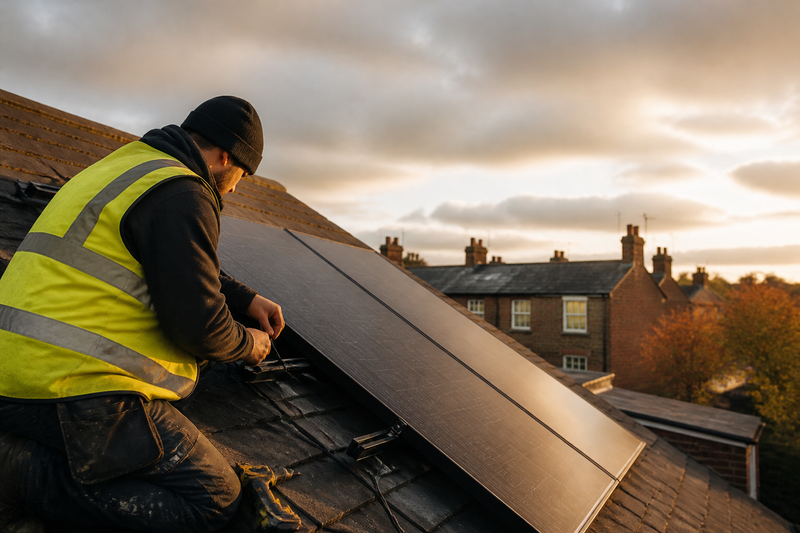
Britain has officially broken its all-time record for the most solar panels installed in a single calendar year, according to official data released by the Microgeneration Certification Scheme on GOV.UK on 20 November 2026.
The certification body confirmed that large commercial rooftops such as sports stadiums and supermarkets joined a wave of household installations to push British capacity past previous annual milestones well before the year ended. Following the energy and tax measures examined in our full Budget 2026 guide, this surge shows that both corporate leaders and working families are actively accelerating their renewable generation plans.
Workplace action points for reward and operations leads
Record installation rates across the country present distinct challenges and opportunities for organisational planners. Employers reviewing staff support packages can use this operational checklist to evaluate their response:
- Audit current employee interest in domestic power solutions, because utility overheads remain a significant factor in household financial wellbeing.
- Review corporate roof space across offices and logistics hubs, mirroring the large commercial installations highlighted in the MCS report.
- Ensure benefits offerings do not burden internal payroll systems, particularly as reward teams prepare for mandatory payrolling of benefits in kind from April 2027.
- Coordinate sustainability reporting schedules, aligning Scope 2 on-site generation wins with employee engagement programmes.
Domestic installation checklist for working households
High national demand means that homeowners considering solar panels and a battery must plan carefully around supply chains, accredited survey capacity and upcoming fiscal deadlines. Families should step through these practical stages before committing to a system:
- Confirm structural roof suitability, verifying that rafters can carry module loadings alongside any required ballast.
- Review your historical electrical consumption in kilowatt-hours, checking winter versus summer baselines across smart meter statements.
- Match your planned solar array with home battery storage, ensuring stored daytime generation can cover evening domestic cooking and lighting loads.
- Verify installer certification through MCS and consumer protection registration with bodies such as the Home Insulation and Energy Systems scheme or the Renewable Energy Consumer Code.
- Request a formal G98 notification or G99 prior-approval application from your installer, which secures the connection with your local Distribution Network Operator.
Delivery factors shaping household and commercial projects
The table below details how key project considerations differ between domestic and large-scale commercial rooftop installations under current market conditions:
| Assessment factor | Domestic installations | Commercial installations |
|---|---|---|
| Grid permission | Usually G98 notification under 3.68kW | Formal G99 engineering application |
| Typical array capacity | 3.5kWp to 8kWp rooftop arrays | 50kWp to several megawatts |
| Installer accreditation | Mandatory MCS certification for guarantees | Engineering procurement contracting standards |
| VAT status | Currently 0% until 1 April 2027 | Standard commercial rate with business recovery |
| Battery integration | High domestic take-up to store daytime yield | Sized to peak operational machinery loads |
Household financial timelines to monitor
The unprecedented volume of installations recorded by MCS indicates that installer diaries are filling rapidly across England, Scotland and Wales. Households considering generation must factor in the scheduled expiry of the current 0% VAT relief on domestic energy-saving materials on 1 April 2027, when the rate rises to 5%.
Securing surveys and quotes early prevents bottlenecks as the VAT transition approaches. Connecting solar panels with an appropriately sized battery allows households to store surplus generation during bright afternoons, reducing reliance on grid power during expensive peak evening hours.
The MCS figures confirm that British households and businesses are taking power generation into their own hands at an unprecedented pace. For working families, generating clean power on the roof and storing it in a home battery provides dependable protection against fluctuating retail tariffs. Our priority is making these vital home upgrades straightforward and genuinely accessible for employees across the UK.
Gaurav Ahluwalia, General Manager, The Net Zero Home Scheme
Supporting your workforce with rising energy demand
With employee interest in domestic bill reduction reaching new highs, organisations are seeking practical support mechanisms that do not require capital expenditure or complex administration. Through The Net Zero Home Scheme, employers can give staff access to up to 15% savings on solar panels and a battery on their roof, installed by thoroughly vetted and accredited contractors. The scheme is completely free for employers to offer and involves no salary sacrifice or payroll deductions. It is delivered by the team behind The Electric Car Scheme and The Charge Scheme, giving employers a proven platform for practical workplace sustainability perks.
Questions about record solar uptake and system planning
How does the 2026 installation record affect domestic installation waiting times?
With national installation figures setting fresh highs, accredited installation companies are experiencing sustained demand. In most regions, lead times from initial technical survey to final commissioning range from four to eight weeks, depending on component availability and Distribution Network Operator grid connection approvals.
Why are so many commercial sites installing solar this year?
Commercial sites such as supermarkets and sporting venues have significant daytime electrical demands from cooling, lighting and ventilation. Generating clean electricity on-site delivers immediate savings against standard commercial utility rates, while providing long-term predictability for corporate budgeting and meeting corporate carbon reduction targets.