Why Heat Pump Refrigerant Choice Dictates Water Temperatures
A walk-through of R290 propane versus R32 heat pump thermodynamics, safety exclusion zones, flow temperatures, and real running costs for UK retrofits.
- Written by
- Net Zero Home Scheme editorial team
- Last updated
- Topic
- heat pumps, energy efficiency, energy bills
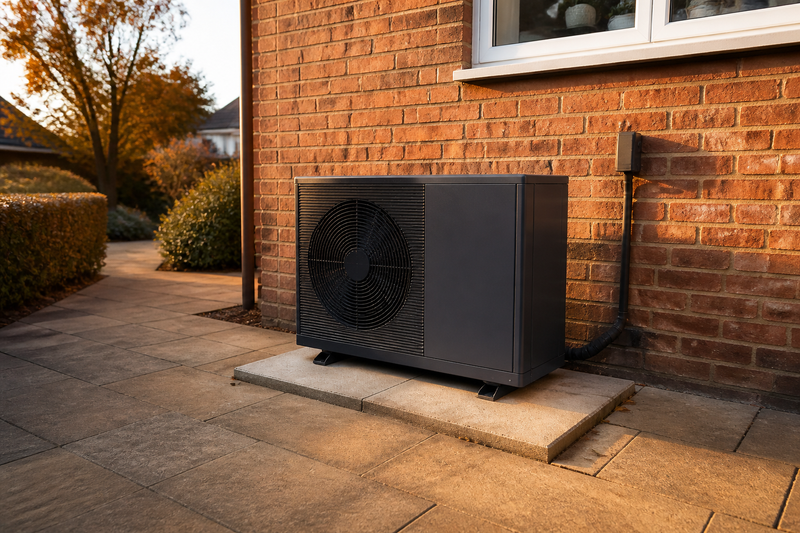
Does the type of gas sealed inside an outdoor heat pump unit actually change how warm your radiators get in January?
For years, most domestic air source heat pumps installed across England, Scotland, and Wales relied on fluorinated greenhouse gases such as R410A or R32. Over the past two years, outdoor units using R290, which is high-purity propane, have rapidly gained ground across the British retrofit market. The transition is not simply an environmental label, because the underlying fluid physics directly governs the water temperature your heating circuit can achieve without backup electric immersion elements. Choosing between these refrigerants affects pipework clearances, outdoor equipment positioning, and the seasonal efficiency that determines your quarterly energy outgoings.
Here is a walk-through of how to evaluate refrigerant choices when planning a home heating upgrade.
1. Checking your heating circuit flow temperature
The first step in assessing any clean heating project is establishing how hot your radiators need to be on the coldest day of winter. Traditional gas and oil boilers deliver water at 65°C to 75°C, whereas low-carbon heating systems deliver their highest seasonal performance at flow temperatures between 35°C and 45°C.
If your home has modern radiators or underfloor heating, an R32 system operating at a 45°C design flow temperature works with high seasonal efficiency. If you live in an uninsulated Victorian or 1930s property where replacing every radiator would cause substantial cosmetic disruption, the required design flow temperature may remain at 55°C or even 65°C. The refrigerant inside the unit dictates whether the compressor can generate those higher temperatures without rapid mechanical wear or excessive power consumption.
2. Comparing thermodynamic physics between R290 and R32
The physical properties of the working fluid determine how the vapour-compression cycle behaves across extreme outdoor temperature drops. A heat pump absorbs heat from outside air, boils the liquid refrigerant into vapour, compresses that vapour to raise its pressure and temperature, and condenses it to release heat into your wet central heating circuit.
R32, chemically known as difluoromethane, has a critical temperature of 78.1°C and an operating pressure range that creates high discharge temperatures when pushed to produce hot water. As flow temperature approaches 60°C, the compressor must work against steep pressure ratios, causing system efficiency to fall sharply. In contrast, R290 has a critical temperature of 96.7°C, alongside lower discharge temperatures and favorable vapour density. This thermodynamic headroom allows R290 outdoor units to produce radiator flow temperatures of 70°C to 75°C while staying within the safe operating envelope of the compressor.
Environmental properties also diverge significantly between the two fluids. R32 carries a 100-year Global Warming Potential of 675, meaning that a 1.5-kilogram leak warms the atmosphere as much as driving thousands of miles in a petrol car. R290 carries a Global Warming Potential of roughly 0.02 to 3, meaning that accidental venting poses almost no direct atmospheric harm. Under the UK fluorinated gas regulations, refrigerants with high warming potential face scheduled supply phase-downs, encouraging manufacturers to engineer natural refrigerant hardware.
| Operational metric | R32 (Difluoromethane) | R290 (Propane) |
|---|---|---|
| Chemical classification | Hydrofluorocarbon (HFC) | Hydrocarbon (Natural refrigerant) |
| Global Warming Potential (100-year) | 675 | 3 (or lower) |
| Typical maximum flow temperature | 55°C to 60°C | 70°C to 75°C |
| Flammability standard | A2L (Lower flammability) | A3 (Higher flammability) |
| Typical outdoor charge size | 1.0 kg to 2.2 kg | 0.8 kg to 1.5 kg |
| Critical temperature | 78.1°C | 96.7°C |
3. Measuring outdoor clearance and safety exclusion zones
Because propane is combustible, R290 heat pumps must comply with strict safety rules under British Standard BS EN 378 and MCS installation guidance MIS 3005-D. These rules create an invisible safety exclusion zone around the outdoor monobloc casing.
Propane vapour is heavier than air, so any accidental leak sinks to ground level rather than dispersing upwards. Installers must map a three-dimensional safety clearance, often extending 1 to 1.5 metres from the casing joints, relief valves, and electrical access panels. Within this envelope, there can be no unsealed air bricks, open drains, cellar windows, doors, or potential ignition sources such as non-weatherproof electrical switches or garden sockets.
For a detached or semi-detached house with a wide driveway or rear garden, meeting these boundary rules is straightforward. For a narrow terraced property with a compact courtyard, finding an outdoor mounting spot that sits clear of a kitchen door, a ground-level gulley, and neighbouring boundaries requires careful measurement. If your outdoor space cannot accommodate the required safety perimeter, an R32 monobloc or split system provides much greater siting flexibility because lower-flammability refrigerants carry far smaller clearance buffers.
4. Calculating seasonal efficiency across freezing winter spells
High water temperature capability does not exempt a system from the laws of thermodynamics. While an R290 unit can pump 70°C water to your radiators when freezing air surrounds the casing, delivering water that hot requires significantly more kilowatt-hours of electricity than running the circuit at 45°C.
The metric that governs your electricity bills is the Seasonal Coefficient of Performance, known as SCOP. A heat pump running at a 35°C flow temperature typically achieves a SCOP between 3.8 and 4.4, delivering around four units of heat for every unit of electricity consumed. If that same unit is programmed to supply 65°C water to undersized radiators, its operating efficiency drops closer to 2.5. With domestic electricity costing approximately four times as much as natural gas per unit, maintaining an efficiency above 3.0 is essential to ensure heating running costs match or beat a modern condensing gas boiler.
As Centrica chief executive Chris O'Shea highlighted to BBC News on 22 November 2026, household energy budgets face persistent pressure, making it crucial that heating upgrades achieve their expected efficiency in practice rather than running up unexpectedly high electricity demands.
5. Balancing upfront hardware premiums against running economics
Propane heat pumps generally command a modest hardware premium over older fluorinated designs because their internal electrical enclosures require spark-proof components, explosion-resistant fan assemblies, and robust factory pressure testing. However, choosing an R290 system often lowers overall project costs by avoiding extensive radiator replacements inside your living spaces.
Before signing a contract, compare the cost of installing an R32 unit with new, high-output double-panel radiators against the cost of an R290 system that can run smoothly on your existing radiator network at 55°C. For households exploring these upgrades, The Net Zero Home Scheme offers member pricing on solar with battery storage and heat pumps through accredited installers, giving working families up to 15% off standard installation costs with no salary sacrifice or complex paperwork required.
The conversation around clean heating has matured beyond simply asking whether a heat pump works in a cold British winter. Today, working households are looking closely at how refrigerant thermodynamics, radiator sizing, and system controls come together to keep winter bills predictable. When an installation is designed around the right flow temperatures from the outset, families get comfortable rooms and genuine peace of mind.
Gaurav Ahluwalia, General Manager, The Net Zero Home Scheme
Can an R290 heat pump be installed inside a garage or utility room?
Domestic R290 units installed in the UK are almost exclusively sealed outdoor monobloc systems. Because propane is classified as an A3 flammable refrigerant, building standards strictly limit the volume of propane permitted inside occupied indoor spaces. By housing the entire sealed refrigeration circuit inside the outdoor chassis and piping hot water into the home through insulated pipes, the indoor risk is eliminated.
Do R32 heat pumps face an immediate ban under UK rules?
No immediate ban applies to existing domestic R32 systems. The UK fluorinated greenhouse gas regulations enforce gradual quota reductions that phase down imports of high-GWP refrigerants over the coming decade. While manufacturers are switching their production lines to natural refrigerants, certified engineers will maintain and service installed R32 heat pumps throughout their typical fifteen-year operational lifespan.
Does using propane mean your radiators run hot like a gas boiler?
An R290 unit can supply water up to 75°C, but running your heating circuit that hot permanently wastes electricity. To achieve lower running costs, an accredited installer will configure weather compensation controls, allowing the system to run at 45°C during mild spells and raising temperatures only when outdoor temperatures drop below freezing.