Ground Source Heat Pump Checklist: Costs, Permitted Work and Timeline
A practical UK householder guide to ground source heat pumps, covering space needs, borehole drilling, grants, installer checks and typical project timelines.
- Written by
- Net Zero Home Scheme editorial team
- Last updated
- Topic
- heat pumps, energy efficiency, energy bills
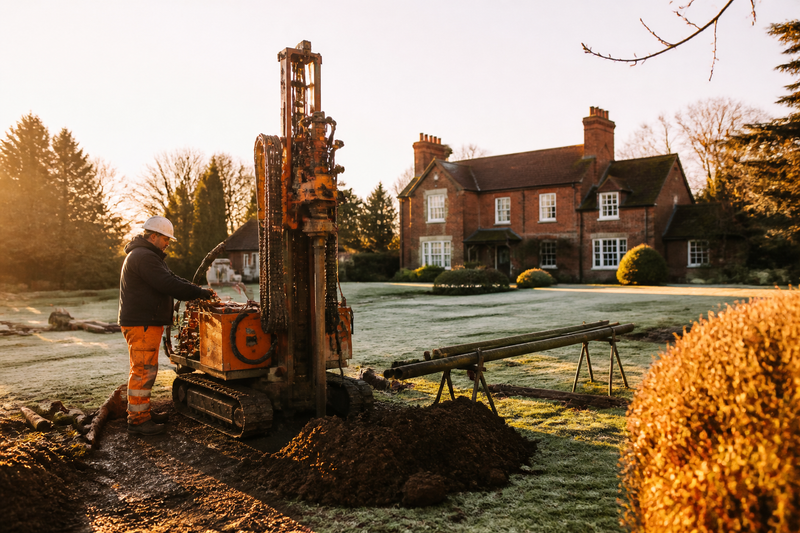
Standing in a frost-covered garden in rural Shropshire, a homeowner watches a heat loss engineer mark out soil boundaries with a laser tape. The goal is straightforward: swap the home's aging oil boiler for a ground source heat pump that extracts stable thermal energy from below the frost line. While air source systems draw heat from the ambient air, ground source systems rely on consistent underground temperatures of 10 to 12 degrees Celsius throughout the year. Converting that ground heat into reliable space heating and hot water requires careful site planning, geological checks and qualified installation engineering.
Preparing your home for a ground source installation involves distinct physical and administrative steps. This guide walks through land requirements, system costs, accreditation standards and realistic project timelines so you can evaluate whether the technology suits your property.
Checking whether your plot suits horizontal loops or a vertical borehole
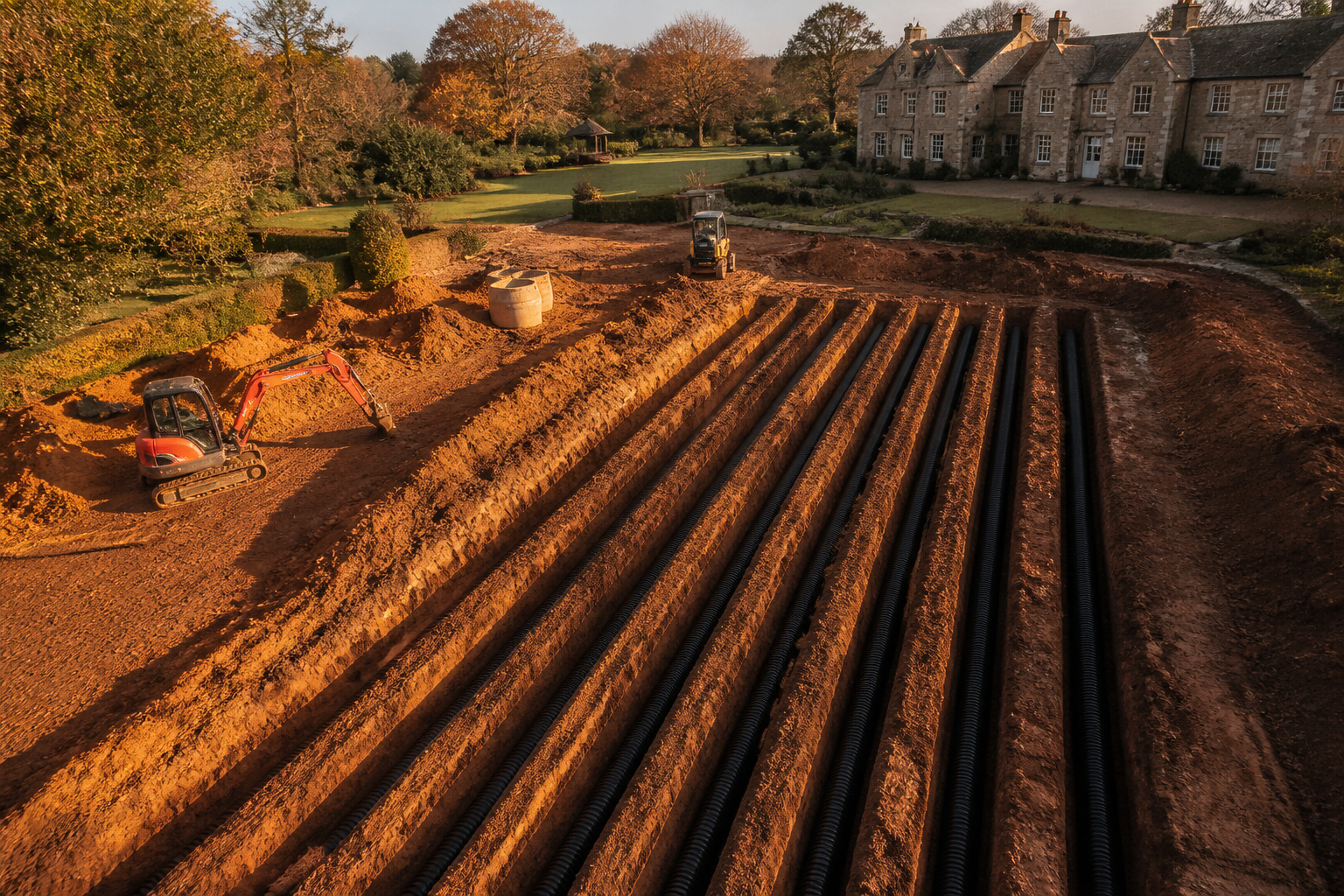
The primary technical constraint for ground source heating is physical access to the earth surrounding your home. Collector pipes, which circulate fluid mixed with glycol to absorb ground heat, are deployed either horizontally in shallow trenches or vertically down drilled boreholes.
Horizontal array installations, often called slinky loops, require significant open ground. As a benchmark, the unshaded land area available should equal roughly two to three times the total heated floor area of the property. For a typical 150 square metre house, you need between 300 and 450 square metres of accessible garden, paddock or field. The soil must be excavatable to a depth of 1.2 to 2 metres without hitting solid rock strata or dense tree root networks.
Vertical boreholes suit properties with limited outdoor space. A drilling rig requires a footprint about the size of a standard delivery van, plus clearance for drill rods and mud management equipment. Boreholes typically descend between 70 and 120 metres into the bedrock. A geological desk study, conducted by your installer, determines local subterranean conditions and ensures drilling does not interfere with aquifers or protected groundwater zones.
| Collector Type | Land Requirement | Typical Trench or Hole Depth | Installation Method | Typical Installed Cost (Excluding Grant) |
|---|---|---|---|---|
| Horizontal Slinky Array | 300 to 800 sq metres | 1.2 to 2.0 metres | Excavator trenching across garden area | £16,000 to £22,000 |
| Vertical Borehole Array | 10 to 20 sq metres | 70 to 120 metres | Heavy drilling rig through bedrock | £20,000 to £28,000 |
Realistic costs and available grant funding
Installing a ground source heat pump carries a higher upfront capital cost than an air source system due to the groundworks involved. However, because ground temperatures remain constant through midwinter, ground source heat pumps achieve high operational efficiency, often delivering a Seasonal Coefficient of Performance (SCOP) between 3.5 and 4.5. This means that for every 1 kWh of electricity consumed, the system generates 3.5 to 4.5 kWh of usable heat.
For a standard detached family home in Britain, a complete horizontal system installation ranges from £16,000 to £22,000. Vertical borehole installations cost more, typically between £20,000 and £28,000, driven by specialist drilling fees and geological surveying.
Financial support is available across Great Britain:
- Boiler Upgrade Scheme (England and Wales): Provides a upfront grant of £7,500 toward the cost of swapping a fossil fuel boiler for a ground source heat pump. Your installer applies on your behalf and deducts the grant directly from your invoice.
- Home Energy Scotland Grant and Loan (Scotland): Offers up to £7,500 in grant funding, with an additional £1,500 available for households in designated rural locations, alongside optional interest-free loans.
- Zero Rate VAT: Under current HM Revenue and Customs tax regulations, domestic heat pump installations benefit from a 0% VAT rate on both equipment and labor until 31 March 2027.
A cross-parliamentary report published on 16 November 2026 highlighted that public support for domestic decarbonisation relies heavily on ensuring systems deliver genuinely lower running costs. Lowering upfront capital hurdles through available grants is critical to achieving those household savings.
Essential installer accreditations and survey steps
Because ground source projects combine civil engineering with domestic plumbing and electrical work, choosing an appropriately certified installer is vital. Before agreeing to a site survey, check that your prospective installer holds active registrations with key industry standard bodies:
- Microgeneration Certification Scheme (MCS): Mandatory for your installation to qualify for the Boiler Upgrade Scheme grant. MCS standards govern both system design and equipment efficiency.
- TrustMark: Demonstrates compliance with government-endorsed quality standards and consumer protection frameworks.
- Consumer Protection Scheme: Membership in RECC (Renewable Energy Consumer Code) or HIES (Home Insulation and Energy Systems Contractors Scheme) ensures deposit protection and insurance-backed guarantees.
- Electrical and Plumbing Compliance: Installers must be qualified under NICEIC, NAPIT or equivalent competent person schemes to self-certify compliance with Building Regulations Part P (electrical) and Part L (conservation of fuel and power).
A competent engineer must perform a room-by-room heat loss survey using CIBSE BS EN 12831 design standards rather than simple floor area estimates. This survey determines the peak heat demand of your home in kilowatts (kW) and identifies whether existing radiators or pipework need upgrading to handle flow temperatures around 45 to 50 degrees Celsius.
Your installer must also submit a grid connection application to your local Distribution Network Operator (DNO). Systems with higher electrical starting currents require explicit prior approval under ENA Engineering Recommendation G99 rules before work begins.
Key questions to ask before signing a contract
To avoid unexpected variations during groundworks, ask these specific operational questions during initial site consultations:
- Has a geological desk study been completed for my specific postcode to confirm ground thermal conductivity?
- Does the quoted contract price include full reinstatement of topsoil or paving following trenching or drilling?
- What specific flow temperature was used to size the heat pump and calculate expected annual electricity use?
- Will the ground loop require a non-toxic glycol anti-freeze mix, and what is the required maintenance interval for fluid testing?
- How will the installer handle unexpected sub-surface obstacles, such as unmapped rock or high groundwater pressure?
Step-by-step installation timeline from survey to switch-on
A typical ground source project spans 8 to 14 weeks from initial contact to final commissioning. Understanding each phase helps you plan around vehicle access and household heating downtime.
- Weeks 1 to 2: Initial site visit, room-by-room heat loss calculation, geological desktop assessment and formal quote preparation.
- Weeks 3 to 4: Application for the Boiler Upgrade Scheme grant and submission of G99 grid notification to the Distribution Network Operator.
- Weeks 5 to 7: Equipment procurement, groundworks scheduling and pre-installation plumbing preparation, including hot water cylinder replacement if required.
- Weeks 8 to 10: Ground loop installation. For horizontal arrays, excavators dig trenches, lay pipework and backfill over two to three days. For vertical systems, a drilling rig sinks boreholes over three to five days.
- Weeks 11 to 12: Internal installation. Engineers position the heat pump unit, connect ground manifold pipes, integrate the buffer vessel and wire controls.
- Weeks 13 to 14: System flushing, pressure testing, glycol filling, MCS commissioning registration and user training.
"Ground source heating offers exceptional seasonal efficiency, but success depends on thorough upfront geological and heat loss design. Taking time to verify installer credentials and plot suitability ensures that homeowners secure the long-term bill benefits offered by constant ground temperatures."
Gaurav Ahluwalia, General Manager, The Net Zero Home Scheme
If your employer offers home energy perks, you can connect with vetted, accredited specialists for swapping your boiler for a heat pump through The Net Zero Home Scheme. The scheme is completely free for employers to launch and involves no payroll deductions or salary sacrifice, giving members direct pricing discounts on certified installations.
Key questions about ground source heating
Do I need planning permission for a ground source heat pump in England?
In most cases, installing a ground source heat pump on a single dwelling falls under Permitted Development rights in England, Wales and Scotland. However, planning permission is usually required if your property is a listed building, situated within a conservation area with specific Article 4 directions, or if the outdoor equipment exceeds volume limits. Always check with your local planning authority before starting groundworks.
How long do underground collector pipes last compared to the heat pump unit?
High-density polyethylene (HDPE) ground loops installed in trenches or boreholes have an operational lifespan of 50 to 100 years. The internal heat pump compressor unit itself typically lasts 20 to 25 years, which is significantly longer than standard gas or oil boilers. This means ground collector loops often outlast multiple generations of heat pump units.
Can a ground source heat pump work with existing radiators?
Yes, provided the radiators are correctly sized for lower water flow temperatures. Ground source heat pumps operate most efficiently when delivering water at 45 degrees Celsius or below. Your installer's heat loss survey will identify whether specific room radiators need replacing with double-panel (Type 22) models or fan-assisted units to maintain warm indoor temperatures during winter peak periods.