Solar Panel Pitch and Orientation: Testing 5 UK Myths
Discover the physics behind solar panel orientation in the UK, comparing south-facing roofs with east-west systems, tilt angles, and real generation data.
- Written by
- Net Zero Home Scheme editorial team
- Last updated
- Topic
- solar, home energy, energy efficiency
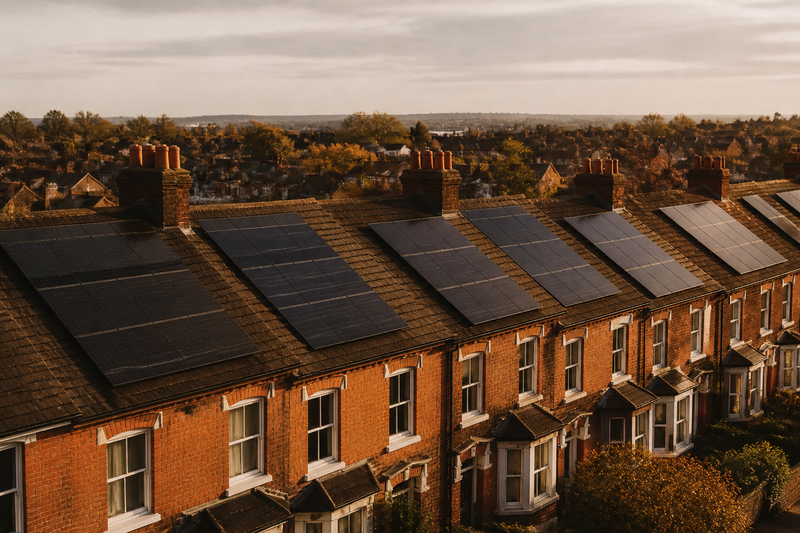
Does your roof need to face directly south for solar panels to be worth the investment in the UK? For years, standard advice told homeowners that unless panels pointed south at a 35-degree tilt, solar generation would suffer steep losses. However, actual UK generation data, improvements in panel efficiency, and shifts in daily energy usage patterns tell a different story.
Understanding solar physics comes down to two measurements: azimuth (the horizontal direction your roof faces, measured in degrees from south) and pitch (the vertical tilt angle of your roof). While a south-facing system at a 35-degree angle receives peak solar radiation around midday, most UK households consume the bulk of their electricity during the morning rush and evening peak.
Here is how five widespread beliefs about solar panel pitch and orientation hold up against practical engineering evidence and UK installation standards.
Belief: Solar panels only pay back on a south-facing roof
Many homeowners assume that installing solar panels on an east, west, or south-east facing roof results in poor financial returns. The physics of solar irradiance in Great Britain does show that a south-facing array angled between 30 and 40 degrees maximises total annual kilowatt-hour (kWh) generation. In central England, a 4 kWp south-facing array generates roughly 3,800 kWh of electricity per year under standard MCS yield calculator projections (Microgeneration Certification Scheme MIS 3002 standard).
However, placing panels on an east or west-facing roof only reduces total annual output by approximately 15% to 20%, yielding between 3,000 kWh and 3,200 kWh per year for a similarly sized system. Because diffuse sunlight, light scattered by cloud cover, makes up around 50% of total annual solar radiation in the UK, solar PV modules generate power whenever there is daylight, regardless of direct sun beam alignment.
The table below compares expected performance across common UK roof orientations and tilt angles, based on standard European Photovoltaic Geographic Information System (PVGIS) modeling for central UK locations:
| Roof Orientation | Pitch Angle | Annual Yield relative to South (35°) | Peak Generation Time | Best Daily Use Match |
|---|---|---|---|---|
| South | 30° - 40° | 100% | 12:00 - 13:00 | Midday home working, appliance schedules |
| South-East / South-West | 30° - 40° | 95% | 10:30 / 14:30 | Balanced daytime demand |
| East-West Split (Dual Array) | 30° - 40° | 82% - 86% | Morning & Evening twin peaks | Morning kettle & evening cooking |
| West | 30° - 40° | 80% - 85% | 14:00 - 17:00 | Afternoon cooking, EV charging after work |
| East | 30° - 40° | 80% - 85% | 08:00 - 11:00 | Morning heating, breakfast appliances |
| Flat Roof (Ballasted) | 10° - 15° | 88% - 92% | 11:30 - 13:30 | Low-profile residential & extensions |
Belief: East-west solar arrays generate too little energy to power a home
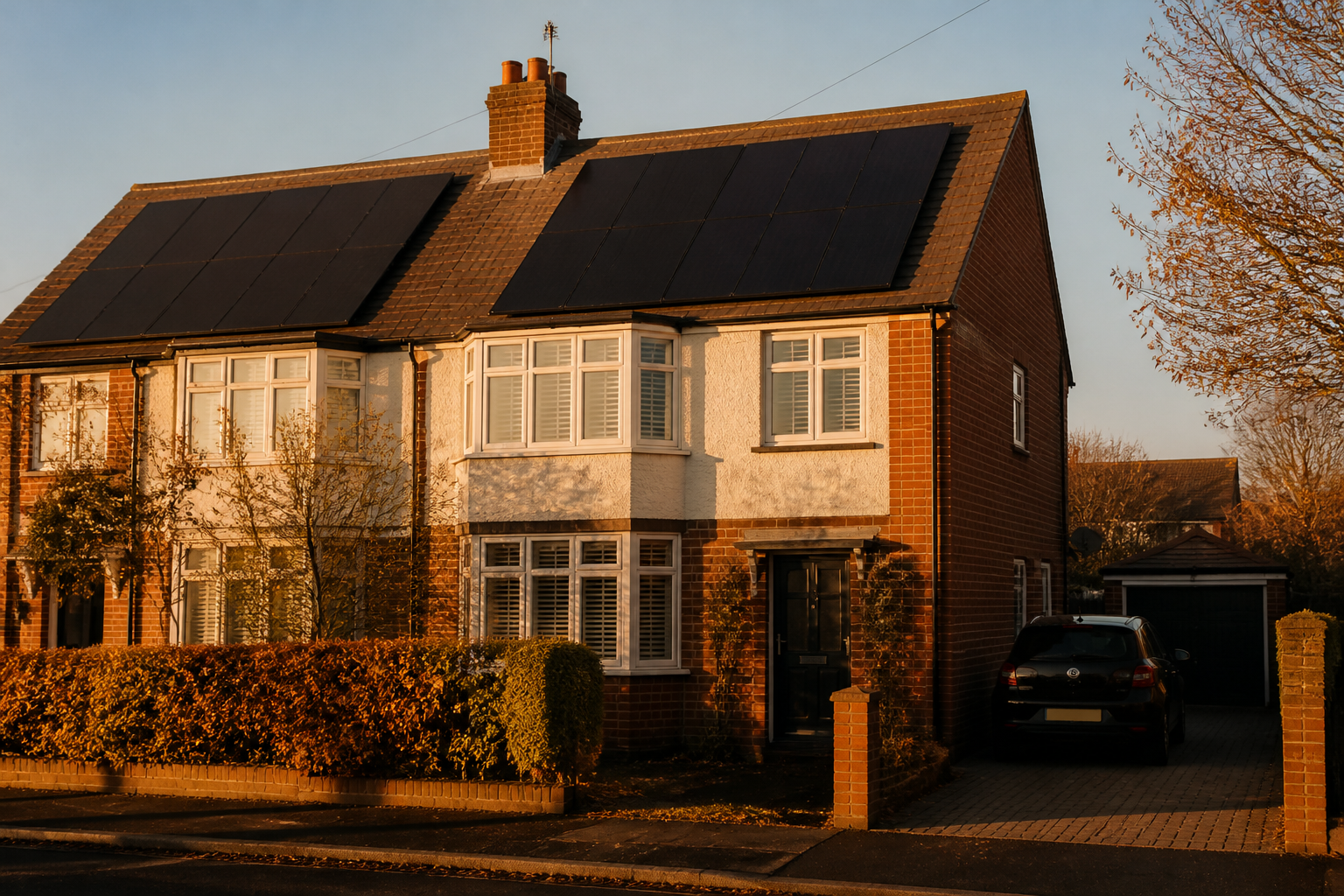
While a purely south-facing system produces a tall, narrow generation spike around solar noon, an east-west split distribution creates a broader, flatter power curve. Panels mounted on an eastern roof pitch pick up early morning sunshine just as household kettle, toaster, and heating loads turn on. Meanwhile, western panels pick up late afternoon sun when family members return home.
This split profile aligns closely with typical household consumption profiles. A single south-facing array often creates excess power at midday, exporting energy to the grid when demand is low, while leaving the home reliant on grid electricity during morning and evening periods.
An east-west system spreads generation across a 12-hour window in summer. By pairing an east-west array with a domestic battery, households capture both morning and afternoon generation curves, reducing grid dependence during peak tariff hours.
Belief: Steep roof angles produce the most electricity in the UK
UK roof pitches typically range between 30 and 45 degrees, which aligns well with optimal annual generation angles. However, some householders believe steeper roof slopes, such as 50 or 60 degrees, perform better during dark winter months when the sun stays low on the horizon.
While a 60-degree tilt does capture slightly more direct rays during December and January, winter daytime hours in Great Britain are short and overall solar radiation is low. Over 70% of a UK solar system's annual generation occurs between April and September, when the sun reaches elevation angles of 50 to 62 degrees above the horizon.
Setting panels at a steep angle penalises summer generation far more than it helps in winter. Conversely, installing panels on shallow roofs angled at 10 to 15 degrees, typical of flat roof ballasted frames, loses only 8% to 12% of total annual output compared to an ideal 35-degree pitch. Shallow tilts also benefit from capturing sunlight from all directions throughout overcast days.
Belief: Minor morning or evening shade ruins the output of an entire roof array
In traditional solar array installations using string inverters, solar panels are connected in series like Christmas tree lights. If a single panel on a western roof slope is shaded by a chimney or dormer window, the electrical current across the whole string can drop to match the shaded panel's output.
Modern UK installations resolve this issue using two key technical approaches:
- Bypass diodes integrated directly inside modern solar modules, which allow current to pass around shaded cell sections.
- Module-level power electronics (MLPE), such as microinverters or DC optimisers, which isolate each panel's voltage and current tracking.
Under RECC (Renewable Energy Consumer Code) guidelines, accredited installers assess shading using a sun-path diagram or digital LiDAR site scan to calculate a shade factor (expressed as a decimal from 0 to 1). If your roof suffers localized shading from nearby trees or adjacent gables for part of the day, fitting optimisers ensures unshaded panels continue generating at full capacity.
Belief: Off-south roofs take too long to offset their installation cost
The return on investment for solar panels depends on self-consumption rates and equipment installation costs rather than total raw kWh output alone. Under current UK tax rules, domestic solar installations executed by MCS-accredited contractors benefit from a 0% VAT rate until March 2027.
Because east-west installations often allow installers to fit more total panels across two roof slopes instead of packing a single south slope, the total installed capacity (in kWp) can be larger. A 6 kWp east-west system costing £7,000 often generates more usable self-consumed electricity than a smaller 3.5 kWp south system costing £5,500, because the home consumes a higher percentage of the generated power directly without letting it spill onto the grid.
When evaluating system designs, demand a detailed yield calculation based on MCS MIS 3002 standards from your installer. This standard accounts for your exact geographic location, roof orientation, pitch, and shading factors to provide realistic annual kWh estimates.
If you are exploring solar panels and a battery on your roof to cut household energy bills, workplace benefits programs can help lower upfront installation costs. Joining The Net Zero Home Scheme is free for employers to offer and involves no salary sacrifice or payroll administration. Employees gain access to member pricing on solar panels with battery storage, installed by vetted MCS and TrustMark accredited installers across England, Scotland and Wales. The scheme is delivered by Net Zero Benefits, the team behind The Electric Car Scheme and The Charge Scheme.
When planning your installation, ensure your contractor carries TrustMark registration and RECC or HIES consumer protection membership. Verify that your installer submits a G98 notification to your local Distribution Network Operator (DNO) for systems up to 3.68 kW per phase, or secures G99 grid approval prior to work beginning for larger arrays.
Sources
- Microgeneration Certification Scheme Standards (MIS 3002), MCS Certified
- Photovoltaic Geographical Information System (PVGIS), European Commission Joint Research Centre
- Renewable Energy Consumer Code (RECC), RECC