EU Leaders Propose Deeper Clean Energy Ties With UK
Five European leaders have called for closer EU-UK clean energy links, highlighting long-term power market trends as households prepare for 2027 VAT changes.
- Written by
- Net Zero Home Scheme editorial team
- Last updated
- Topic
- policy, energy efficiency, energy bills
The leaders of Germany, Belgium, the Netherlands, Luxembourg and Denmark called for closer clean energy ties with the UK in a joint letter sent to European Union officials, as reported by The Guardian on 7 November 2026.
This diplomatic push highlights how cross-border power connections shape wholesale electricity stability, arriving as UK employers and households evaluate long-term energy planning in our full Budget 2026 guide. While macroeconomic policies determine wholesale energy import costs, domestic householders face practical decisions about how to insulate their budgets against grid price volatility. With the 0% VAT rate on domestic energy storage and heating equipment set to rise to 5% on 1 April 2027, timing household upgrades has become a pressing consideration for both families and workplace reward teams.
Key differences across domestic energy choices
Households evaluating self-generation or heating upgrades have three primary routes, each offering distinct mechanical setups, upfront capital demands and financial returns. Comparing these routes side by side helps clarify which technology fits a specific property type and budget.
| Feature | Solar PV with Home Battery | Air Source Heat Pump | Plug-In Solar Kit |
|---|---|---|---|
| Primary Energy Function | Generates daytime electricity and stores surplus power | Replaces fossil fuel heating with electric heat extraction | Offsets base-load daytime electricity consumption |
| Typical System Size | 4.0 kWp array with 5.0 kWh to 10.0 kWh storage | 5.0 kW to 12.0 kW thermal output | 400 W to 800 W panel capacity |
| Regulatory Standard | MCS installation, PAS 63100 safety, G98 grid application | MCS installation, Building Regulations Part L, HIES/RECC code | G98 notification to Distribution Network Operator |
| Current VAT Rate | 0% until 31 March 2027 (rises to 5% on 1 April 2027) | 0% until 31 March 2027 (rises to 5% on 1 April 2027) | Standard 20% VAT on retail hardware |
| Grant Support | None direct; accessible via targeted local council grants | £7,500 via the Boiler Upgrade Scheme | None |
| Typical Annual Bill Offset | 50% to 75% of household power consumption | Replaces gas/oil purchase; seasonal SCOP of 3.2 to 3.8 | 300 kWh to 650 kWh of annual electricity |
Which installation option matches your property type?
Choosing the right system depends on tenure, roof orientation and existing heating infrastructure.
Rooftop solar PV coupled with battery storage
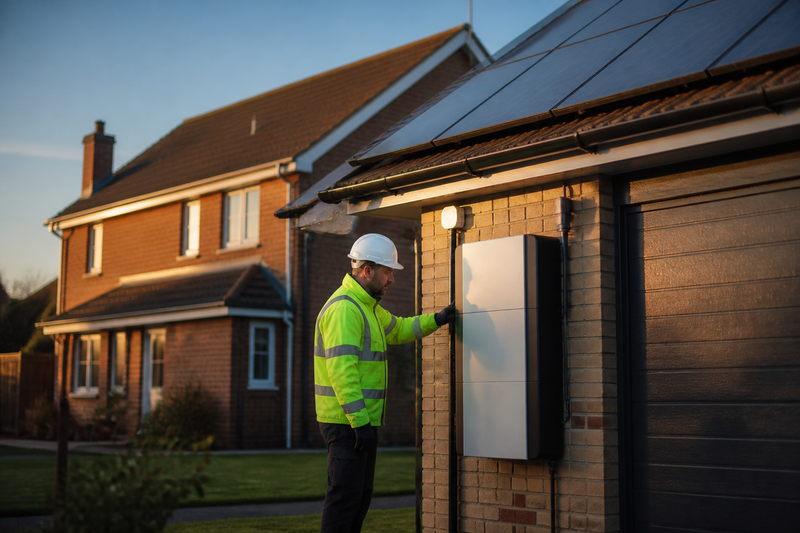
This combination suits owner-occupiers living in semi-detached or detached properties with unshaded south, east or west roof aspects. A 4.0 kWp solar array paired with a 7.0 kWh battery allows a household to capture generation during peak daylight hours and discharge it during evening electricity price windows. Under Microgeneration Certification Scheme (MCS) standards and PAS 63100 fire safety guidance, batteries must be installed in suitable locations such as utility rooms or attached garages with appropriate interlinked fire detection. For households on time-of-use tariffs, storing off-peak grid power in winter provides year-round bill reductions even when daylight hours are short.
Air source heat pumps
Air source heat pumps suit homes looking to transition away from mains gas, oil or LPG central heating. Operating at high seasonal coefficients of performance (SCOP), a heat pump delivers between 3.2 kWh and 3.8 kWh of heat for every 1 kWh of electricity consumed, provided radiators are correctly sized for lower flow temperatures between 45°C and 55°C. Homes with existing hydronic central heating circuits can utilise the £7,500 government grant under the Boiler Upgrade Scheme, provided the property has an up-to-date Energy Performance Certificate without outstanding recommendations for loft or cavity wall insulation.
Plug-in solar arrays
Plug-in solar offers a portable alternative for renters or households living in flatted accommodation without access to a private roof. These systems typically consist of one or two panels connected directly to a standard 13A wall socket via a microinverter capped at 800 W output. While plug-in kits do not qualify for zero-rate VAT or central capital grants, they require no structural alterations and can be registered with the local Distribution Network Operator using a simple G98 notification form.
Household timing and payback before the 2027 VAT change
UK householders preparing for winter energy costs must account for impending regulatory shifts. Following policy updates detailed in official Treasury documentation, the temporary 0% VAT rate applied to domestic solar, home batteries and heat pumps will expire on 31 March 2027, reverting to 5% on 1 April 2027.
On an average solar and battery installation costing £9,000, the addition of 5% VAT adds £450 to total project expenditure. For a heat pump installation costing £11,500 prior to the £7,500 Boiler Upgrade Scheme grant, a 5% tax change increases the net out-of-pocket balance. Completing installations before April 2027 preserves maximum return on investment and reduces system payback windows by several months.
Households should also monitor local authority funding. As reported by BBC News on 9 November 2026, individual local authorities including councils in Surrey are opening application windows for targeted household support grants up to £250 to assist residents managing energy bill pressures. Combining targeted grant relief with low-carbon home improvements ensures households protect themselves against unpredictable wholesale power markets.
Strategic guidance for workplace reward leaders
For HR, reward and benefits leaders, international power market discussions reported by The Guardian on 7 November 2026 underline a clear reality: energy price volatility remains a structural issue for UK employees. Financial wellbeing initiatives that focus solely on short-term relief miss the opportunity to offer staff permanent reductions in essential living expenses.
Workplace reward teams evaluating financial benefits should consider the administrative load of different perks:
- Salary sacrifice schemes: Highly effective for high-value items like electric cars, but require payroll software integration, benefit-in-kind tax accounting and minimum wage compliance checks.
- Direct payroll deductions: Provide simple spreading of costs, but carry employer balance sheet liabilities and administrative overhead.
- Voluntary benefit platforms: Require no payroll integration, involve zero employer capital outlay and avoid tax compliance risks while giving staff access to preferential member pricing.
To help employees reduce household bills without introducing administrative payroll friction, some employers offer home energy installation benefits. Joining The Net Zero Home Scheme is free for employers and provides staff with member pricing on solar panels and a battery fitted by vetted, accredited installers across England, Scotland and Wales.
By introducing practical home energy benefits ahead of the April 2027 VAT adjustments, reward teams help employees lock in zero-rate tax benefits and secure long-term bill savings.