G98 vs G99 Rules: Sizing Solar and Battery Systems in the UK
Learn how G98 and G99 grid export limits affect inverter sizing, DNO permissions and battery storage returns for UK homes under network regulations.
- Written by
- Net Zero Home Scheme editorial team
- Last updated
- Topic
- solar, battery storage, energy efficiency
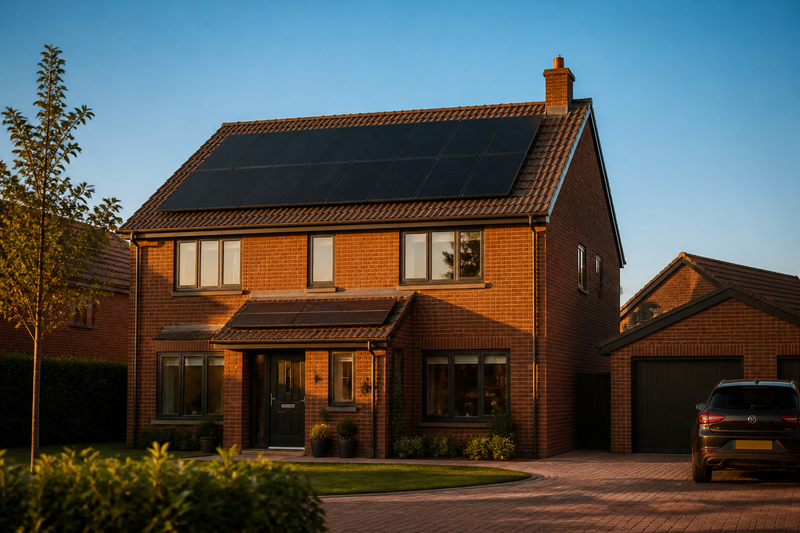
Are you wondering why your solar installer recommended a 3.68 kW inverter when your roof can easily fit 6 kW of solar panels? When upgrading your home energy setup, the physical capacity of your roof is only half the equation. The other half is governed by electrical physics and grid connection rules set by your local Distribution Network Operator (DNO). In Great Britain, the boundary between simple notification and formal permission hinges on two standards set by the Energy Networks Association: Engineering Recommendation G98 and Engineering Recommendation G99. Understanding how these rules work prevents costly delays, ensures grid compliance, and helps you design a system that delivers maximum financial payback on your electricity bills.
Why is 3.68 kW the export limit for domestic solar installations in the UK?
The 3.68 kW limit per single-phase supply exists because energy networks specify that single-phase grid connections can handle up to 16 amperes per phase without prior network reinforcement checks under Engineering Recommendation G98. In the UK, standard domestic mains voltage is rated nominally at 230 volts AC. Multiplying 230 volts by 16 amperes gives exactly 3,680 watts, or 3.68 kilowatts. Local electricity distribution networks were originally designed for one-way power flow, carrying electricity from regional substations into residential homes. When thousands of homes export power back into low-voltage street cables simultaneously on sunny afternoons, local voltage levels rise. If voltage exceeds the statutory limit of 253 volts (230V plus 10 percent), household appliances can suffer thermal stress, and street transformers risk overloading. To protect grid integrity without requiring individual engineering assessments for small systems, network operators allow installations up to 16A per phase to connect under a streamlined notification process.
What is the difference between G98 and G99 grid applications for home batteries and solar?

The main difference is that G98 allows you to notify your Distribution Network Operator after installing equipment up to 3.68 kW, whereas G99 requires formal permission from the network operator before installing systems above 3.68 kW. Under G98 regulations, an accredited installer fits your equipment, verifies that your inverter includes certified grid protection relays, and submits a post-commissioning form to the DNO within 28 days. There is no waiting period for grid approval and no application fee. In contrast, G99 applies whenever the combined continuous AC output rating of your generation and storage equipment exceeds 3.68 kW on a single-phase supply, or 11.04 kW on a three-phase supply. Under G99, your installer must submit a detailed application describing your equipment specifications, single-line wiring diagrams, and export limiting controls before any work begins. The DNO then models your local network cluster to determine whether the street grid can absorb your maximum potential generation.
| Feature | G98 Notification | G99 Application |
|---|---|---|
| Maximum Single-Phase AC Power | 3.68 kW (16 Amperes at 230V) | Greater than 3.68 kW |
| Approval Timing | Post-commissioning (notify within 28 days) | Prior approval required before installation |
| DNO Turnaround Time | Immediate connection | 4 to 10 weeks typically |
| Application Fees | Free | £0 to £350+ depending on DNO |
| Combined Solar & Battery Calculation | Total AC inverter rating combined | Total AC inverter rating combined |
| Export Limiter Required | No | Often required if array exceeds export limit |
| Suitable Property Type | Typical 3 to 4 bedroom home | Large detached homes, high consumption |
How does grid export limiting physics affect your solar panel generation and storage returns?
Export limiting physics restricts the amount of power flowing out through your meter while allowing your inverter to generate higher total AC power internally for self-consumption and battery charging. If you install a 6 kWp solar array paired with a 5 kW hybrid inverter and a home battery, your system can produce 5 kW of usable AC power during peak daylight hours. If your DNO approves a G99 application with a strict 3.68 kW export limit, a current transformer (CT) clamp attached at your main meter monitors power directional flow in real time. When your home consumes 1.32 kW for heat or appliances, the full 5 kW generation is utilised: 1.32 kW powers your home, 3.68 kW exports to the grid, and zero energy is wasted. If your house consumption drops to 500 watts while your battery is fully charged, the export limiter signals the inverter to throttle DC generation down to 4.18 kW (3.68 kW export plus 0.5 kW house load). Understanding this physics helps you size your storage correctly, ensuring surplus solar energy charges your battery rather than being curtailed by grid limits.
Does a G99 application cost more money and delay your installation timeline?
Applying for G99 permission adds between two to eight weeks to your project timeline and may incur network assessment fees from your Distribution Network Operator ranging from zero to several hundred pounds. While G98 notifications incur no DNO fees, DNOs treat G99 filings as individual network engineering studies. If your local street transformer is already saturated with local solar generation, the network operator might issue a conditional approval requiring a hard export cap, or in rare cases, offer a grid reinforcement quote costing thousands of pounds. For most suburban homes, DNOs approve G99 export limits between 4 kW and 7 kW without requiring network upgrades. However, you must factor the pre-approval waiting window into your project schedule, as installers cannot fit equipment or energise your system until the DNO issues written formal consent.
How can you maximize solar generation if your DNO limits your grid export?
You can install a larger solar array paired with dynamic export limiting controls and a home battery to capture surplus generation for evening use rather than losing it to grid curtailment. Over-sizing your solar array relative to your inverter rating, known as DC-to-AC over-powering, allows your system to reach peak output earlier in the morning and maintain peak generation later in the afternoon. For example, installing 6.5 kWp of solar panels on a 3.68 kW inverter ensures your system generates the maximum allowable 3.68 kW even during overcast weather or mid-morning shoulder hours. Any peak generation above 3.68 kW during mid-summer clear skies can be directed into charging your home battery or heating your domestic hot water cylinder.
How do you check if your roof upgrade requires G98 or G99 approval through workplace schemes?
Accredited installers assess your local Distribution Network Operator constraints and handle all G98 notifications or G99 prior approval applications before mounting panels or fitting batteries on your home. If you are planning to add solar panels and a battery on your roof, joining The Net Zero Home Scheme gives you access to member pricing through vetted, accredited installers who manage all DNO filings on your behalf. The scheme is completely free for employers to offer, with no salary sacrifice or payroll administration involved. Working with MCS certified engineers ensures your inverter complies with ENA protection settings, avoiding compliance disputes with your network provider and safeguarding your smart export tariff eligibility.
Sources
- Energy Networks Association - Distributed Generation Connection Guides, Energy Networks Association
- Microgeneration Certification Scheme Standards, MCS