AC-Coupled vs DC-Coupled Home Battery Options Explained
Compare AC-coupled and DC-coupled battery storage for UK homes, including costs, efficiency gains, inverter rules and DNO approval steps.
- Written by
- Net Zero Home Scheme editorial team
- Last updated
- Topic
- battery storage, solar, home energy
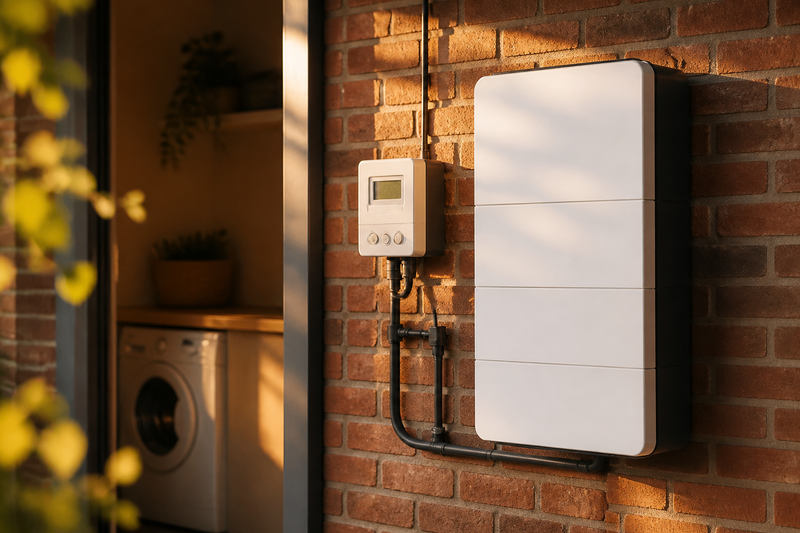
Standing in a utility room in Berkshire, you might see a compact solar inverter mounted high on the wall, converting direct current from your roof into alternating current for your washing machine and kettle. Adding storage to that system requires a fundamental choice: do you connect the battery before or after that conversion takes place?
Choosing between an alternating current (AC) coupled system and a direct current (DC) coupled system determines your upfront costs, installation complexity and how much power you lose whenever electricity moves in or out of storage.
Comparison table: AC-coupled vs DC-coupled storage systems
| Technical Feature | AC-Coupled System | DC-Coupled System |
|---|---|---|
| Best fit for property | Existing solar arrays with working inverters | New solar installations or inverter replacements |
| Power conversion path | DC to AC (panels), AC to DC (battery), DC to AC (house) | DC straight to battery, DC to AC (house) |
| Round-trip efficiency | 85% to 89% | 90% to 94% |
| Installation flexibility | High (can sit anywhere near consumer unit) | Medium (must sit close to hybrid inverter) |
| Inverter requirement | Standalone battery inverter alongside solar inverter | Single hybrid inverter handling panels and battery |
| Typical UK supply and fit cost (5 kWh to 10 kWh) | £3,500 to £6,500 | £2,800 to £5,200 (when fitted alongside PV) |
| Grid charging capability | High (charges directly from grid at cheap off-peak rates) | High (charges from grid or panels via hybrid unit) |
Which battery coupling method suits your property?
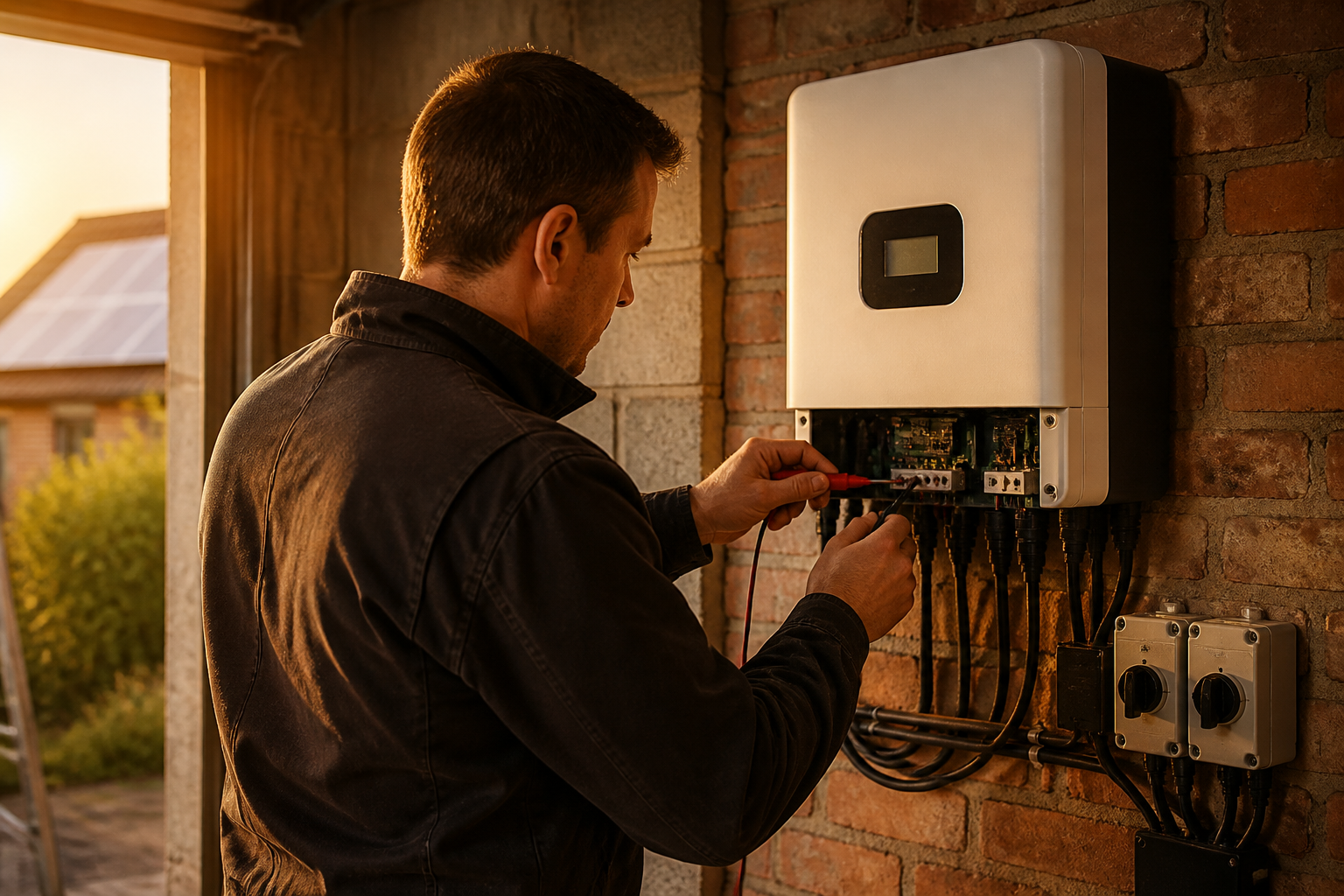
If your home already has solar panels installed and your solar inverter is relatively new, an AC-coupled battery is usually the most straightforward choice. The battery system brings its own dedicated inverter and connects directly to your main electrical consumer unit. It operates independently of your solar panels, reading smart meter data to store excess solar electricity during the day or draw low-cost power from the grid overnight.
Conversely, if you are building a system from scratch or replacing an inverter that has reached the end of its ten-year lifespan, a DC-coupled setup offers clear efficiency advantages. In a DC-coupled arrangement, electricity generated by your roof flows directly into the battery as direct current, bypassing unnecessary conversion stages. Power is converted into alternating current only when your home demands it. According to testing data from the Microgeneration Certification Scheme (MCS), cutting out those intermediate conversion steps can reduce energy losses by 4% to 7% over the lifetime of the system.
DC-coupled systems use a single hybrid inverter rather than two separate units. This saves physical wall space and simplifies equipment warranties, but it creates a single point of failure. If a hybrid inverter develops a fault, both your roof generation and your storage capabilities pause until repairs are completed.
Electrical site checks and grid connection rules
Before ordering any battery system, an accredited electrician must conduct a thorough survey of your home electrical infrastructure.
- Consumer unit capacity: Your main fuse box must have a spare ways allowance or space for a dedicated miniature circuit breaker (MCB) and residual current breaker with overcurrent protection (RCBO). Older fuse boxes with rewireable fuses will require an upgrade to meet BS 7671 wiring standards.
- Main supply fuse rating: Most UK homes have a 60A, 80A or 100A main service fuse cut-out. Your installer must verify that your main fuse can handle the peak discharge current of the battery alongside your daily household loads.
- Distribution Network Operator (DNO) notifications: Connecting generation or storage to the local electricity grid is governed by Energy Networks Association rules.
- G98 Standard: If the total power export of your solar inverter and battery inverter combined is 16A per phase or less (roughly 3.68 kW), your installer can fit the equipment and notify your DNO within 28 days of commissioning.
- G99 Standard: If the combined output exceeds 3.68 kW, your installer must submit a formal G99 application to your DNO and await written approval before installation begins. Approval timelines vary by region, taking anywhere from two to eight weeks depending on local grid capacity.
With British smart meter infrastructure transitioning to non-profit management following years of licence delays reported by The Guardian in November 2026, ensuring your smart meter communicates reliably with your energy supplier is essential to access dynamic tariff rates.
Technical questions to put to your installation engineer
When evaluating installer quotes, ask specific questions about components, wiring paths and standards compliance:
- Which battery chemistry are you quoting? Lithium Iron Phosphate (LFP) chemistry is generally preferred for domestic wall-mounted storage due to its high thermal stability and longer cycle life compared to traditional Nickel Manganese Cobalt (NMC) cells.
- What is the usable depth of discharge (DoD)? A 10 kWh battery with an 80% DoD delivers only 8 kWh of usable power, whereas a unit with a 95% DoD provides 9.5 kWh.
- Is the system G100 compliant for export limiting? If your DNO restricts how much energy you can feed back into the local grid under a G99 agreement, your system must feature hardware-certified export limitation to avoid penalties.
- Does the quote include full MCS, TrustMark and HIES or RECC protections? Certification guarantees that your installation meets strict safety benchmarks and qualifies for standard export tariffs.
Typical installation timeline and site setup
A domestic battery retrofitting project follows a predictable sequence over four to eight weeks:
- Week 1: Desktop survey and initial quote: You provide photos of your consumer unit, main service fuse, existing solar inverter (if present) and proposed battery mounting location.
- Weeks 2 to 3: Physical survey and DNO paperwork: The technical surveyor verifies cable routes and earthing arrangements. If a G99 application is required, it is submitted to your local DNO at this stage.
- Weeks 4 to 6: Equipment procurement and grid approval: Components are ordered once the DNO grants connection approval.
- Week 7: Installation day: A qualified electrician (NICEIC or NAPIT registered) mounts the battery and inverter, runs cable trunking to the consumer unit, fits current transformer (CT) clamps to monitor house loads, and tests all safety cut-offs. Physical work typically takes between four and eight hours.
- Week 8: Commissioning and paperwork: You receive your MCS certificate, electrical installation certificate (EIC) and notification of DNO registration.
Accessing accredited battery installers through workplace benefits
Upgrading your home energy infrastructure requires trusted tradespeople who understand strict DNO grid rules and safety codes. If your employer offers home upgrades as a workplace perk, you can get verified advice and preferential pricing without your company spending a penny. Joining The Net Zero Home Scheme gives employees access to member pricing of up to 15% off getting solar panels and a battery on your roof, fitted by vetted, accredited installers across England, Scotland and Wales. Delivered by Net Zero Benefits, the scheme is run by the team behind The Electric Car Scheme and The Charge Scheme.
Frequently asked questions about battery coupling
Does an AC-coupled battery waste energy through double conversion?
Yes, an AC-coupled battery experiences small conversion losses twice. When solar power is stored, DC electricity from panels turns into AC through your solar inverter, then back into DC to enter the battery, and finally into AC when powering your home. This triple-stage path drops overall round-trip efficiency to roughly 85% to 89%, compared to 90% to 94% for DC-coupled hardware. However, for homes with existing, functional solar inverters, the lower installation cost of an AC-coupled battery often outweighs the minor efficiency loss.
Do I need to inform my Distribution Network Operator before installing a battery?
It depends on total output capacity. Under ENA rules, if your battery and solar equipment together can export more than 3.68 kW (16A) to the grid, your installer must get explicit approval under a G99 application before fitting the equipment. If the total export is 3.68 kW or under, your installer can fit the unit under G98 rules and inform the DNO within 28 days post-commissioning.
Can I upgrade a DC-coupled battery if my inverter fails later?
Replacing a hybrid inverter in a DC-coupled system requires sourcing a unit compatible with your existing battery's communication protocol (usually CAN bus or RS485). While major manufacturers maintain compatible product lines, selecting widely established hardware brands ensures easier component replacement if an inverter fails after its standard ten-year warranty period.