Home Battery Location Rules: What PAS 63100 Requires
A practical guide to UK home battery location rules under PAS 63100, detailing safe installation areas, fire safety requirements, and installer standards.
- Written by
- Net Zero Home Scheme editorial team
- Last updated
- Topic
- battery storage, home energy, mcs
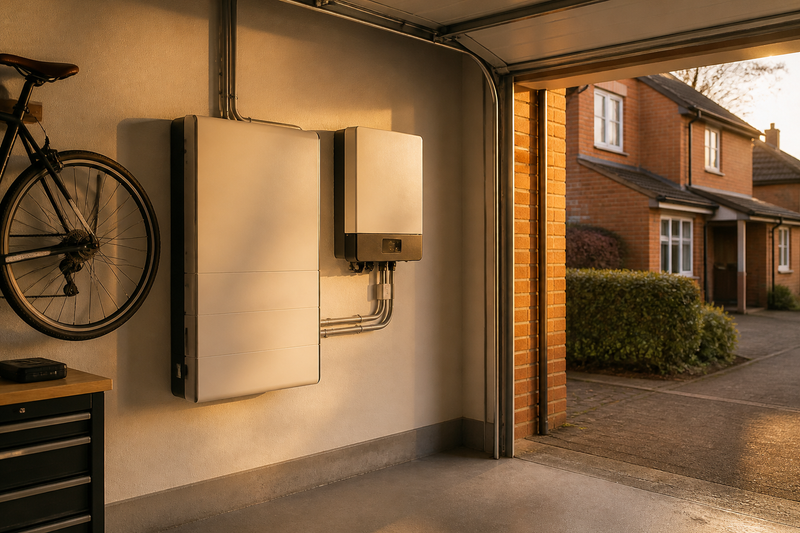
According to Microgeneration Certification Scheme (MCS) data, certified home battery installations in the UK exceeded 10,000 per month during 2024, reflecting rapid growth in residential energy storage. Householders are installing batteries to store electricity generated by rooftop solar panels or to take advantage of off-peak energy tariffs. However, as battery adoption accelerates, clear rules regarding where these systems can be placed inside or outside a property are vital. In 2024, the Institution of Engineering and Technology (IET) published PAS 63100, the UK code of practice dedicated to domestic electrical energy storage safety. Despite these formal guidelines, several common beliefs persist about where batteries can go, how they perform in winter, and what safety checks are required.
Belief 1: A home battery can be safely placed in any loft or under-stairs cupboard
Many homeowners assume that an unused loft or a compact cupboard under the stairs provides an ideal, out-of-sight location for a home battery. In reality, PAS 63100 explicitly restricts these installation locations to mitigate fire risk and ensure safe building evacuation.
Batteries generate heat during charge and discharge cycles. In an uninsulated loft, ambient temperatures in midsummer can easily exceed 40°C, causing battery management systems to throttle performance or degrade battery cell life prematurely. Furthermore, lofts present significant access challenges for fire and rescue services in the rare event of thermal runaway, where a failing cell overheats and ignites neighbouring cells.
Similarly, under-stairs cupboards frequently sit directly along a home's primary escape route. PAS 63100 prohibits installing battery systems along protected escape paths or under stairs unless separated by certified fire-resisting construction. Installing a battery directly under a timber staircase risks trapping occupants on upper floors if an electrical fault develops.
| Location in home | PAS 63100 status | Key requirements and restrictions |
|---|---|---|
| Uninsulated loft space | Non-compliant | High ambient summer temperatures and fire service access constraints prohibit loft placement |
| Under-stairs cupboard | Non-compliant | Prohibited if the area forms part of the sole escape route from upper floors |
| Bedrooms and nurseries | Non-compliant | Strictly prohibited in any room intended for sleeping or resting |
| Attached or integral garage | Compliant | Permitted with connected heat detection and non-combustible wall mounting |
| External brick wall | Compliant | Permitted with IP65 weather enclosure and 300mm clearance from windows |
| Utility room | Compliant | Permitted provided the space is not a sole escape route and heat alarms are fitted |
Compliant internal locations include utility rooms, dedicated plant rooms, or integral garages, provided the mounting wall is non-combustible and the room does not form part of an escape route.
Belief 2: Outdoor battery installations suffer severe efficiency losses in winter
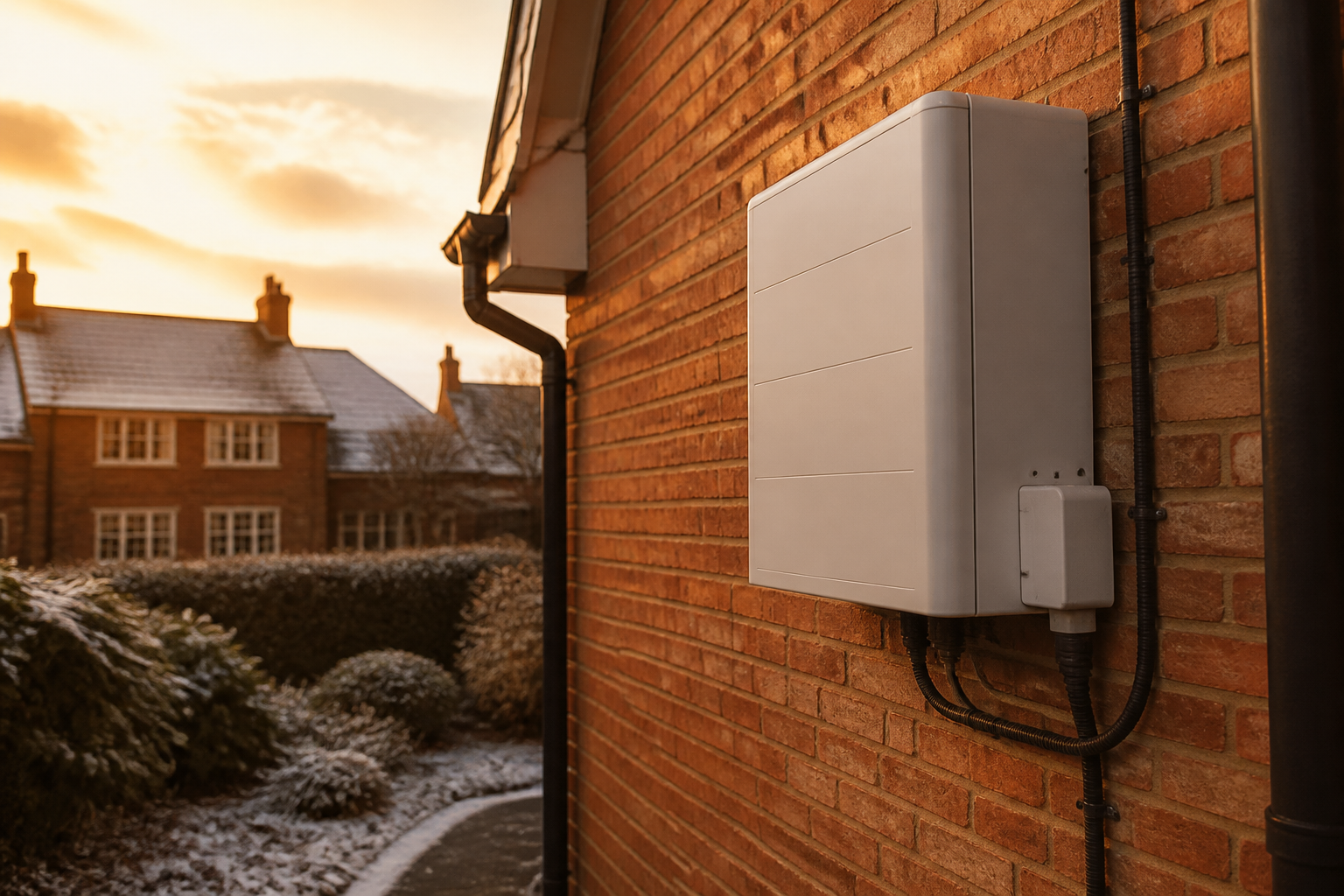
A widespread concern among householders is that placing a battery outside will leave it vulnerable to freezing British winter temperatures, resulting in severe power drops or hardware damage. While cold weather does affect battery chemistry, modern hardware is designed to operate outdoors safely when installed correctly.
Lithium iron phosphate (LFP) chemistry, which is standard in most domestic batteries installed in the UK, experiences slower chemical reactions at temperatures below 5°C. Charging a battery when cell temperatures fall below 0°C without management can cause permanent cell degradation. However, modern outdoor-rated storage units include intelligent internal heating elements. When ambient temperatures drop, the battery uses a small amount of stored energy to maintain cell temperatures within an optimal 15°C to 25°C operating window.
To ensure long-term reliability outdoors, installers must ensure the battery housing carries at least an IP65 ingress protection rating, protecting it against heavy rain and dust. Installers must also maintain a minimum clearance of 300mm from nearby windows, doors, or drainpipes, and mount the unit at least 100mm above ground level to protect against standing water and splashback.
Belief 3: Any qualified domestic electrician can fit home energy storage
Because a home battery connects to your main consumer unit, homeowners often believe that any qualified domestic electrician can perform the installation. While general electrical competency under BS 7671 (the IET Wiring Regulations) is essential, battery storage systems require specific specialist qualifications and notifications.
Domestic batteries operate at high direct current (DC) voltages before converting to alternating current (AC). Installers must understand DC isolation, surge protection device (SPD) installation, and earthing arrangements, particularly for systems that offer emergency backup power during a grid outage. Furthermore, connecting a battery to the local electricity grid requires compliance with Distribution Network Operator (DNO) regulations under Engineering Recommendation G98 (for small systems up to 16A per phase) or G99 (for larger systems requiring prior DNO approval).
Householders should look for installers holding MCS certification for electrical energy storage systems, alongside membership in a recognized trade body such as NICEIC, NAPIT, or the Renewable Energy Consumer Code (RECC). MCS certification ensures that the installation meets rigorous quality standards, is registered with local building control, and remains eligible for smart export tariffs.
Joining The Net Zero Home Scheme costs employers nothing to set up, introducing no salary sacrifice or administrative burden for workplace benefit administrators. Employees gain access to member pricing with savings of up to 15% on solar panels and a battery on their roof, installed by accredited tradespeople who meet strict national standards.
Belief 4: Batteries require no extra fire alarms or ventilation upgrades
Another common misconception is that a home battery operates like any standard household appliance, requiring no changes to your property's fire detection or ventilation setup. In practice, PAS 63100 and building regulations require specific safety enhancements whenever energy storage is added to a domestic building.
Under BS 5839-6 (the standard for domestic fire detection), any room containing a domestic battery must be fitted with an interconnected heat detector rather than a standard optical smoke alarm. Heat detectors prevent false alarms caused by minor dust or temperature fluctuations, while ensuring early warning throughout the dwelling if cell overheating occurs. The alarm must be wirelessly or hardwire linked to the rest of the home's smoke alarm network so that all occupants are alerted immediately.
In addition, installers must evaluate ventilation and wall structural limits. While sealed LFP battery modules do not emit gases during normal operation, adequate space around the unit (typically 150mm to 300mm of clear air gap around ventilation louvres) is required to dissipate heat. Wall-mounted units must be secured to solid masonry or reinforced timber studs capable of supporting weights that often exceed 80kg to 120kg for a standard 10kWh system.
Sources
- MCS Certified Installation Standards, MCS
- IET Standards: Electrical Energy Storage Systems, The Institution of Engineering and Technology
- Energy Saving Trust: Guide to Home Energy Storage, Energy Saving Trust