Solar Inverter Over-Sizing and Clipping Physics
Discover why pairing a larger solar array with a smaller inverter maximizes annual yield under UK light conditions and G98 grid rules.
- Written by
- Net Zero Home Scheme editorial team
- Last updated
- Topic
- solar, energy efficiency, regulation
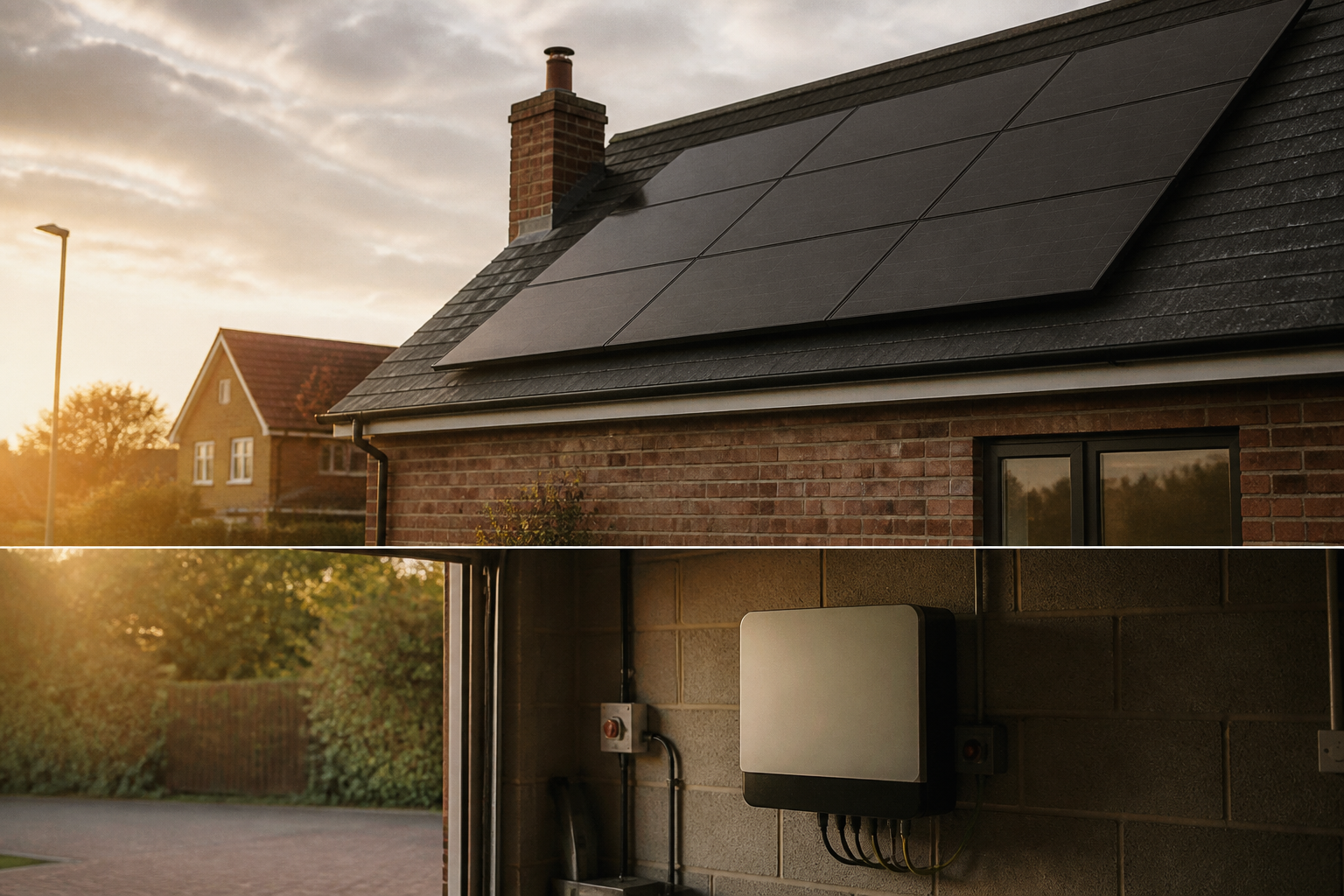
When planning a home solar system in the UK, householders are often surprised when an installer recommends connecting a 5 kilowatt-peak (kWp) array of solar panels to a 3.68 kilowatt (kW) inverter. On the surface, sizing the inverter smaller than the total peak capacity of the panels appears to waste potential power. In the solar industry, this practice is known as DC-to-AC overprovisioning, or oversizing the array relative to the inverter.
Understanding why this is standard engineering practice requires examining solar panel rating physics, real-world UK solar irradiance, grid connection limits, and inverter operational dynamics. While peak generation can be truncated during sunny summer afternoons, an oversized array yields significantly more total energy across autumn, winter, and spring.
How standard test conditions differ from UK weather
Solar panels carry a peak rating in kilowatt-peak (kWp), determined under Standard Test Conditions (STC) in a laboratory. STC specifies an irradiance level of 1,000 watts per square metre (W/m²), a solar cell temperature of 25 degrees Celsius, and an air mass spectrum of 1.5.
In the UK climate, these exact laboratory conditions occur rarely. For most of the year, ambient solar irradiance is considerably lower, ranging between 100 W/m² on overcast winter days and 600 to 800 W/m² during typical spring and summer weather. Furthermore, on rare occasions when irradiance reaches 1,000 W/m² in mid-summer, high ambient temperatures heat the photovoltaic cells well above 25 degrees Celsius. Because silicon solar cells lose efficiency as temperature rises, their actual peak output drops below their STC rating.
As a result, a 5 kWp array installed on a UK roof will operate below 3.68 kW output for the vast majority of its operating hours throughout the year.
The physics of inverter clipping

An inverter converts direct current (DC) generated by solar panels into alternating current (AC) suitable for household appliances and the electricity grid. Every inverter has a maximum AC power output limit, governed by internal thermal limits and semiconductor power ratings.
When DC power input from the panels exceeds the maximum AC output capacity of the inverter, the inverter engages power clipping. The inverter adjusts its Maximum Power Point Tracking (MPPT) algorithm, shifting the operating voltage along the solar panel current-voltage curve away from the optimum peak point. This intentionally reduces the current drawn from the array, causing the excess energy to remain unextracted as mild heat within the panels themselves.
While power clipping sounds like wasted energy, the mathematical trade-off works heavily in favour of oversizing in temperate climates.
Grid regulations and the G98 threshold
In Great Britain, domestic grid connections are regulated by the Energy Networks Association under Engineering Recommendation G98 and G99. Under G98, micro-generators up to 16 amperes per phase (which equates to 3.68 kW at nominal 230 volts) can be connected to the distribution network using a simple notification process after installation.
Installing an AC inverter larger than 3.68 kW requires prior approval from the local Distribution Network Operator (DNO) under Engineering Recommendation G99. DNO approval can take weeks or months, and in areas with congested local sub-stations, the DNO may require network upgrades or impose export limits.
By capping the inverter at 3.68 kW AC, home owners maintain compliance with simplified G98 registration while expanding the DC panel capacity on the roof to 5 kWp or even 6 kWp.
Comparing yield across different DC to AC ratios
The ratio of DC panel capacity to AC inverter capacity is called the DC-to-AC ratio, or inverter load ratio. A ratio of 1.0 means array and inverter ratings match exactly, whereas a ratio of 1.35 means 5.0 kWp of panels are connected to a 3.68 kW inverter.
The economic advantage of a higher ratio comes from shoulder seasons and low-light performance. A 5 kWp array generating at 50% capacity on an overcast October morning outputs 2.5 kW, which the 3.68 kW inverter converts without clipping. A 3.68 kWp array operating at the same 50% efficiency outputs only 1.84 kW. The larger array yields 35% more usable energy during low-light hours.
Analysis published by Carbon Brief in October 2026 highlighted that higher renewable generation helped the UK avoid £5.9bn in gas imports during energy market volatility, underscoring how maximizing low-light self-generation contributes to both national energy security and lower domestic energy bills.
| DC Array Size (kWp) | Inverter AC Rating (kW) | DC:AC Ratio | Estimated Annual UK Yield (kWh) | Typical Summer Clipping Loss (%) | Relative Winter Yield vs 1:1 Ratio | G98 Notification Status |
|---|---|---|---|---|---|---|
| 3.68 | 3.68 | 1.00:1 | 3,300 | 0.0% | 100% (Baseline) | G98 Standard |
| 4.50 | 3.68 | 1.22:1 | 3,950 | 0.8% | +122% | G98 Standard |
| 5.20 | 3.68 | 1.41:1 | 4,450 | 2.5% | +141% | G98 Standard |
| 6.00 | 3.68 | 1.63:1 | 4,900 | 5.2% | +163% | G98 Standard |
| 6.00 | 5.00 | 1.20:1 | 5,200 | 0.4% | +163% | G99 Approval Required |
Engineering trade-offs and component lifespan
While overprovisioning offers clear yield benefits, solar engineers must manage several technical trade-offs:
- Inverter thermal stress: Operating an inverter at its maximum output for extended periods generates internal heat. Inverters must be installed in well-ventilated spaces, such as utility rooms or cool garages, to prevent thermal throttling and maintain service lifespan.
- Maximum DC input voltage: Installers must verify that the total open-circuit voltage of the panel strings under cold weather conditions does not exceed the inverter's maximum DC input voltage limit, typically 550V to 600V for single-phase UK string inverters.
- MPPT operating windows: Inverters require a minimum start voltage and an optimal MPPT voltage range. Panel string voltage must remain comfortably within this window under high summer temperatures.
- Battery charging integration: DC-coupled home batteries can store excess DC power before it reaches the AC inverter stage. If a DC-coupled battery is active, panel generation above 3.68 kW can charge the battery directly at up to 5 kW DC, preventing clipping losses entirely.
When installing solar PV through accredited installers, such as those registered with MCS and RECC, sizing calculations ensure that inverter DC limits are respected according to BS 7671 electrical standards.
What this means for you
If your roof space allows for more panels than your inverter's AC rating, oversizing the DC array is usually a sound financial and engineering choice in the UK. The extra kWh gained during winter, spring, and autumn far outweigh the small percentage of energy lost to summer clipping.
If your employer offers the Net Zero Home Scheme, you can access member pricing on accredited solar PV and home battery installations across England, Scotland, and Wales without salary sacrifice or payroll deductions.
Before committing to a system layout, ask your MCS certified installer to provide a shading and yield simulation that compares different DC-to-AC ratios for your specific roof pitch and orientation.
Frequently asked questions
Does inverter clipping damage the solar panels or the inverter?
No. Clipping is a normal operational state for grid-tied inverters. The inverter simply adjusts its internal impedance to draw less current from the panels. Unused energy remains in the panels as a tiny, harmless increase in thermal temperature.
Is a G99 application always better if I want a larger solar array?
Not necessarily. While a G99 approval allows an inverter larger than 3.68 kW (such as 5 kW or 6 kW AC), the process takes several weeks, requires DNO application fees, and may be rejected or restricted by the network operator if local transformer capacity is constrained.
How does an East-West roof orientation affect inverter oversizing?
East-West split arrays naturally complement inverter oversizing. Because the east panels peak in the morning and the west panels peak in the late afternoon, the combined system rarely reaches a sharp mid-day peak. This allows a higher DC-to-AC ratio (up to 1.5:1 or 1.6:1) with virtually zero energy lost to clipping.