Why Replacing Wood Stoves with Heat Pumps Improves Health and Bills
A breakdown of indoor particulate pollution, seasonal efficiency physics, and delivered heat costs when swapping a log burner for a heat pump.
- Written by
- Net Zero Home Scheme editorial team
- Last updated
- Topic
- heat pumps, energy efficiency, energy bills
A multi-city study published in ScienceDirect on 13 November 2026 revealed that indoor exposure to carcinogenic polycyclic aromatic hydrocarbons (PAHs) from domestic wood burning can match or exceed exposure levels from outdoor traffic exhaust. While many UK households installed log burners as a decorative or backup heat source over the past decade, scientific evidence on indoor air pollution alongside the evolving economics of home heating is reshaping how we evaluate domestic fires.
Understanding why swapping a wood-burning stove for a modern heat pump makes practical sense requires examining three factors: atmospheric particulate physics inside the home, delivered heat efficiency, and real running costs per kilowatt-hour.
The Physics of Indoor Pollution and Wood Combustion
Wood combustion is a complex chemical process. Even dry hardwood with a moisture content below 20% releases fine particulate matter ($PM_{2.5}$), volatile organic compounds, nitrogen oxides, and toxic PAHs. When you open a stove door to reload logs or adjust airflow controls, air pressure changes force microscopic particles directly into your living room.
According to research conducted across six European urban areas in November 2026, indoor particulate concentrations spike significantly during stove operation, lingering in enclosed rooms for hours. $PM_{2.5}$ particles measure less than 2.5 micrometres in diameter, fine enough to penetrate deep into lung tissue and enter the bloodstream. Outdoors, chimney emissions add to neighbourhood smog during cold, stagnant winter evenings, making domestic wood burning the UK's largest single source of primary $PM_{2.5}$ emissions according to Defra air quality statistics.
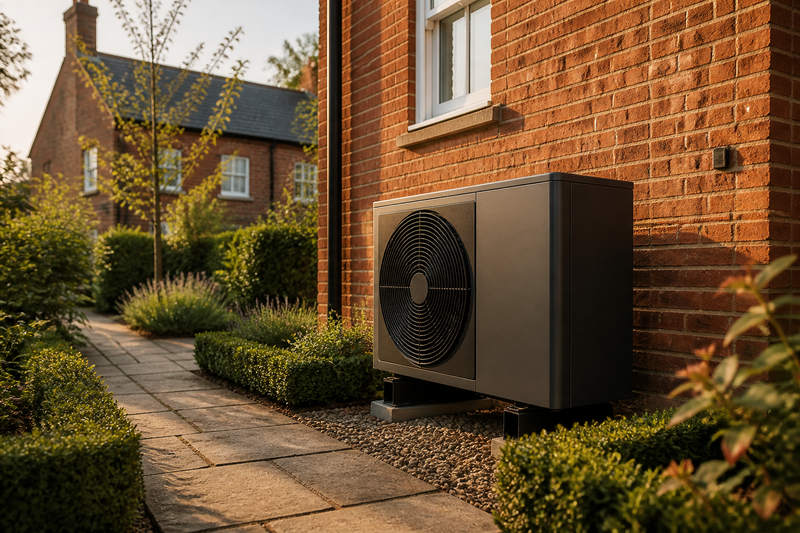
By contrast, an electric heat pump moves thermal energy from external air into your central heating circuit using a sealed refrigerant loop. It produces zero local emissions, eliminating indoor particulate spikes entirely while keeping outdoor air clean.
The Economics of Delivered Heat: Stoves vs Heat Pumps

A modern Defra-exempt wood stove operates at an nominal thermal efficiency of 70% to 78%. That means for every 10 kilowatt-hours (kWh) of energy stored in the wood, roughly 7 to 7.8 kWh enters the room as heat, while the remaining 2.2 to 3 kWh escapes up the flue pipe.
Buying dried hardwood logs in net bags or bulk builders' bags currently costs between 14p and 20p per kWh of available thermal energy. After accounting for stove efficiency loss, the effective cost of heat delivered into your living space ranges from 18p to 26p per kWh.
An air source heat pump operates on an entirely different thermodynamic principle. Instead of creating heat through fire, it uses a compressor to upgrade ambient heat absorbed from outside air. Its efficiency is measured as a Seasonal Coefficient of Performance (SCOP). A system with an SCOP of 3.2 generates 3.2 kWh of usable heat for every 1 kWh of electricity consumed, achieving an effective efficiency of 320%.
Under the Ofgem price cap, standard domestic electricity costs roughly 24.5p per kWh. Dividing this tariff by an SCOP of 3.2 yields an effective heating cost of 7.66p per kWh of delivered heat. If you pair the heat pump with a time-of-use smart tariff offering cheaper off-peak electricity, your average delivered heat cost can drop even lower.
| Heating Source | Efficiency / SCOP | Indoor $PM_{2.5}$ Impact | Typical Delivered Cost per kWh | Carbon Intensity |
|---|---|---|---|---|
| Wood-Burning Stove | 70%, 78% efficiency | High (spikes during loading) | 18p, 26p | Medium (localized smoke) |
| Open Coal / Wood Fire | 15%, 30% efficiency | Very High | 35p, 50p | High |
| Gas Boiler | 88%, 92% efficiency | Minimal (flue vented) | 7.5p, 8.5p | High (fossil fuel) |
| Air Source Heat Pump | 300%, 400% SCOP | Zero | 6.5p, 8.5p | Low and declining |
Genuine Uncertainties and Trade-Offs to Consider
While the air quality and running cost figures favour electric heating, replacing a wood stove or using a heat pump as your primary heat source involves clear practical trade-offs.
- Upfront Installation Capital: A log burner and flue lining typically cost between £2,000 and £4,500 to install. A full air source heat pump system costs significantly more before subsidies. However, the UK Government's Boiler Upgrade Scheme provides a £7,500 upfront grant in England and Wales, while Home Energy Scotland offers interest-free loans and grants, reducing the capital gap.
- Radiant Ambiance vs Continuous Thermal Comfort: A stove provides intense, localized radiant heat that rapidly warms a single room. A heat pump is designed to run quietly at lower flow temperatures (35°C to 45°C), maintaining consistent warmth throughout the whole house rather than scorching one spot.
- Power Outage Resilience: A manual wood burner can operate during a power cut, providing emergency warmth without electricity. Heat pumps rely on a continuous power supply, although UK grid reliability remains high.
- Building Insulation and Radiator Sizing: To achieve an SCOP of 3.2 or higher, your home requires reasonable insulation and correctly sized radiators or underfloor heating. A heat loss survey carried out to BS EN 12831 standards is essential before installation to avoid under-sizing.
If your workplace wants to help staff manage domestic energy costs without administrative overhead, joining The Net Zero Home Scheme costs your organisation nothing to implement. The scheme gives employees member pricing on heat pump installations carried out by MCS-accredited engineers across England, Scotland, and Wales, with no payroll deduction or salary sacrifice required.
“Decarbonising home heating is as much about improving daily living conditions and air quality as it is about lowering long-term energy bills. As evidence highlights the indoor health impacts of solid fuel burning, providing clear, practical routes for households to adopt clean electric heating becomes essential.
Gaurav Ahluwalia, General Manager, The Net Zero Home Scheme
Frequently Asked Questions
Can a heat pump heat an older UK home as effectively as a wood burner?
Yes. An air source heat pump engineered and sized to BS EN 12831 standards can maintain a comfortable 21°C indoor temperature even when outdoor temperatures drop to -3°C or lower. Older homes may require larger, double-panel radiators or minor insulation improvements to allow the heat pump to run at peak efficiency.
Do I need to remove my wood stove if I install a heat pump?
You are not required to remove an existing wood stove. Many homeowners retain a clean-burning stove for occasional aesthetic use while using their heat pump as the primary, automated heating system. However, reducing stove usage directly improves indoor air quality.
How do I check if my heating system is suitable for a heat pump upgrade?
An MCS-accredited installer will conduct a room-by-room heat loss calculation to assess your home's thermal performance, current pipework, and radiator surface area. They will provide a detailed design proposal specifying the precise heat pump capacity and expected SCOP before any work begins.