Hydronic Balancing for Air Source Heat Pumps: Delta T and Flow
Why correct water flow rates and Delta T balancing are essential for keeping heat pump running costs low in UK retrofits.
- Written by
- Net Zero Home Scheme editorial team
- Last updated
- Topic
- heat pumps, energy efficiency, mcs

Have you ever wondered why two similar houses fitted with identical air source heat pumps can end up with noticeably different winter running costs?
While insulation levels and weather compensation curves play major roles, one of the most common reasons for disappointing heat pump performance is incorrect hydronic balancing. The physics of moving low-temperature water around a home require far tighter control over water flow rates than traditional fossil fuel systems ever demanded.
What traditional gas boiler setups leave behind
For decades, UK domestic heating systems were designed around high-temperature gas or oil boilers. A standard gas boiler typically supplied water to radiators at 70°C to 80°C, returning water at around 50°C to 60°C. This created a wide temperature differential, known in building services engineering as a Delta T (ΔT) of 20°C.
Because boiler water was so hot, installers could leave pipework hydraulics largely unbalanced without triggering comfort complaints. Radiators closest to the boiler received a disproportionate share of the flow, warming up quickly, while radiators further away received less water. The high flow temperature compensated for the poor water distribution, warming rooms even when flow rates were far from optimal.
When swapping a gas boiler for an air source heat pump, this historical imbalance turns into an operational problem. Heat pumps achieve their highest efficiency, measured by the Seasonal Coefficient of Performance (SCOP), when delivering lower flow temperatures, typically between 35°C and 45°C. At lower temperatures, the temperature difference between the flow and return pipes narrows significantly, usually to a target Delta T of 5°C.
Under guidelines set out in MCS installer standard MIS 3005-D and CIBSE domestic heating design rules, an air source heat pump must move a much larger volume of water per minute through the heating circuit to deliver the same thermal energy into a room. If water flows too fast through near radiators and starves distant ones, the heat pump returns water to the outdoor unit hotter than necessary. This forces the heat pump compressor to work harder, reducing efficiency and raising winter electricity consumption.
What changes during hydronic balancing and commissioning
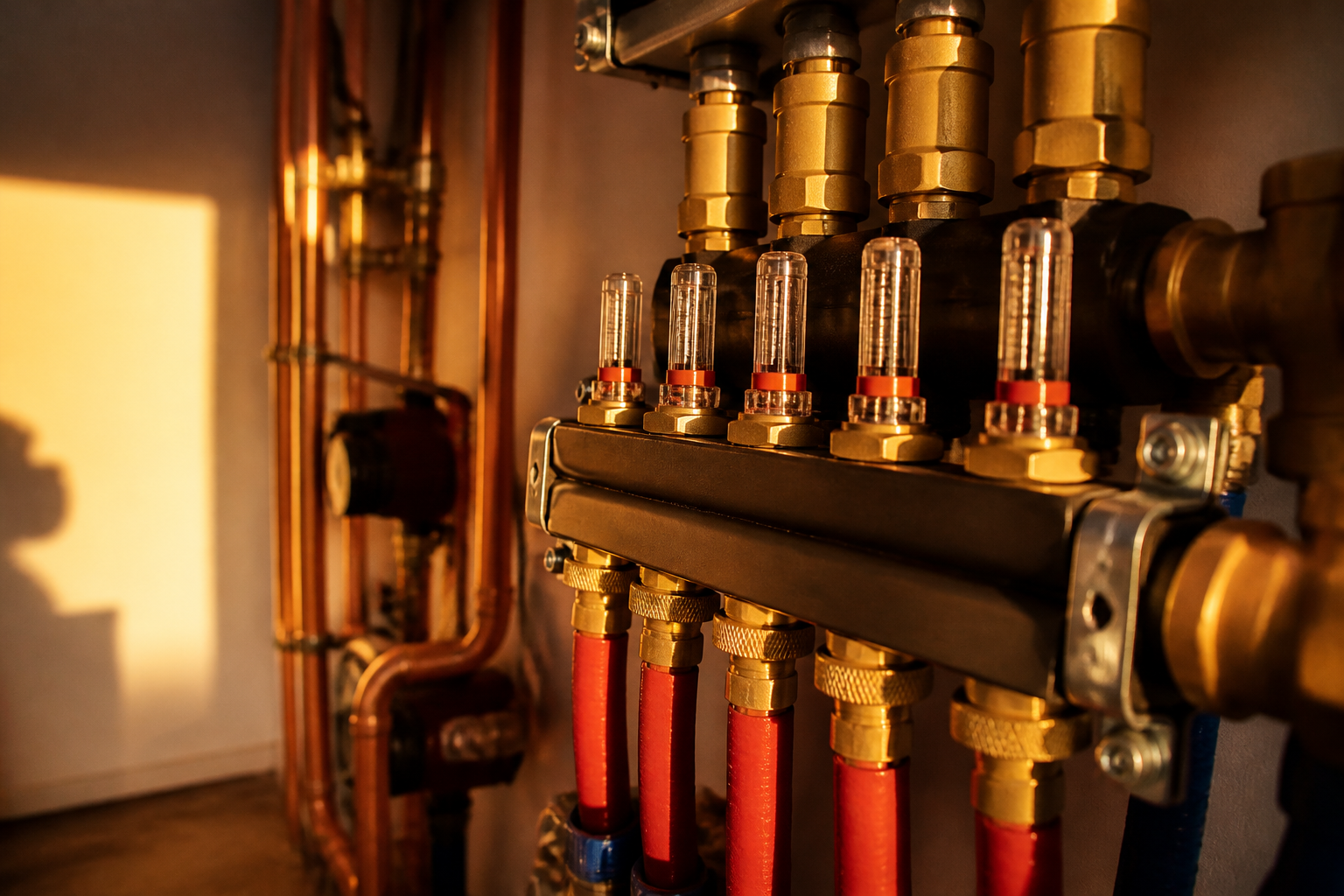
To ensure every radiator receives its correct share of warm water, installers perform hydronic balancing during system commissioning. Heat transfer within a water-based heating system follows a core physical formula: heat output (in watts) equals water mass flow rate multiplied by the specific heat capacity of water and the temperature difference across the emitter.
Because heat pump flow temperatures are low, even minor restrictions or excessive flow rates disrupt room temperature stability. During hydronic balancing, an installer calculates the exact heat loss for every room using room-by-room heat loss calculations under BS EN 12831. They then adjust the lockshield valve on each radiator or adjust flow meters on an underfloor heating manifold to regulate water resistance.
The goal is to equalise hydraulic resistance across every branch of the heating system so that water moves through all radiators simultaneously at the design Delta T of 5°C.
| Parameter | Legacy Gas Boiler Setup | Optimised Air Source Heat Pump Setup |
|---|---|---|
| Flow Temperature | 70°C to 80°C | 35°C to 45°C |
| Target Delta T (ΔT) | 20°C | 5°C |
| Relative System Flow Rate | Low volume, high temperature | High volume, low temperature |
| Efficiency Sensitivity | Low (masked by high heat) | High (directly dictates SCOP) |
| Primary Balancing Mechanism | Basic lockshield adjustments | Precision flow meters or PICVs |
Modern heat pump retrofits often use pressure-independent control valves (PICVs) or dynamic lockshield valves. These valves automatically compensate for pressure fluctuations when individual thermostatic radiator valves (TRVs) open or close elsewhere in the property. Without dynamic balancing, closing a radiator valve in a spare bedroom redirects extra water flow to remaining open circuits, throwing off their calibrated Delta T.
What to watch over the coming months and winter seasons
Once a heat pump system is balanced and commissioned, monitoring performance over your first winter helps verify that the hydraulics are operating as intended.
Field trials from the Energy Systems Catapult Electrification of Heat project demonstrated that well-designed, correctly balanced domestic heat pump systems consistently achieved real-world SCOP values between 3.4 and 4.0. In contrast, systems suffering from restricted flow or hydraulic short-circuiting frequently dropped below an SCOP of 2.5. For an average UK home using 10,000 kWh of space heating annually, that efficiency gap translates to hundreds of pounds in extra electricity costs each year.
There are genuine design trade-offs to consider during balancing:
- Radiator sizing: To deliver target heat outputs at a 5°C Delta T and low flow temperatures, existing radiators often need replacing with larger double-panel (Type 22) or triple-panel (Type 33) units.
- Pipework diameter: Older microbore pipework (8mm or 10mm copper tubing) creates high hydraulic resistance. If pipe diameters are too narrow to handle the required volumetric flow rate without excessive pump energy, sections of distribution pipework must be upgraded to 22mm or 28mm.
- TRV interaction: Fully closing TRVs in reference rooms can starve the heat pump of minimum required flow, triggering system fault codes or forcing backup electric immersion heaters to turn on.
If you are considering swapping your gas boiler for a heat pump, ensuring your installer carries out full room-by-room heat loss calculations and hydronic balancing is critical to long-term savings. Joining The Net Zero Home Scheme gives employees access to member pricing of up to 15% off installations by vetted, accredited installers who design systems to strict MCS standards. The scheme is free for employers to set up and involves no salary sacrifice or payroll administration.
Over coming winter seasons, pay attention to how evenly your home warms up. If certain rooms remain cool while others heat rapidly, or if your heat pump cycles on and off frequently during mild weather, ask your installer to review system flow rates and lockshield valve settings.
Sources
- MCS Standards and Compliance Documents, Microgeneration Certification Scheme
- Electrification of Heat Demonstration Project, Energy Systems Catapult
- Domestic Heating Design Guide, Chartered Institution of Building Services Engineers