Ground-Mounted Solar PV: UK Planning Rules, Cable Runs and Costs
A practical guide to planning permission, trenching requirements, cabling costs and installer accreditations for ground-mounted solar arrays in UK homes.
- Written by
- Net Zero Home Scheme editorial team
- Last updated
- Topic
- solar, home energy, mcs
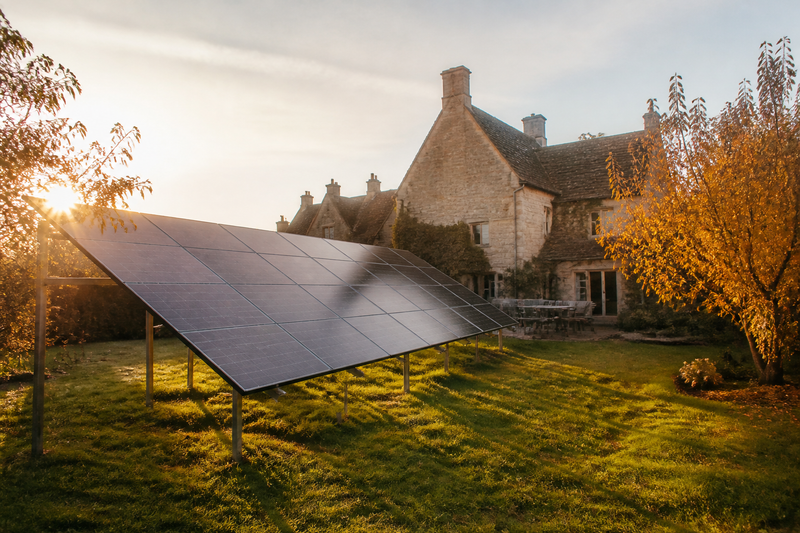
According to official solar statistics from the Department for Energy Security and Net Zero (DESNZ), over 1.4 million UK homes have installed solar panels, yet fewer than 3% of domestic arrays are positioned on the ground rather than a roof. For homeowners with shaded roofs, listed buildings, complex slate tiles or simply ample garden space, placing solar panels on ground frames offers an effective alternative that can optimize sun exposure.
To understand how a ground-mounted project works in practice, consider this realistic illustration. Mark and Sarah live in a converted barn in Gloucestershire with a steep, east-facing slate roof that receives significant shade from adjacent trees. After calculating that a roof installation would yield sub-optimal generation, they decided to explore placing a 5 kilowatt-peak (kWp) array in their south-facing garden plot 25 metres from their main fuse board.
Permitted Development and Planning Permission Rules
Unlike roof installations, which usually fall under Permitted Development rights across England and Wales, ground-mounted solar PV faces stricter rules. Under the Town and Country Planning (General Permitted Development) (England) Order 2015, a ground-mounted solar installation qualifies as Permitted Development only if it meets all of the following conditions:
- The array must not exceed 4 metres in height above ground level.
- The total surface area of the panels cannot exceed 9 square metres (which typically accommodates only 4 to 5 standard modern panels).
- The array must be situated at least 5 metres from any boundary of the property.
- Only one ground-mounted array is permitted per property.
- The installation cannot be located within the curtilage of a listed building or in front of the wall facing a highway in Conservation Areas.
Because a typical 4 kWp to 5 kWp domestic system requires between 10 and 14 panels spanning 22 to 30 square metres, most ground-mounted residential arrays exceed the 9 square metre limit. Mark and Sarah quickly established that their planned 12-panel array required a full householder planning application to their local planning authority. Obtaining approval usually takes 8 to 12 weeks, costs £258 in planning fees in England, and requires a clear site location plan, block plan, and structural elevation drawing.
Ground Anchors, Cable Trenching and Voltage Drop Physics

Once planning consent is secured, site preparation focuses on two primary elements: securing the frame to the earth and digging the electrical trench back to your home's consumer unit.
Installers typically use ground screws or ballast concrete footings to secure ground arrays. Ground screws are steel shafts driven into the soil using hydraulic machinery. They cause minimal ground disturbance, work well in rocky or uneven terrain, and allow panels to be mounted immediately without waiting for concrete to cure. Concrete pads or ballasted ballast trays are used where deep ground penetration is impossible, such as over shallow bedrock.
Cabling requires meticulous attention to electrical physics and safety regulations. Under BS 7671 (IET Wiring Regulations), outdoor underground cables must be Steel Wire Armoured (SWA) and buried at a depth that prevents accidental damage, typically between 500mm and 750mm. The trench should contain a layer of soft sand around the SWA cable, topped with warning tape before backfilling.
Distance introduces electrical resistance. As direct current (DC) or alternating current (AC) travels through long copper conductors, energy is lost as heat, causing voltage drop. To keep system losses below the recommended 1% threshold over a 25-metre run, your installer must size the SWA core correctly. While a 4mm² core might suffice for a short roof-to-inverter run, a 25-metre ground run carrying 5 kW of power usually requires a 6mm² or 10mm² copper cable to prevent efficiency losses and keep the inverter within safe grid operating limits.
| Project Requirement | Standard Technical Specification | Household Check |
|---|---|---|
| Planning Status | Permitted Development (<9m²) or Householder Planning (>9m²) | Check boundary distance (>5m) and surface area |
| Mounting Foundations | Galvanised ground screws or ballasted concrete footings | Test soil stability and verify underground services |
| Cable Trenching | SWA cable buried at 500mm to 750mm depth | Ensure soft sand bedding and yellow cable warning tape |
| Voltage Drop | Kept below 1% to 2% under BS 7671 guidance | Upsize SWA conductor core (e.g. 6mm² to 10mm²) for long runs |
| Accreditations | MCS certified installer, RECC or HIES member, Part P certified | Confirm installer uploads data to MCS database for SEG eligibility |
| Grid Connection | DNO G98 (<3.68kW single phase) or G99 (>3.68kW) | Submit G99 prior application if inverter exceeds 16A per phase |
Realistic Costs, Installer Qualifications and Grid Approval
Ground-mounted solar installations generally cost 15% to 25% more than equivalent rooftop systems due to ground frames, foundations, trenching labor and heavy-gauge SWA cabling. A typical 5 kWp ground-mounted array costs between £7,500 and £10,500, depending on soil conditions and trench length, compared to £6,000 to £8,500 for a straightforward roof installation.
When hiring an installer, insist on the following certifications:
- Microgeneration Certification Scheme (MCS): Required to claim Smart Export Guarantee (SEG) payments from energy suppliers for excess electricity exported back to the grid.
- Consumer Protection Membership: Look for membership in the Renewable Energy Consumer Code (RECC) or Home Insulation & Energy Systems Contractors Scheme (HIES).
- Electrical Safety: The electrician must be Part P registered (NICEIC, NAPIT or ELECSA) to sign off high-voltage mains connections and consumer unit modifications.
Grid connection rules depend on system capacity. If your inverter output is 3.68 kW or less on a single-phase supply (16 Amps per phase), your installer submits a G98 notification to your Distribution Network Operator (DNO) within 28 days after commissioning. If your inverter output exceeds 3.68 kW, as in Mark and Sarah's 5 kW setup, your installer must submit a G99 application and receive written approval from the DNO before connecting the system to the grid. DNO G99 approvals typically take 4 to 8 weeks.
Timeline and Final Checklist for Homeowners
From initial consultation to generating clean electricity, a ground-mounted solar project takes between 10 and 16 weeks when planning permission is required:
- Weeks 1 to 2: Desktop solar design, shade analysis and soil evaluation.
- Weeks 3 to 10: Submission and determination of the householder planning application and DNO G99 grid approval.
- Weeks 11 to 12: Civil works, including trench digging, ground screw installation and SWA cable laying.
- Week 13: Frame assembly, panel mounting, inverter installation and AC/DC wiring.
- Week 14: System commissioning, DNO notification, Part P sign-off and MCS certificate issuance.
If your employer signs up to The Net Zero Home Scheme, offering the benefit costs your organisation nothing while giving you access to member pricing on solar panels and a battery on your roof or land. Vetted, MCS-accredited installers manage the site survey, DNO paperwork and installation steps from start to finish.
Ground-mounted solar PV requires more initial planning and groundwork than rooftop panels, but for homes with unsuitable roofs or shaded tiles, ground arrays offer an efficient way to generate homegrown energy for decades.