Why Hot Summer Days Lower Solar Panel Efficiency in UK Homes
Explore the semiconductor physics behind solar panel heat losses, temperature coefficients, and how ventilation impacts annual household electricity yields.
- Written by
- Net Zero Home Scheme editorial team
- Last updated
- Topic
- solar, energy efficiency, home energy
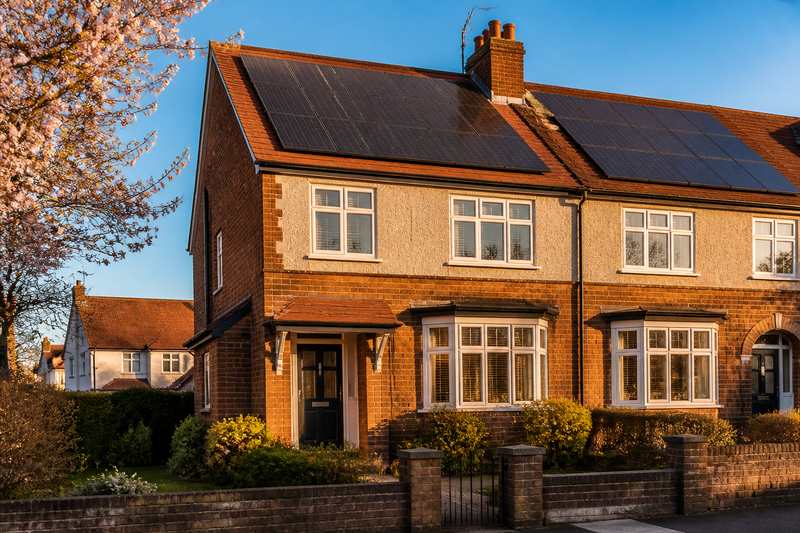
A common assumption among UK householders is that the hottest, sunniest days of midsummer produce the maximum possible electrical output from rooftop solar panels. When temperatures soar above 30°C in July, it feels intuitive that solar generation should break records. Yet, monitoring data from real installations across England, Scotland, and Wales frequently shows peak power output dropping during heatwaves compared to cooler, clear days in April or May.
Belief 1: Hot weather increases rooftop solar panel generation
The relationship between light, heat, and solar electricity comes down to silicon semiconductor physics. Photovoltaic (PV) cells convert light energy, measured in photons, into direct current electricity by freeing electrons within silicon wafers. However, ambient heat directly interferes with this electrical process.
Solar panels undergo laboratory rating under Standard Test Conditions (STC), which specify a light intensity of 1,000 watts per square metre, an air mass of 1.5, and a fixed cell temperature of 25°C. In the real world, cell temperature rarely stays at 25°C when sunlight strikes dark glass.
Every solar panel carries a technical rating known as the temperature coefficient of maximum power ($P_{max}$), recorded on its manufacturer data sheet according to IEC 61215 standards. For modern monocrystalline silicon modules, this coefficient typically sits between -0.30% and -0.40% per degree Celsius. This means that for every single degree Celsius the panel temperature rises above 25°C, its electrical power output drops by that fixed percentage.
When ambient summer air hits 30°C in the UK, dark solar panels mounted on a roof absorb thermal radiation rapidly, easily reaching internal cell temperatures of 65°C. At 40°C above the STC baseline of 25°C, a panel with a temperature coefficient of -0.35%/°C experiences a 14% drop in peak power output. High irradiance delivers more photons, but thermal energy increases voltage resistance across the silicon junction, cutting the instantaneous power output.
Belief 2: Laboratory power ratings reflect actual UK summer performance
When evaluating installer quotes, householders often see kilowatt-peak (kWp) numbers calculated solely from STC laboratory benchmarks. Assuming a 4 kWp array will continuously output 4,000 watts during clear summer weather ignores the physical reality of roof surface dynamics.
To account for real-world environmental conditions, testing standards also measure Normal Operating Cell Temperature (NOCT). NOCT measures panel temperature under realistic field conditions: an ambient air temperature of 20°C, solar irradiance of 800 W/m², a wind speed of 1 metre per second, and an open back mounting structure. Under NOCT conditions, typical solar cells operate at roughly 43°C to 47°C, immediately reducing operating efficiency by 6% to 8% compared to STC ratings.
On typical UK residential roofs, thermal conditions can be harsher than NOCT benchmarks. Dark slate or concrete roof tiles absorb significant heat, creating a hot microclimate directly beneath array frames. Without sufficient airflow, trapped heat drives panel temperatures even higher.
| Operational Condition | Cell Temp (°C) | Power Loss vs STC (%) | Real Output (4.0 kWp Array) |
|---|---|---|---|
| Standard Test Conditions (STC) | 25°C | 0.0% | 4,000 W |
| Cool Spring Day (15°C Ambient) | 35°C | -3.5% | 3,860 W |
| Standard NOCT Baseline | 45°C | -7.0% | 3,720 W |
| Hot Summer Heatwave (30°C Ambient) | 65°C | -14.0% | 3,440 W |
| Unventilated Roof Mounting (35°C Ambient) | 75°C | -17.5% | 3,300 W |
The evidence demonstrates that voltage drop, rather than current reduction, drives these high-temperature losses. While current (amperes) increases slightly with heat, open-circuit voltage (Volts) falls steeply, reducing overall wattage output ($Watts = Volts \times Amps$).
Belief 3: Mounting panels flush to roof tiles improves system yield

Householders often prefer flush-mounted solar arrays that sit as flat as possible against roof tiles for aesthetic reasons. However, pushing solar panels close to roof tiles severely limits convective air cooling, exacerbating temperature-induced losses.
Physics dictates that thermal energy must dissipate through natural convection and wind flow beneath the module frame. The gap between the underside of the panel and the roof cladding determines how freely cool air can rise and carry away trapped heat.
Building regulations and installation standard codes published by the Microgeneration Certification Scheme (MCS) recommend maintaining a clear ventilation gap under rooftop arrays. Research into building-integrated and roof-mounted PV shows that a ventilation gap below 50mm chokes airflow, raising cell operating temperatures by up to 10°C on still summer days.
Increasing the mounting gap to between 100mm and 150mm allows chimney-effect convection to draw cooler air beneath the panels. This simple structural gap can reduce peak cell temperatures by 5°C to 8°C during midsummer peak hours, recovering between 2% and 3% of lost power output without requiring complex mechanical cooling.
Belief 4: Heat-driven losses severely compromise annual solar payback
While temperature losses lower peak power generation on hot summer afternoons, their overall impact on annual solar energy generation in the UK remains manageable. Understanding seasonal climate patterns provides crucial context for financial projections.
In the UK, peak solar generation occurs during spring months like April, May, and June. During these months, long daylight hours combine with low ambient air temperatures, allowing solar panels to operate near maximum efficiency. High solar irradiance paired with 12°C to 18°C ambient air provides optimal conditions where cell temperatures remain moderate and voltage losses stay low.
By mid-July and August, higher ambient temperatures reduce peak instantaneous wattage, but extended day length partially offsets the loss in total daily kilowatt-hours (kWh). Annual generation estimates produced under MCS standards account for regional solar radiation data and average seasonal temperatures, ensuring payback calculations remain reliable.
To maximise the value of generated power across all seasons, pairing rooftop solar panels with domestic energy storage helps capture midday generation for evening use, offsetting expensive grid tariffs. For employers looking to support their workforce with these household upgrades, introducing workplace benefits requires minimal operational burden. Through The Net Zero Home Scheme, employers can give staff access to member pricing on solar panels and a battery on your roof, installed by accredited professionals, without managing salary sacrifice, payroll deductions, or scheme overheads.
Belief 5: Hot weather thermal degradation permanently damages solar panels
A final concern among homeowners is whether high summer temperatures permanently degrade solar cells, reducing their working lifespan.
It is essential to distinguish between temporary temperature coefficient loss and irreversible thermal degradation. Temporary voltage drop occurs while the panel is hot and fully reverses as ambient temperatures cool in the evening. Monocrystalline silicon panels are designed to withstand thermal cycling between -40°C and +85°C, as tested under IEC 61215 accelerated aging standards.
Irreversible degradation in modern panels primarily stems from Potential Induced Degradation (PID) or Light and Elevated Temperature Induced Degradation (LeTID). Modern quality tier-1 panels undergo anti-PID and anti-LeTID manufacturing treatments, keeping permanent output loss below 0.5% per year over a typical 25-year manufacturer power warranty.
To ensure long-term system health and guard against localized hot-spot damage, home energy design should focus on three practical steps:
- Ensure your installer maintains a minimum 100mm ventilation air gap beneath the mounting rail system.
- Choose solar modules with a low temperature coefficient, ideally below -0.35%/°C.
- Use accredited MCS installers who follow RECC consumer codes to verify structural wind loading and shading dynamics before fitting your roof.