Solar Panel Installation Guide: Costs, Rules and Timelines
A practical guide to retrofitting rooftop solar in the UK, covering DNO applications, accredited installer checks, realistic installation schedules and export setup.
- Written by
- Net Zero Home Scheme editorial team
- Last updated
- Topic
- solar, energy efficiency, mcs

Control of Great Britain's 39 million smart meters passed to a non-profit operator on 2 November 2026, according to The Guardian, marking a major structural shift in how home generation and export data are managed nationwide. For householders planning to generate their own power, smart meter reliability is central to recording exported electricity and unlocking competitive export tariffs. Combining rooftop solar panels with an export tariff allows homeowners to sell unused generation back to the electricity grid, but achieving a smooth retrofit requires navigating specific technical checks, local grid rules and installer standards.
Adding solar panels to a UK home remains one of the most direct ways to cut grid reliance. With zero-rate VAT currently applicable to domestic solar installations across England, Scotland and Wales, equipment costs have stayed stable. However, the success of any installation depends heavily on initial survey quality, choosing the right system sizing and following proper regulatory steps from start to finish.
Recent changes to British grid rules and smart meter management
Recent updates to national infrastructure have streamlined how generation data is processed. The transition of the national smart meter network operator on 2 November 2026 aims to resolve long-standing communication delays that previously hampered export meter readings. For householders, having a functioning smart meter capable of half-hourly readings is mandatory if you want to sign up for export tariffs that pay for excess power sent to the grid.
At the same time, distribution network operators (DNOs) across Great Britain have tightened monitoring on local electricity substations. As more homes install solar arrays and domestic battery storage, DNOs actively manage local line capacity. Understanding whether your proposed installation falls under simple notification rules or requires formal prior approval is now the first critical milestone in planning a project.
Pre-installation site checks and grid approval requirements
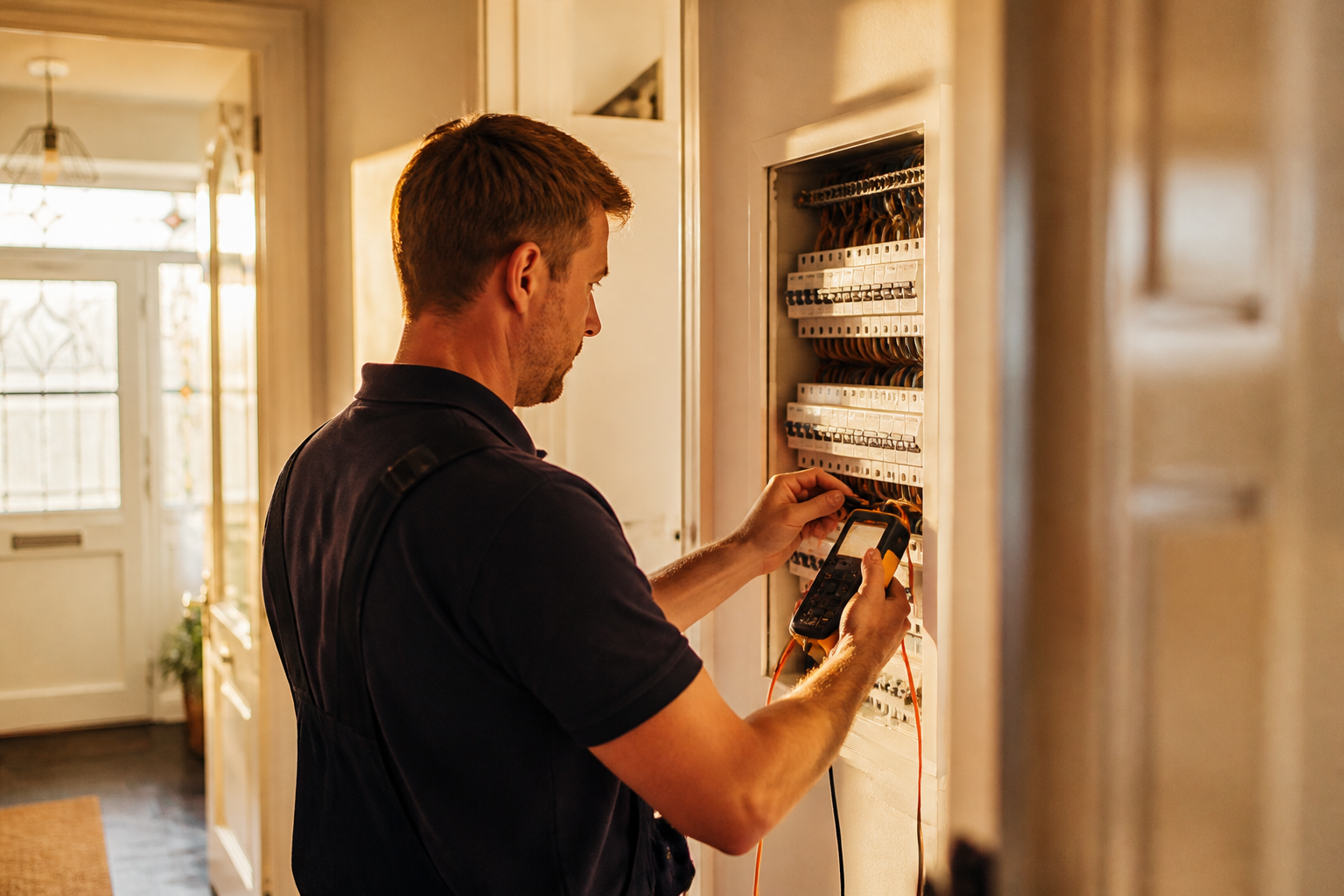
Before signing a contract or paying a deposit, your home must undergo two essential assessments: a structural evaluation of the roof and an electrical inspection of your incoming mains supply.
Roof integrity determines whether your tiles and timber rafters can support the additional weight. A standard solar array adds between 12 kg and 16 kg per square metre. Installers must check rafter dimensions, moisture levels and roof orientation. While south-facing roofs generate the maximum total annual kilowatt-hours (kWh), east-west splits have become increasingly popular because they produce power across a wider portion of the morning and evening, matching typical household routines.
Your electrical setup requires a clear check of the consumer unit (fuse box) and incoming main cut-out fuse. Older fuse boxes with rewireable fuses often require upgrading to a modern consumer unit fitted with residual current devices (RCDs) or arc fault detection devices (AFDDs) to meet BS 7671 wiring regulations.
Grid connection rules split into two distinct pathways depending on total export capacity:
- G98 Notification: Applies to systems where maximum AC export capacity is 3.68 kW or less per single-phase supply (equivalent to 16 amperes). Under G98, your accredited installer fits the system and notifies the local DNO within 28 days of commissioning. Prior permission is not required.
- G99 Application: Applies to systems exceeding 3.68 kW AC output per single-phase supply. The installer must submit a formal application to the DNO before any work begins on site. Approval takes between 4 and 11 weeks, depending on local transformer capacity and whether grid reinforcement is needed.
Evaluating installer quotes and required industry accreditations
Choosing a qualified installer protects both your household finances and your property value. Never rely solely on remote aerial photographs or online estimates; an accredited surveyor must inspect your loft space and consumer unit in person.
To ensure quality and maintain eligibility for export payments, verify that your installer holds valid accreditation with recognized industry bodies. The table below outlines the core standards and consumer protections you should look for on any written quote.
| Organisation | Accreditation Type | What It Protects or Guarantees |
|---|---|---|
| Microgeneration Certification Scheme (MCS) | Product & Installer Quality | Required to claim Smart Export Guarantee payments and ensure installation safety standards |
| Renewable Energy Consumer Code (RECC) | Consumer Protection Code | Covers deposit protection, clear pre-contractual information and fair trade practices |
| Home Insulation & Energy Systems (HIES) | Consumer Protection Scheme | Provides free dispute resolution, mediation and deposit insurance back-up |
| National Inspection Council for Electrical Installation Contracting (NICEIC) | Electrical Competency | Verifies compliance with BS 7671 wiring regulations and Part P building controls |
When reviewing written quotes, confirm that scaffolding, DNO application fees, structural calculations and MCS registration fees are included in the total price. Ask the installer specifically whether panel performance warranties (typically 25 years to 80% output) and inverter warranties (usually 5 to 10 years) are backed by third-party insurance.
Installation timeline and site setup from start to finish

From initial consultation to generating your first kilowatt-hour, a typical domestic solar installation takes between six and twelve weeks. The physical work on site takes only one to two days, but administrative preparation takes longer.
- Week 1 to Week 3: Initial site survey, structural assessment and quote sign-off. If your inverter rating exceeds 3.68 kW, your installer submits a G99 application to the local DNO.
- Week 4 to Week 8: Waiting for DNO G99 approval (if required). Scaffolding delivery is scheduled once grid approval is confirmed.
- Week 9 (Day 1): Scaffolding is erected around the roof perimeter. Installers fix roof hooks directly to timber rafters, attach aluminium mounting rails and run DC cabling into the loft space.
- Week 9 (Day 2): Solar panels are clamped onto the mounting rails. Inside the house, the electrician mounts the inverter and AC isolator switches, connects the array to your main consumer unit and tests earth fault protection.
- Post-Installation: The installer commissions the system, provides an MCS certificate, hands over safety documentation and submits the final G98 or G99 paperwork to the DNO.
What to watch over the coming months and years
Once your system is fully commissioned and registered on the MCS database, you can apply for a Smart Export Guarantee (SEG) contract or a commercial export tariff through your chosen energy supplier. Export rates vary widely across suppliers, currently ranging from around 5p to 15p per kWh, making it worthwhile to shop around once your smart meter registers export data correctly.
System maintenance for rooftop solar is minimal because rainwater cleans pitched panels naturally. However, monitoring your inverter's display or mobile application helps identify string outages or shading issues early. Inverters generally have a operational lifespan of 10 to 12 years, meaning you should budget for a single replacement during the 25-to-30-year lifetime of your solar array.
For businesses seeking to help employees lower home energy costs without adding company overheads, structured benefit schemes offer a straightforward route. At zero cost to the employer and with no payroll changes required, The Net Zero Home Scheme gives staff access to member pricing on solar panels and a battery installed by accredited contractors across England, Scotland and Wales. Delivered by the team behind The Electric Car Scheme and The Charge Scheme, the platform helps staff upgrade their homes with complete confidence.