Why Home Battery Round-Trip Efficiency Affects Savings
Round-trip efficiency losses cut into domestic battery savings. Learn how inverter physics, temperature, and coupling affect energy storage payback in the UK.
- Written by
- Net Zero Home Scheme editorial team
- Last updated
- Topic
- battery storage, energy efficiency, energy bills
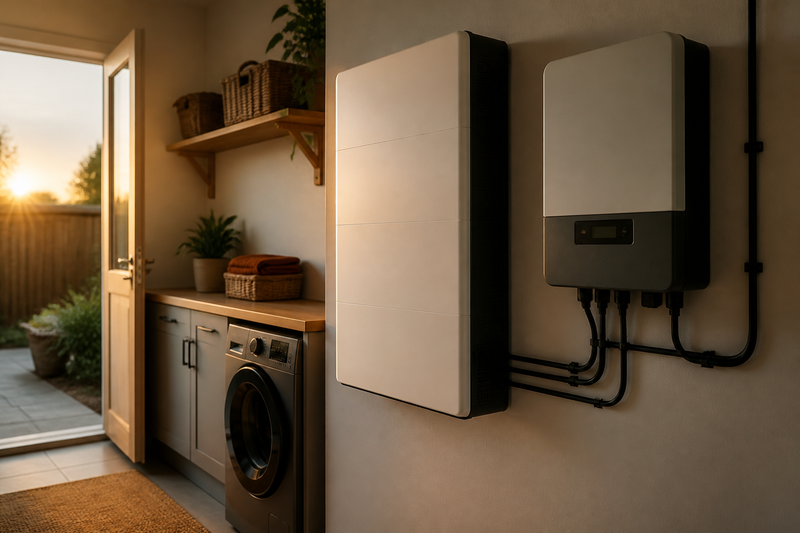
In November 2026, updated technical performance testing standards published by the Microgeneration Certification Scheme highlighted how real-world round-trip efficiency losses alter the payback calculations for domestic battery storage systems.
What is home battery round-trip efficiency?
Home battery round-trip efficiency is the percentage of electrical energy retrieved from a storage system compared to the total amount of energy used to charge it. When you supply electricity to a domestic battery, whether from rooftop solar panels or an off-peak grid tariff, not every kilowatt-hour of energy is successfully stored and subsequently delivered back to your home circuits. Electrical energy undergoes multiple physical transformations during the storage process, changing from alternating current (AC) supplied by the grid or solar inverter into direct current (DC) inside the battery cells, and then back into AC when powering home appliances.
Each stage of conversion generates energy loss, primarily released as low-grade heat. A battery system rated with an 85% round-trip efficiency delivers 8.5 kilowatt-hours (kWh) of usable electricity for every 10 kWh of power drawn from your supply. The remaining 1.5 kWh is lost during the electrochemical charge, standby power consumption, and thermal dissipation across internal electronics. Understanding this efficiency metric allows households to calculate realistic bill reductions, rather than assuming that every stored unit of power translates directly into displaced peak energy costs.
How much energy is lost during battery charging and discharging?
Most domestic battery systems lose between 10% and 22% of total throughput energy across a complete charge and discharge cycle. These losses stem from three distinct physical sources within the home energy setup: inverter conversion inefficiencies, electrochemical resistance within battery cells, and continuous background standby consumption from monitoring hardware.
Inverter efficiency dictates a substantial portion of overall system losses. In an AC-coupled setup, electricity generated by solar panels passes through a solar inverter to become AC power, enters a secondary battery inverter to convert back into DC for storage, and undergoes a third conversion back to AC when powering household lights or appliances. Each conversion step operates at approximately 94% to 97% efficiency under optimum load. Accumulating three separate conversion steps reduces net conversion efficiency to between 83% and 88%.
DC-coupled systems, which feed DC electricity directly from solar arrays into storage before converting to household AC through a single hybrid inverter, avoid one conversion step and typically achieve higher overall round-trip efficiencies of 90% to 94%. However, continuous parasitic power draw further reduces net efficiency. Battery Management Systems (BMS), Wi-Fi monitoring modules, and internal cooling circuits consume between 15 watts and 35 watts constantly. Over a 24-hour period, this background drain consumes 0.36 kWh to 0.84 kWh, which represents a noticeable percentage loss on smaller domestic battery capacities during low-use periods.
Why do battery losses change between summer and winter?
Battery efficiency decreases in colder conditions because low ambient temperatures increase internal electrochemical resistance and trigger automated heating circuits. Standards under PAS 63100 recommendations for safe domestic installation frequently specify locating battery enclosures in unheated spaces such as garages, outbuildings, or external walls. When ambient winter temperatures drop below 10°C, the chemical movement of lithium ions within Lithium Iron Phosphate (LFP) cells slows significantly.
To protect battery cell chemistry from degradation during cold weather, integrated thermal management systems direct internal power toward heating elements to bring cell temperatures up to safe charging thresholds, typically above 5°C. This heating process draws energy directly from the grid or stored capacity, lowering net round-trip performance. In sub-zero conditions, effective round-trip efficiency for external installations can drop by an additional 5% to 8% compared to operation at standard test conditions of 25°C.
Conversely, excessive summer heat presents operational trade-offs. When battery temperatures exceed 30°C during heavy charging or discharging, internal fans or passive heatsinks must dissipate thermal buildup. If internal temperatures rise higher, battery management software automatically throttles charge and discharge rates to safeguard internal components, extending cycle times and slightly increasing standby losses.
How do battery efficiency losses affect your annual energy bill?
Efficiency losses reduce net annual financial savings by increasing the total volume of off-peak electricity required to meet daily household power needs. To quantify this financial impact, consider a household storing energy on an off-peak tariff rate of 9p per kWh to displace daytime peak grid electricity costing 30p per kWh. Nominally, displacing 10 kWh of peak power suggests a gross daily saving of £2.10, derived from paying 90p for off-peak power instead of £3.00 for peak power.
Factoring in real-world round-trip efficiency changes the underlying economics. If the storage installation operates at an 80% effective round-trip efficiency due to AC coupling and winter standby losses, drawing 10 kWh of usable power requires purchasing 12.5 kWh of off-peak electricity from the grid. The cost to charge the battery rises from 90p to £1.13 per cycle, narrowing the net daily margin to £1.87.
The following comparison illustrates how different storage configurations and round-trip efficiencies impact annual input requirements and lost financial value for a system supplying 10 kWh of daily usable household electricity:
| System Configuration | Nominal Round-Trip Efficiency | Daily Usable Output | Daily Grid Input Required | Annual Cost of Energy Lost (at 9p/kWh Off-Peak) |
|---|---|---|---|---|
| High-efficiency DC Hybrid (LFP) | 92% | 10.0 kWh | 10.87 kWh | £28.58 |
| Standard AC-Coupled (LFP) | 85% | 10.0 kWh | 11.76 kWh | £57.82 |
| Retrofit AC-Coupled (Low Temp Garage) | 78% | 10.0 kWh | 12.82 kWh | £92.64 |
| Older NMC Battery Architecture | 81% | 10.0 kWh | 12.35 kWh | £77.20 |
Over a ten-year operational lifetime, the difference in conversion performance between an optimized 92% efficient setup and a 78% cold-exposed retrofit represents over £640 in cumulative unrecovered electricity costs. While storage systems still generate substantial positive financial returns by shifting energy consumption away from high peak rates, selecting equipment with high conversion metrics minimizes these invisible operational costs.
"Understanding round-trip efficiency allows households to form accurate expectations about domestic energy storage before investing. While battery storage remains a proven tool for shifting energy consumption away from peak rates, hardware selection and physical placement directly dictate real-world return on investment. Clear technical guidance empowers householders and workforce teams to maximize their household savings."
Gaurav Ahluwalia, General Manager, The Net Zero Home Scheme
What should you check before installing a home battery?
Before installing a home battery, you should check the independent MCS certificate for confirmed round-trip efficiency ratings, review the inverter topology, and verify that the intended installation location minimizes temperature extremes. Checking data sheets for standalone cell efficiency is often misleading, as cell metrics exclude the essential conversion losses from inverters and ongoing standby draw. Always look for system-level efficiency figures evaluated across realistic charge and discharge rates.
Location planning forms another critical factor. Installing battery hardware inside an insulated wall envelope or an enclosed garage maintaining temperatures between 10°C and 20°C helps preserve optimal chemical performance without triggering energy-intensive internal heating elements. Ensure your installer is accredited under MCS, TrustMark, and Renewable Energy Consumer Codes (RECC) standards, ensuring that cable runs, inverter matching, and safety clearances adhere to British regulations.
As employee demand for help with domestic energy bills continues to grow, joining The Net Zero Home Scheme gives staff member pricing of up to 15% off solar panels and a battery on your roof installed by accredited installers. The scheme costs nothing for employers to set up and involves no salary sacrifice or payroll adjustments.