Solar Microinverters vs String Inverters: Physics and Economics
An in-depth guide to the physics, shading performance, installation costs and long-term trade-offs between microinverters and central string inverters for UK homes.
- Written by
- Net Zero Home Scheme editorial team
- Last updated
- Topic
- solar, energy efficiency, regulation
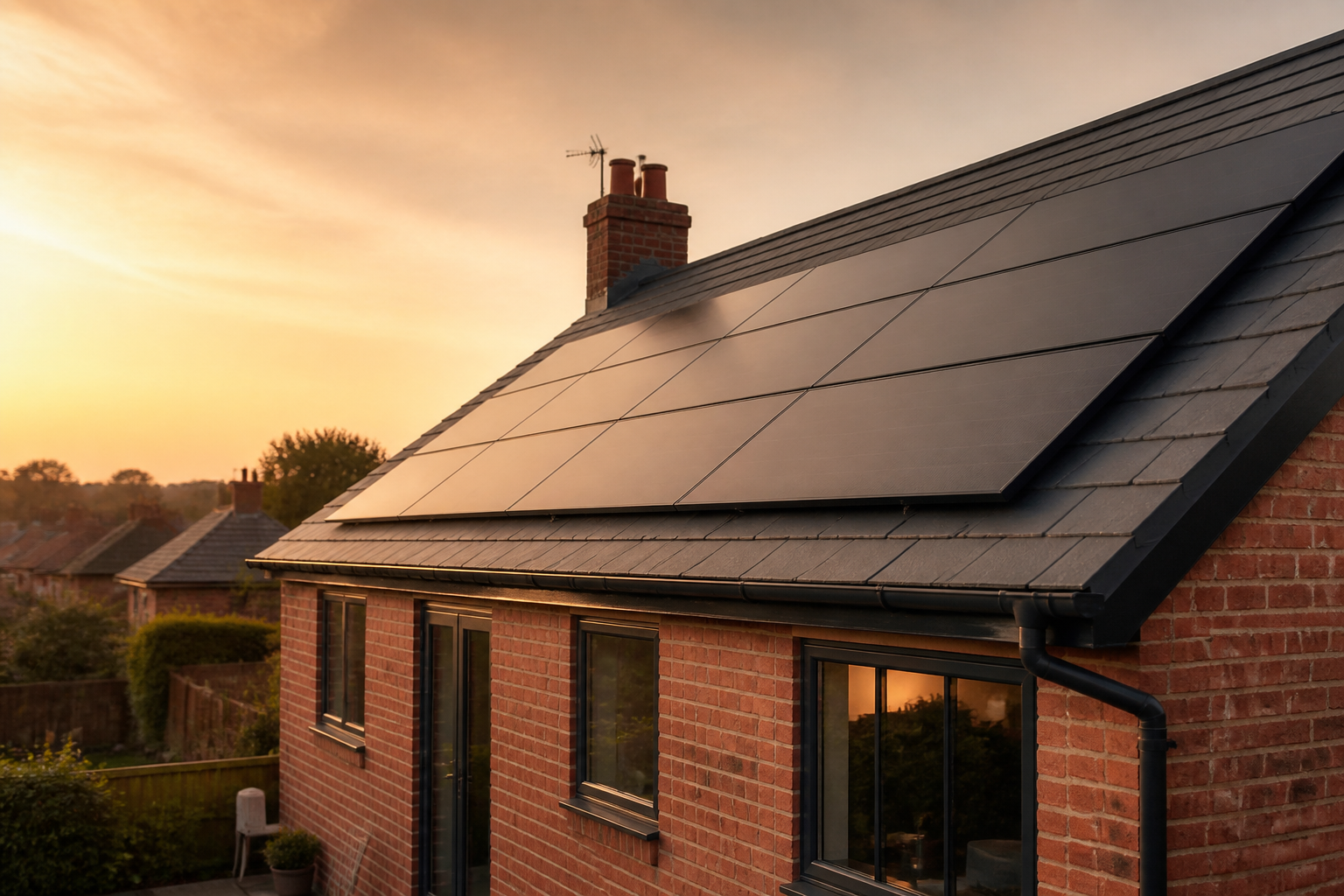
When installing a domestic solar photovoltaic (PV) system, one of the primary architectural decisions is how to convert the direct current (DC) generated by your roof panels into alternating current (AC) used by your home appliances and exported to the electricity grid. Traditionally, solar panels are wired together in series to form a string that connects to a single, central string inverter usually mounted in a loft or garage. Alternatively, microinverters sit directly behind individual panels on the roof, converting power at the module level.
Choosing between these two technologies involves clear trade-offs in electrical physics, energy yield, upfront capital expenditure and long-term maintenance. Understanding how panel stringing operates under real-world British weather conditions helps clarify which approach delivers the best economic return for your roof layout.
How MPPT physics and shading mismatch affect solar output
To understand why inverter selection matters, it helps to examine how solar panels behave under uneven light conditions. Every solar panel has a non-linear current-voltage characteristic. To extract maximum power, an inverter uses Maximum Power Point Tracking (MPPT) algorithms to continually adjust the electrical load so the panel operates at its peak efficiency point.
In a traditional string inverter system, multiple solar panels (typically 6 to 16 panels per string) are connected in series. Because current flowing through a series circuit is constrained by the weakest point, the power output of the entire string can drop significantly if even a single panel experiences partial shading from a chimney, dormer window, tree branch or passing cloud. While modern solar panels include bypass diodes to divert current around completely shaded cells, this mechanism reduces string voltage and operates as a crude, stepped correction rather than a precise optimization.
Microinverters resolve this mismatch by giving every single panel its own independent MPPT controller. If a chimney casts a shadow across two panels on a ten-panel roof, the remaining eight panels continue to produce 100% of their available power, unaffected by the drop in current across the shaded modules. Field testing published by the National Renewable Energy Laboratory shows that individual module-level power electronics can recover 5% to 15% of annual energy yield on roofs affected by complex, dynamic shading compared to standard single-string configurations.
System efficiency, clipping and thermal stress
While microinverters outperform string systems under partial shade, central string inverters retain a minor efficiency advantage under uniform, unobstructed sunlight.
Central string inverters operate at higher DC voltages (often between 200V and 600V DC), where modern silicon carbide power electronics achieve peak conversion efficiencies between 97% and 98.5%. Microinverters operate at lower module-level voltages (typically 30V to 60V DC), stepping power up to 230V AC across smaller internal components, resulting in a slightly lower peak efficiency between 96.5% and 97.5%.
Another factor is the DC to AC sizing ratio, commonly referred to as inverter clipping. Installers often pair an array of solar panels rated at 4.4 kWp total output with a 3.68 kW inverter to match the UK G98 grid notification threshold. On clear summer days, panel output may exceed the AC power cap of the inverter, causing excess potential power to be clipped. String inverters manage array clipping centrally across all panels, whereas microinverter systems manage clipping on a panel-by-panel basis according to each microinverter's individual power cap.
Thermal stress also behaves differently across the two designs. Microinverters are mounted under the solar panels on the roof surface. In peak summer, roof temperatures can exceed 50°C, exposing microinverter power electronics to elevated operating temperatures that gradually accelerate component degradation. Loft-mounted string inverters benefit from cooler ambient conditions, provided the space is adequately ventilated.
Battery storage compatibility and electrical safety
Integrating home battery storage introduces further trade-offs between the two inverter architectures.
String inverter systems easily support DC-coupled batteries. In a DC-coupled design, power generated by the solar panels feeds directly into the battery via a hybrid inverter without undergoing AC conversion first. This keeps round-trip storage efficiency high, typically losing only 3% to 5% during charge and discharge cycles.
Because microinverters convert DC to AC directly at the roof level, any connected battery must be AC-coupled. Power generated by the solar panel is converted to 230V AC, travels down the building wall, and is then rectified back to DC by a separate battery inverter to charge the cells. When the battery discharges into the home, power is converted to AC a second time. This double conversion process introduces an additional 4% to 8% energy loss over the full cycle.
However, microinverters offer significant advantages in domestic electrical safety. By converting DC to AC on the roof, high-voltage DC wiring inside the dwelling is completely eliminated. Standard residential AC cabling runs from the roof to your consumer unit, reducing arc-fault risks and simplifying compliance with BS 7671 wiring regulations and MCS installation guidelines.
| Feature | Central String Inverter | Solar Microinverters |
|---|---|---|
| Conversion Location | Central wall/loft location | Behind each individual panel |
| Maximum Voltage | Up to 600V DC inside home | 230V AC down wall, low DC on roof |
| Shading Mismatch Loss | High (entire string affected) | Very low (isolated to shaded module) |
| Peak Hardware Efficiency | 97.0% to 98.5% | 96.5% to 97.5% |
| Standard Warranty | 5 to 12 years | 25 years |
| Typical Replacement Cost | £800 to £1,500 (inverter only) | £150 to £250 per unit + roof access |
| Battery Integration | DC-coupled or AC-coupled | AC-coupled only |
Economics, warranties and maintenance trade-offs
For an average 4 kWp UK domestic system (approx 10 panels), a standard string inverter installation typically adds £800 to £1,200 in inverter equipment costs. Equipping the same array with individual microinverters adds roughly £1,500 to £2,100 in hardware costs, representing an upfront premium of £700 to £900.
The economic evaluation changes when factoring in hardware lifespans and replacement cycles. Central string inverters generally carry manufacturer warranties of 5 to 10 years (extendable to 12). Over a solar array's 25 to 30 year operational lifetime, a homeowner should budget for at least one full string inverter replacement, costing between £800 and £1,500 including electrician labour.
Microinverters (such as those manufactured by Enphase) typically come with 25-year performance warranties, matching the degradation lifetime of the solar panels themselves. If a single microinverter fails after 12 years, only that specific panel stops generating power, while the rest of the array continues operating. However, replacing a microinverter requires an installer to access the roof, remove the solar panel, swap the unit, and refit the panel, which incurs higher scaffolding or access costs than swapping a loft-mounted inverter.
What this means for you
If your roof faces due south with a uniform pitch, no tree shade, and no architectural obstructions like chimneys or dormers, a standard central string inverter remains the most cost-effective option. The higher conversion efficiency and lower upfront capital cost deliver a slightly faster payback period.
If your installation spans multiple roof orientations (such as an East-West split), suffers from variable shading throughout the day, or involves a complex layout across multiple roof faces, microinverters offer clear performance advantages. The isolated MPPT tracking prevents shading from dampening system-wide yield, fully recovering the higher initial equipment expenditure over the system's life.
If your employer offers access to the Net Zero Home Scheme, you can explore member pricing on accredited solar PV and storage installations to find an architecture tailored to your home's roof pitch and budget.
Frequently asked questions
Are microinverters worth the extra cost on an unshaded south-facing roof?
On an completely unshaded roof with a single orientation, microinverters rarely generate enough additional electricity to justify their higher upfront hardware cost. A high-efficiency central string inverter will typically deliver equal or slightly superior overall yield at a lower initial capital spend.
Can I monitor individual panel performance with a string inverter?
Standard string inverters only measure total output for the entire string. To achieve panel-level monitoring on a string system, you must add individual DC power optimisers (such as SolarEdge or Tigo devices) behind each panel, which adds hardware cost similar to a microinverter system.
What happens to a microinverter system if the grid drops power?
Like standard string inverters, standard microinverters are required by UK grid regulation G98 to shut down instantly during a mains power cut to prevent backfeeding power into the external electricity network (a safety mechanism called anti-islanding). Continuous operation during grid outages requires specialized islanding control gear and an AC-coupled battery system.
Sources
- Microgeneration Certification Scheme (MCS) Installation Standards, MCS
- BS 7671 Requirements for Electrical Installations, Institution of Engineering and Technology