Britain Begins £150bn Grid Upgrade to Connect Clean Power
A £150bn electricity grid overhaul aims to expand transmission capacity fivefold by 2030, though short-term network levies will impact household energy bills.
- Written by
- Net Zero Home Scheme editorial team
- Last updated
- Topic
- policy, energy bills, solar
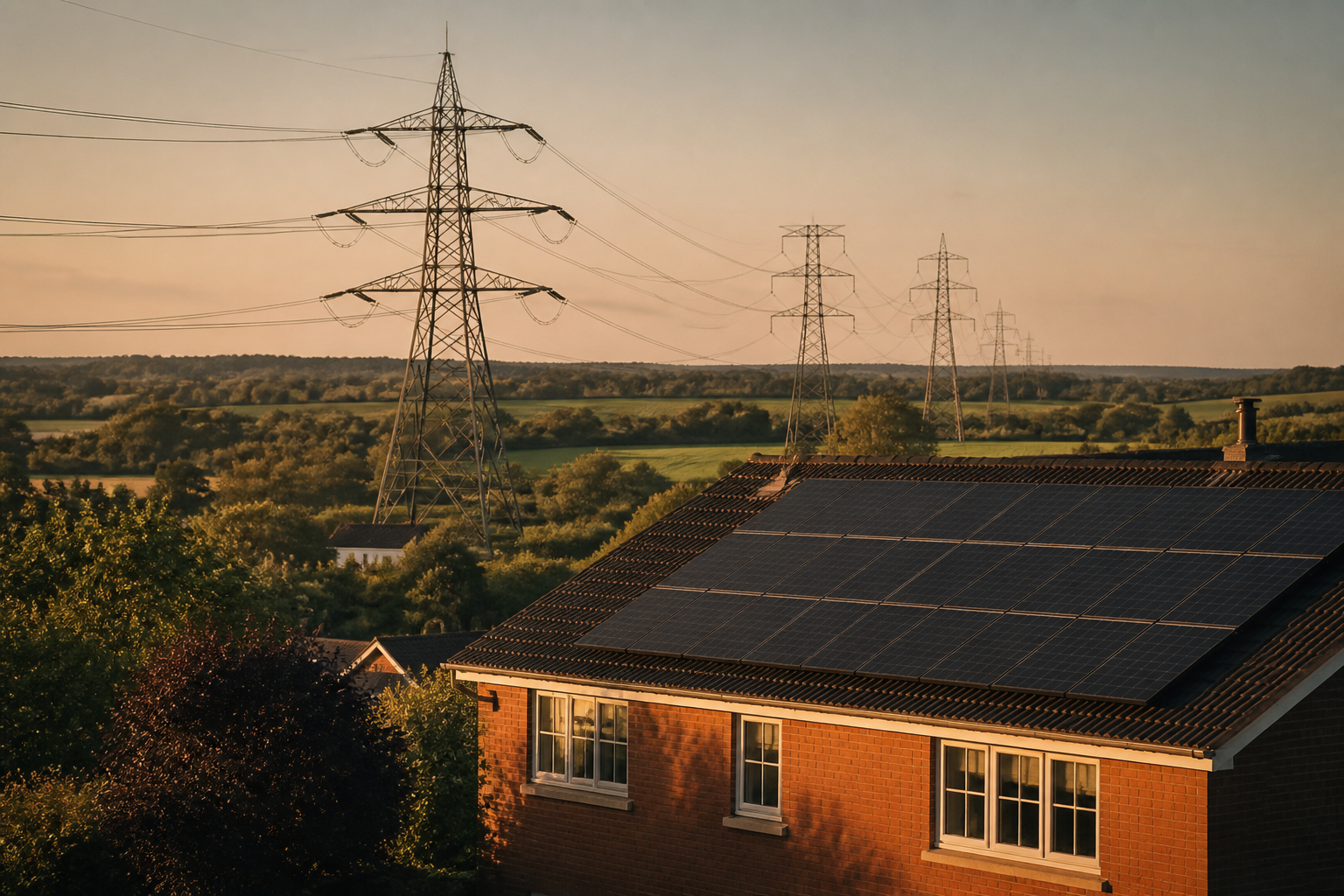
On 13 September 2026, The Guardian reported that Britain has embarked on a £150bn overhaul of its national electricity grid, representing the largest infrastructure expansion in generations. The project aims to construct five times more grid infrastructure by 2030 than was built in the previous three decades combined.
The development involves installing thousands of miles of new overhead power lines, subsea cables, and high-voltage converter stations across England, Scotland, and Wales. However, reporting published by The Guardian on 13 September 2026 highlights that funding this rapid capital buildout will increase household energy bills in the short term, even as it aims to protect consumers from international fossil fuel price shocks over the long term.
What the £150bn grid upgrade involves
The scale of the grid expansion reflects a fundamental shift in where Great Britain generates its electricity. Historical power networks were built to move electricity from concentrated coal and gas power stations located near major industrial population centres. Modern generation relies increasingly on wind power in Scotland and off the east coast of England, alongside distributed solar farms across southern and central regions.
To move power from rural generation sites to towns and cities, transmission operators must build massive new high-voltage links. Key components of the overhaul include:
- High-voltage direct current subsea cables running along the east and west coasts of Great Britain.
- Upgraded overland pylon corridors across Scotland, northern England, and Wales.
- New converter stations to transform high-voltage direct current into alternating current for local networks.
- Substation reinforcements to connect offshore wind farms and utility-scale battery storage facilities.
Without these transmission upgrades, energy networks suffer from severe bottlenecks. Grid operators frequently pay generation companies to turn off renewable generators when regional lines reach capacity, a cost known as curtailment or constraint payments. Operators then pay gas-fired power plants closer to cities to ramp up production to fill the gap. These constraint payments are added directly to consumer bills through network charges, which currently form a substantial portion of standard variable electricity tariffs regulated by Ofgem.
What the numbers say
Data reported by The Guardian on 13 September 2026 sets out the financial scale and physical requirements of the nationwide grid expansion.
| Metric | Figure Reported | Source & Date |
|---|---|---|
| Total Infrastructure Investment | £150 billion | The Guardian, 13 September 2026 |
| Target Completion Horizon | 2030 | The Guardian, 13 September 2026 |
| Infrastructure Build Rate vs Past 30 Years | 5x speed of previous three decades | The Guardian, 13 September 2026 |
| Planned Cable & Line Length | Thousands of miles | The Guardian, 13 September 2026 |
These figures demonstrate that while long-term system costs may stabilize once clean power replaces expensive gas generation, the capital expenditure phase requires substantial upfront funding. Because network infrastructure costs are recovered through network charges on utility bills, household standing charges and unit rates are expected to reflect these investment levies over the coming years.
Why grid bottlenecks affect domestic energy costs
Household electricity tariffs consist of wholesale energy costs, network charges, policy levies, and operating margins. Network charges pay for the maintenance and expansion of National Grid's transmission system and local distribution networks.
When transmission capacity lags behind renewable generation capacity, the financial penalties fall on consumers. In recent years, grid constraint payments have cost billpayers hundreds of millions of pounds annually. By spending £150bn to rebuild transmission links, grid operators aim to eliminate these bottleneck costs.
However, during the construction phase between 2026 and 2030, network companies are permitted by regulator Ofgem to recoup capital spending through bill surcharges. As a result, householders face a period where short-term network levies increase before the long-term cost benefits of low-cost renewable generation are fully realised.
How local generation mitigates transmission delays
For individual households, central grid bottlenecks illustrate the financial advantage of generating and consuming electricity on-site. When electricity is produced on a home roof and stored in a home battery, it avoids transmission network charges entirely.
- Rooftop Solar PV: A standard 4 kWp domestic solar array produces electricity directly at the point of consumption, bypassing the high-voltage grid.
- Home Battery Storage: Installing a battery, such as a 5 kWh or 10 kWh unit, allows households to store daytime solar output or charge from cheap off-peak domestic tariffs for use during peak evening hours.
- Smart Export Tariffs: Under Microgeneration Certification Scheme (MCS) rules, householders who generate surplus power can export it back to the local distribution network, receiving payments via the Smart Export Guarantee (SEG) or flexible supplier tariffs.
By generating clean energy locally, households reduce their exposure to rising network levies and standing charges associated with central grid upgrades.
Frequently asked questions
Why are grid upgrades paid for through domestic energy bills?
Under UK energy regulation enforced by Ofgem, network operators recover the capital costs of building pylons, subsea cables, and substations by levying network charges on energy suppliers. Suppliers pass these costs on to domestic and commercial customers within standard electricity tariffs and standing charges.
How long will the £150bn grid construction project take?
According to reporting by The Guardian on 13 September 2026, the current phase of grid expansion is scheduled to run through 2030. During this period, five times more transmission infrastructure will be constructed across Great Britain than was delivered over the previous 30 years.
Can home solar and batteries reduce exposure to grid costs?
Yes. Electricity generated by domestic solar panels and consumed within the home avoids national network charges and supply chain markups. Adding a home battery allows householders to maximize self-consumption and shift grid demand to off-peak periods when network charges are lower.
What this means for your home
For UK householders, the £150bn grid expansion signals that utility electricity bills are unlikely to fall significantly in the immediate term due to incoming network capital levies. To minimize exposure, residents can take several practical steps:
- Evaluate Rooftop Solar: Installing an MCS-certified solar PV array reduces the volume of grid electricity a household must buy at retail rates.
- Pair Solar with Storage: Adding home battery storage increases self-consumption of generated electricity, protecting against evening peak prices and rising standing charges.
- Explore Clean Heating Options: Transitioning to an efficient heat pump with a Seasonal Coefficient of Performance (SCOP) above 3.5 helps lower overall home energy demand, especially when paired with local solar generation.
- Monitor Tariffs: Review half-hourly or smart export tariffs to ensure any surplus power fed back into the local network receives competitive remuneration.
What this means for employers
Rising household energy costs driven by infrastructure levies place continued financial pressure on working families across England, Scotland, and Wales. HR, reward, and sustainability leaders are increasingly looking for practical benefits that help staff reduce ongoing household expenses without increasing corporate overheads.
Providing employees with access to home energy retrofits allows staff to generate their own power and shield their budgets from grid price fluctuations. Through the Net Zero Home Scheme, employers can offer their workforce member pricing on accredited installations of solar panels, heat pumps, battery storage, and plug-in solar systems, delivered across Great Britain at zero cost to the employer and with no payroll integration required.