Upgrading Your Consumer Unit for Solar, Heat Pumps and EVs
A practical guide to checking your fuse box, cut-out fuse, BS 7671 wiring rules and DNO steps before installing solar, heat pumps or home batteries.
- Written by
- Net Zero Home Scheme editorial team
- Last updated
- Topic
- home energy, regulation, ev charging
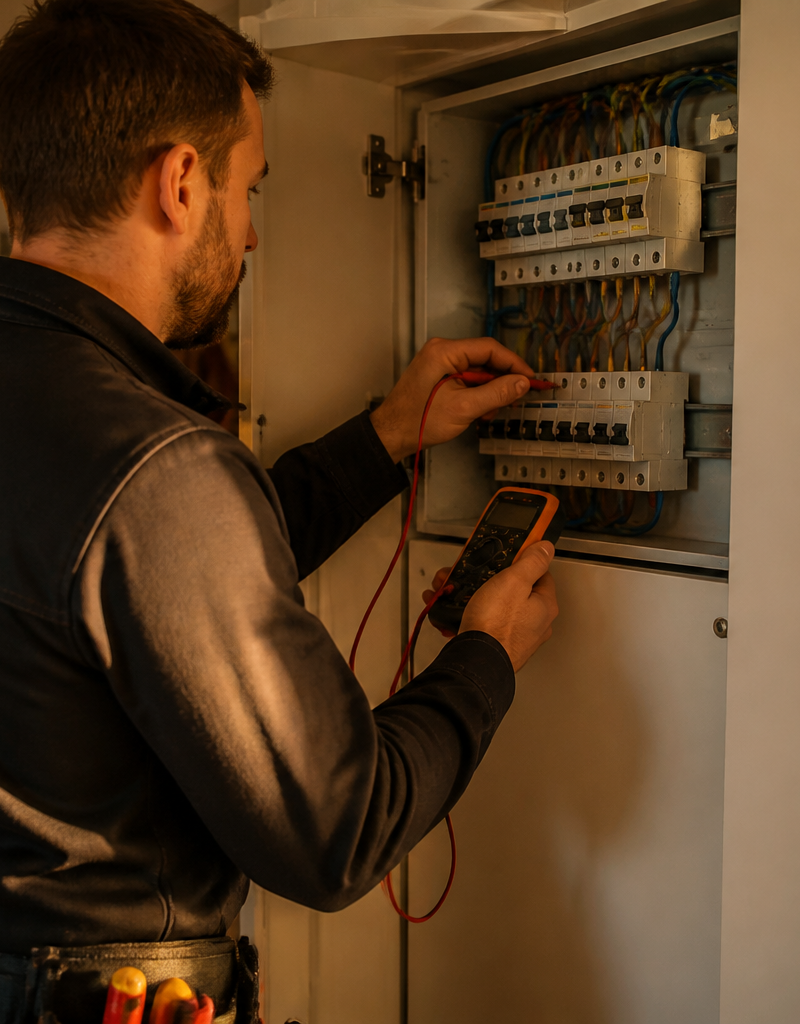
When you plan to install a heat pump, solar PV array, home storage battery or electric vehicle (EV) charger, the first physical barrier you might encounter is not on your roof or in your garden, but inside your electricity meter cupboard. Your consumer unit, commonly known as a fuse box, distributes power throughout your house and protects your wiring from overloads and electrical faults. Older UK consumer units were designed for lighting, cooking and standard household appliances, not for continuous high-load draws or two-way energy flows.
Upgrading your consumer unit ensures your domestic electrical system safely accommodates modern clean energy hardware while meeting current UK building and wiring regulations.
Assessing your current electrical setup and cut-out fuse
Before signing a contract for a heat pump or solar installation, you must audit your electrical intake point.
Checking main fuse capacity
Your property receives electricity through a service cable ending in a main cut-out fuse sealed by your Distribution Network Operator (DNO). In older UK homes, this fuse is often rated at 60 amps (A). Modern low-carbon tech adds significant continuous demand. A typical 7 kW EV wallbox draws 32 A, an 8 kW heat pump compressor can draw up to 16 A, and domestic power circuits run alongside them. If your maximum demand exceeds 60 A, your electrician must request a cut-out fuse upgrade to 80 A or 100 A from your local DNO (such as National Grid Electricity Distribution, UK Power Networks, or SSEN).
Evaluating consumer unit space and condition
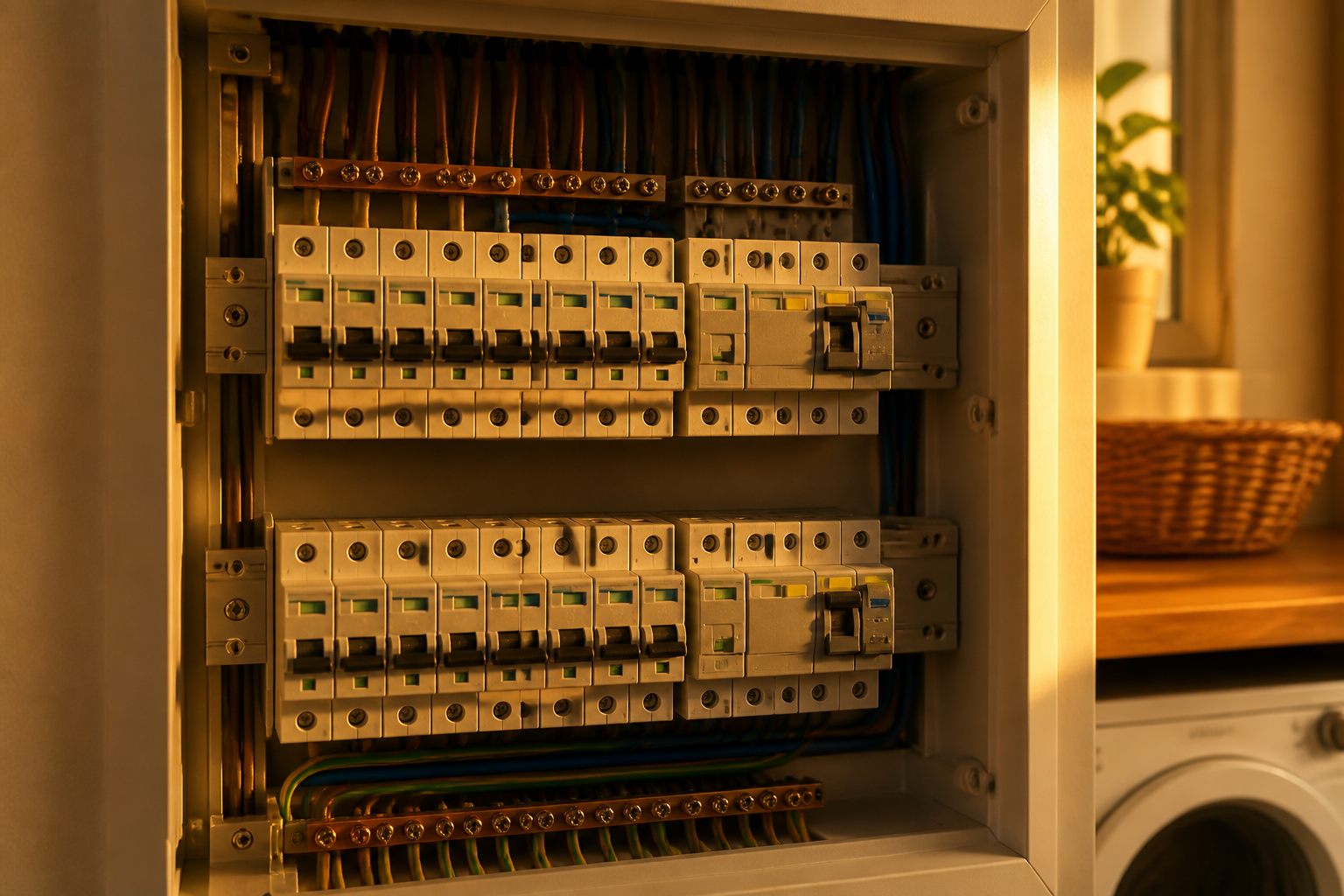
A modern heat pump, battery inverter, solar PV system or EV charger requires its own dedicated circuit breaker. If your current board has no spare usable ways, uses old re-wireable fuses, cast-iron or wooden enclosures, or lacks residual current device (RCD) protection, a full board replacement is necessary. Modern consumer units must feature a non-combustible metal enclosure under BS 7671 Regulation 421.1.201.
Key BS 7671 requirements for clean energy tech
The 18th Edition of the IET Wiring Regulations (BS 7671:2018+A2:2022) sets strict safety rules for low-carbon electrical installations.
RCD selection and DC residual currents
Standard Type AC RCDs, once common in UK homes, only detect alternating current faults. Solar inverters, battery storage systems and EV chargers contain power electronics that can produce direct current (DC) residual leakage. This DC component can blind a Type AC RCD, preventing it from tripping during a dangerous earth fault. Consequently, installations with power electronics require Type A RCDs as a minimum, or Type B RCDs where smooth DC fault currents above 6 milliamperes (mA) are possible.
Surge Protection Devices (SPD)
Amendment 2 of BS 7671 requires Surge Protection Devices (SPDs) in most domestic consumer unit replacements. SPDs protect sensitive electronics inside heat pump microprocessors, solar inverters and battery control units against transient overvoltages caused by lightning strikes or grid switching events.
Bidirectional circuit breakers
Traditional Miniature Circuit Breakers (MCBs) and Residual Current Breakers with Overcurrent protection (RCBOs) are designed for power flowing in one direction, from the grid into your home. Solar PV arrays and battery storage export power back toward the consumer unit and grid. Installing standard unidirectional RCBOs on export circuits can lead to internal damage or failure to trip under fault conditions. Electricians must install certified bidirectional RCBOs on all power-generating or battery storage circuits.
Costs and DNO notification steps
Upgrading a domestic consumer unit involves both hardware costs and regulatory notifications.
Typical equipment and labour costs
A standard 10-way to 14-way metal consumer unit fitted with individual bidirectional RCBOs and an integral Type 2 SPD typically costs between £600 and £1,200 including labour, testing and VAT. If your installation requires supply tails to be upgraded from 16 mm² to 25 mm², or an isolated main switch fitted by your energy supplier, budget an additional £100 to £250.
DNO notifications and un-looping
Under Energy Networks Association (ENA) rules, adding high-demand appliances requires notification to your DNO:
- G98: Solar and battery export under 3.68 kW per phase requires a simple Connect and Notify submission within 28 days of commissioning.
- G99: Systems exceeding 3.68 kW require prior approval from the DNO before installation can begin.
- EV and Heat Pump Notification: Installers must complete the ENA joint notification process to verify grid capacity.
If your service cable is looped (shared with a neighbouring property), your DNO must un-loop the cable before you can install high-load devices. DNOs in England, Scotland and Wales generally perform main fuse upgrades and cable un-looping free of charge, though lead times vary from 2 to 8 weeks.
Practical consumer unit upgrade checklist
| Step | Requirement or Standard | Typical Cost | Realistic Timescale |
|---|---|---|---|
| Initial Electrical Audit | Inspection of cut-out fuse, earth bond, and board space | Free or £80,£150 | 1 to 2 hours |
| DNO Fuse Upgrade | Request 80A or 100A fuse upgrade or un-looping from local DNO | Free of charge from DNO | 2 to 6 weeks lead time |
| Supplier Meter Isolator | Fitting a double-pole isolator switch before consumer unit | Free to £150 via supplier | 1 to 3 weeks lead time |
| Board Replacement | Metal enclosure, Type A or B RCBOs, Type 2 SPD to BS 7671 | £600 to £1,200 fully installed | 4 to 8 hours on site |
| Part P Certification | Electrical Installation Certificate (EIC) and building control notice | Included in electrician fee | Issued within 14 days |
What to ask your electrician or installer
When obtaining quotes for an electrical board upgrade alongside your new home energy technology, ask these key questions:
- Are you registered with a competent person scheme? Verify that your electrician holds membership with NICEIC, NAPIT, or the ECA. This allows them to self-certify compliance with Part P of the Building Regulations in England and Wales.
- Will you install bidirectional RCBOs on solar and battery circuits? Ensure the quote specifies bidirectional protection devices rather than cheaper unidirectional components.
- Does the price include a full Electrical Installation Certificate (EIC)? You will need an official EIC and Building Regulations compliance certificate to validate your home insurance and complete MCS accreditation for solar or heat pumps.
- Who arranges the DNO notification and meter isolator? Confirm whether your electrician will handle the DNO paperwork or if you need to contact your supplier directly for an isolator switch.
Realistic installation timeline
Planning ahead prevents delays when adding clean energy technologies to your home:
- Weeks 1 to 2: Complete an electrical assessment. If your cut-out fuse is 60 A or your supply is looped, submit your upgrade request to your DNO immediately.
- Weeks 3 to 4: Contact your electricity retailer to request a double-pole main isolator switch if your meter setup lacks one.
- Week 5: Your electrician installs the new metal consumer unit, fits bidirectional RCBOs and SPDs, upgrades main earthing bonds to 10 mm² if required, and tests all circuits.
- Week 6: The primary technology installer (solar, heat pump, or EV wallbox) connects to the newly prepared consumer unit, submits ENA notifications, and completes commissioning.
Frequently asked questions
Do I need a new consumer unit before installing solar panels or a heat pump?
If your current consumer unit has spare ways, modern RCD protection, a non-combustible metal casing, and correct cable sizing, you may only need to add dedicated bidirectional RCBOs. However, if your board is full, uses plastic enclosures without RCDs, or lacks surge protection, a complete consumer unit upgrade is required to meet BS 7671 safety standards.
Will my DNO charge me to upgrade my 60A main fuse to 100A?
In most cases across England, Scotland and Wales, Distribution Network Operators upgrade service cut-out fuses from 60 A to 80 A or 100 A free of charge, provided the existing service cable is physically capable of carrying the higher load. If the service cable requires excavation or structural repair, fees may apply, but standard fuse replacements are complimentary.
What is a bidirectional RCBO and why is it required for home batteries and solar?
A bidirectional RCBO is an electrical protection device capable of safely detecting overcurrents and earth faults regardless of whether power flows from the grid into the house or from solar panels and batteries back toward the grid. Standard unidirectional RCBOs can overheat or fail to trip when subjected to reverse power flow, making bidirectional devices mandatory under BS 7671 for generating assets.
What this means for you
Upgrading your consumer unit is a crucial foundational step that ensures your home energy hardware operates safely, legally, and reliably for decades. By checking your cut-out fuse early, selecting certified installers, and installing bidirectional protection devices, you protect your property against electrical faults and clear the way for seamless technology installation. If you are exploring clean energy upgrades at work, the Net Zero Home Scheme offers UK employees access to member pricing on accredited solar, heat pump, battery storage and plug-in solar installations delivered by Net Zero Benefits alongside The Electric Car Scheme.