Replacing a Combi Boiler With a Heat Pump: UK Retrofit Guide
A step-by-step UK guide to swapping a gas combi boiler for a heat pump, covering cylinder space, water flow rates, installer checks, costs and realistic project timelines.
- Written by
- Net Zero Home Scheme editorial team
- Last updated
- Topic
- heat pumps, home energy, energy efficiency
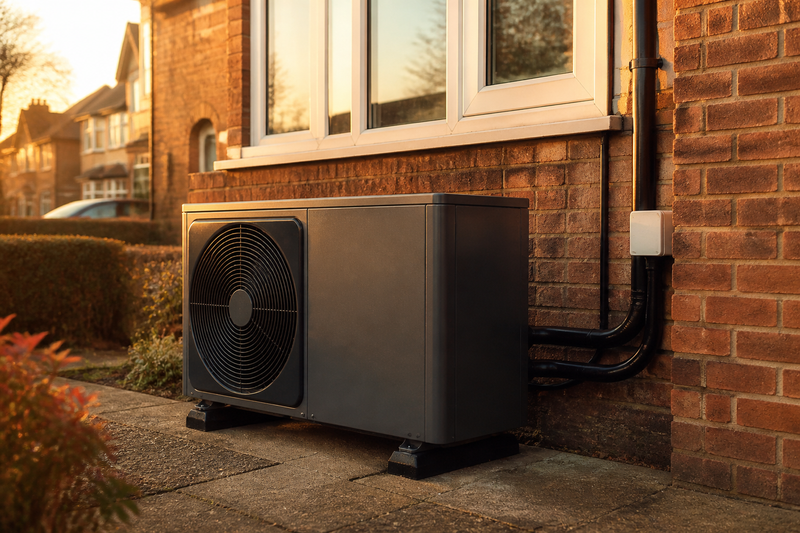
In a three-bedroom 1950s semi-detached house in Solihull, Marcus and Elena are looking at an eight-year-old gas combi boiler tucked inside their kitchen cupboard. Like roughly fifteen million households across England, Scotland and Wales, their home produces domestic hot water instantly on demand without a storage tank. As their thoughts turn to cutting heating emissions and running costs, they face the central puzzle of swapping a combi unit for clean electric heating: where to put the new hot water cylinder, and how to adapt existing pipework without tearing their home apart.
To understand how this transition works in practice, we follow Marcus and Elena through each stage of their retrofit as a realistic hypothetical illustration. Their experience highlights the technical hurdles, practical choices, installer standards and timelines that any householder with a combi boiler should expect.
Checking your incoming water pressure and cylinder space
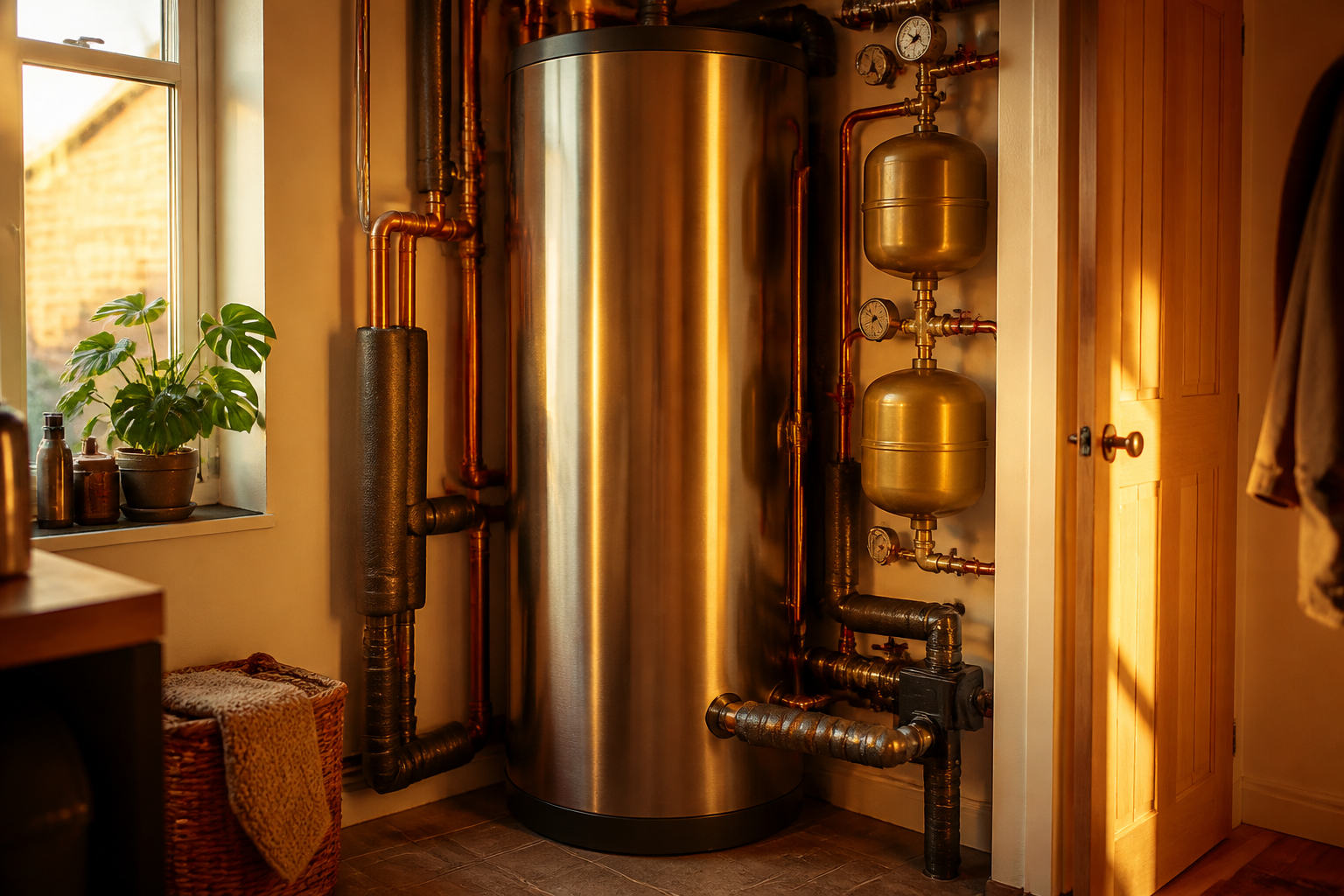
The fundamental difference between a combi boiler and an air source heat pump lies in hot water storage. Gas combis burn fuel at high temperatures to heat cold mains water instantly, whereas heat pumps work far more efficiently by gently warming water over several hours and storing it in an insulated cylinder.
Before spending money on detailed surveys, Marcus and Elena first checked their incoming cold water mains supply. An unvented hot water cylinder relies entirely on incoming water pressure to push hot water out of your taps and showers. You can test your flow rate using a measuring jug and a stopwatch at an outside tap or kitchen sink. A viable unvented system generally requires an incoming dynamic flow rate of at least fifteen litres per minute, alongside a resting water pressure above 1.5 bar.
The next step involved finding roughly 0.6 square metres of floor space with sufficient vertical clearance for a 150 to 200 litre cylinder. Because their home never had a traditional airing cupboard, Marcus and Elena evaluated three realistic locations:
- The back of an integrated garage, which keeps pipework runs short if the outdoor heat pump sits just outside.
- An under-stairs storage cupboard, which requires careful routing for expansion pipes and electrical supplies.
- A boarded loft, which requires structural floor reinforcement and secondary drainage trays to satisfy building regulations.
Marcus and Elena chose the garage, allowing direct pipe connections through the external wall while preserving storage space inside their living areas.
Room heat loss calculations and pipework checks
Many householders worry that a heat pump cannot warm a home designed around high-temperature gas heating. The decisive factor is not the age of the property, but how accurately an installer calculates room-by-room heat loss.
A thorough heat pump assessment begins with an on-site survey following the MCS design standard MIS 3005. Rather than using crude estimates based on room volume, the surveyor measures every external wall, window pane, door and ceiling layer to determine heat demand in watts at design temperatures of minus three degrees Celsius.
For Marcus and Elena, the total design heat loss came to 6.2 kilowatts. Their existing central heating pipework used standard fifteen-millimetre copper feeds connected to twenty-two-millimetre central distribution trunks. This pipe diameter easily carried the necessary water flow rates without causing noisy circulation or excessive pump strain.
Four of their ten steel panel radiators were single-panel units sized for older seventy-degree boiler water. To run the heat pump at a flow temperature of forty-five degrees Celsius and maintain a high seasonal coefficient of performance, those four radiators were swapped for larger double-convector units.
Realistic installation costs and government grant funding
Upgrading from a combi boiler requires more equipment than a simple boiler swap because the work includes an unvented cylinder, outdoor unit mounting, upgraded controls and modified plumbing.
In England and Wales, the Boiler Upgrade Scheme provides a £7,500 upfront capital grant voucher toward air source heat pump installations, administered directly through accredited installers. In Scotland, the Home Energy Scotland scheme offers equivalent grant support alongside optional interest-free loans.
The table below shows the typical gross costs and net expenditure for an average three-bedroom semi-detached home undergoing a combi replacement.
| Upgrade component | Typical cost range | Notes on scope |
|---|---|---|
| Air source heat pump unit (5kW to 8kW) | £3,200 to £4,800 | Includes anti-vibration mountings and outdoor fittings |
| Pre-plumbed unvented cylinder (180L to 200L) | £1,400 to £2,200 | Includes dual immersion backup and expansion vessel |
| Radiator replacements and balancing | £800 to £1,600 | Replacement of undersized emitters and new thermostatic valves |
| Electrical work and consumer unit connection | £600 to £1,200 | Dedicated rotary isolator and cable run from distribution board |
| System flush, commissioning and paperwork | £800 to £1,400 | Chemical cleansing, DNO notification and building control sign-off |
| Labour for removal and full installation | £2,500 to £3,800 | Three to four working days for a two-person heating team |
| Total estimated project cost | £9,300 to £15,000 | Before applying national grant funding |
| Net cost after £7,500 Boiler Upgrade Scheme | £1,800 to £7,500 | Out-of-pocket balance paid by homeowner |
For Marcus and Elena, their finalised contract came to £11,200 including all radiator upgrades. After their installer deducted the £7,500 grant at source, their remaining balance was £3,700.
Essential installer credentials and survey questions
To protect consumer rights and claim national grants, your installer must hold active accreditation with the Microgeneration Certification Scheme for heat pump installations. Working with unvented hot water cylinders also requires verified G3 building regulations certification.
When evaluating quotes, ask potential contractors these specific operational questions:
- Which design software do you use to carry out room-by-room heat loss calculations under MCS 3005?
- What seasonal coefficient of performance do you project for this property at our design flow temperature?
- Are you registered with a certified consumer code such as the Renewable Energy Consumer Code or HIES?
- Will you manage the G98 or G99 notification to our local Distribution Network Operator before installation begins?
- Does your price include pressure testing, power flushing and chemical inhibitor dosing for the heating circuit?
Reputable installers will welcome these questions and supply full written calculation sheets rather than verbal assurances.
"Replacing a gas combi boiler requires an extra layer of planning because households must find dedicated space for hot water storage. When employees receive clear guidance on system design and vetted contractor standards, modernising home heating becomes an organised, manageable project rather than an intimidating leap."
Gaurav Ahluwalia, General Manager, The Net Zero Home Scheme
The retrofit timeline from first survey to final handover
A domestic heat pump retrofit moves through distinct design, approval and construction phases over several weeks.
During weeks one and two, your installer completes the physical property survey, finishes heat loss modelling and submits your grant application to the administrator. They also send an advance connection application or notification to your regional Distribution Network Operator to confirm your local power grid capacity.
Between weeks three and five, equipment arrives and preparatory electrical work takes place. Your installer confirms whether your consumer unit has spare capacity or requires an upgraded mini-distribution board with a dedicated circuit breaker.
Week six brings the physical installation, which typically takes three to four days for a combi replacement:
- Day one: Decommissioning the gas combi boiler, capping off the gas supply and positioning the outdoor concrete slab or mounting brackets.
- Day two: Installing the unvented cylinder, connecting new hot and cold distribution pipework and running refrigerant or primary water flow lines.
- Day three: Upgrading selected radiators, filling the central heating circuit and completing electrical wiring to the heat pump controller.
- Day four: Chemical cleansing, system balancing, control pairing and in-person operational handover to ensure you understand seasonal programming.
For householders who want an easier route to reliable home upgrades, workplace benefits can streamline the vetting process. Through The Net Zero Home Scheme, employers provide their staff with access to pre-vetted, MCS-certified installers who specialise in heat pump retrofits, backed by customer support from the team behind The Electric Car Scheme and The Charge Scheme. The benefit costs nothing for an employer to run and gives workers confidence that their clean heating project will be designed and completed to verified standards.
By taking time to verify mains water pressure, plan cylinder placement and secure an accredited heating engineer, moving away from a gas combi boiler delivers a quiet, comfortable home with predictable year-round warmth.