MVHR in UK Retrofits: Physics, Energy Rules and Trade-Offs
Mechanical ventilation with heat recovery cuts heating loss in airtight homes, but building physics and installation costs dictate where it makes economic sense.
- Written by
- Net Zero Home Scheme editorial team
- Last updated
- Topic
- energy efficiency, home energy, insulation
As UK homeowners seal drafts, insulate lofts and install heat pumps to decarbonise their properties, ventilation often becomes an afterthought. However, tightly sealing a building envelope without controlled air exchange creates serious indoor air quality issues, including high humidity, condensation and mould growth.
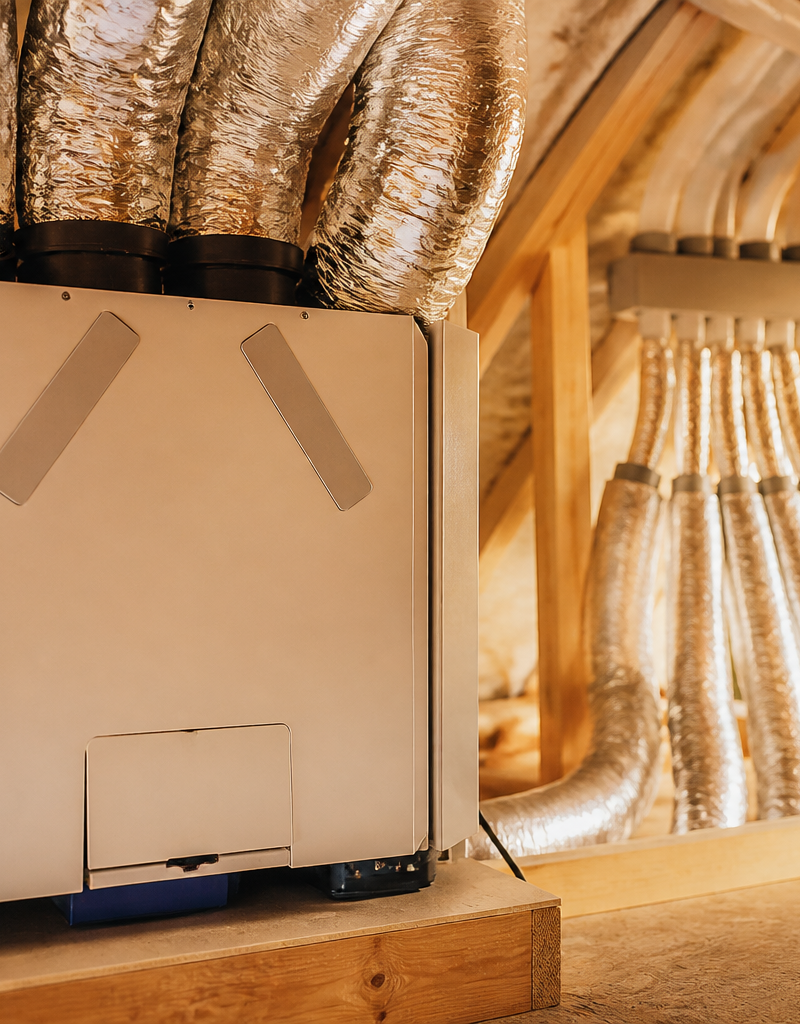
Mechanical Ventilation with Heat Recovery (MVHR) is designed to solve this problem. It continuously extracts stale, moist air from wet rooms such as kitchens and bathrooms while supplying fresh, filtered outside air to living areas and bedrooms. Crucially, it transfers thermal energy from the outgoing exhaust air to the incoming fresh air without mixing the two airflows.
Understanding the physics, economics and installation constraints of MVHR is essential before committing to a retrofit project, as the technology relies on specific building conditions to deliver genuine energy savings.
The physics of heat recovery ventilation

To understand why MVHR matters, you must look at how uninsulated and drafty UK homes lose heat. Heat escapes from a house through two main mechanisms: fabric transmission through walls, windows and roofs, and ventilation loss through air leakage and open vents.
In a typical uninsulated UK home, fabric transmission accounts for roughly 75% to 80% of heat loss, while ventilation accounts for 20% to 25%. However, once you add external wall insulation, high-performance glazing and loft insulation, space heating demand drops dramatically. At this stage, ventilation heat loss becomes the dominant heat loss pathway, accounting for up to 50% of the remaining thermal losses.
MVHR operates using a counter-flow heat exchanger, typically made of thin plastic or aluminium plates. Stale warm air extracted from moisture-heavy rooms passes through tiny channels in one direction, while cold fresh air drawn from outside passes in the opposite direction through alternating adjacent channels.
This heat transfer follows the second law of thermodynamics, moving thermal energy from the warmer exhaust stream to the cooler supply stream across the exchanger walls. High-efficiency MVHR units certified by the Passivhaus Institute achieve sensible heat recovery efficiencies of between 85% and 95%.
Air has a specific heat capacity of approximately 1.005 kilojoules per kilogram kelvin (kJ/kg K). If indoor air is 20°C and outside air is 2°C, a 90% efficient heat exchanger warms the incoming fresh air to 18.2°C purely using recovered heat. This significantly reduces the energy required from your central heating system or heat pump to bring incoming fresh air up to room temperature.
The air tightness bottleneck: why building physics determines performance
The primary technical constraint for MVHR is building air tightness. MVHR is not a draft-proofing system, it relies on a controlled, balanced airflow network.
Air tightness in UK buildings is measured in air permeability: cubic metres of air leakage per hour per square metre of envelope area at 50 Pascals of pressure differential (m³/h·m² at 50Pa). UK Building Regulations Approved Document F and Approved Document L address ventilation and conservation of fuel and power, setting maximum leakage limits for new builds at 8 m³/h·m², though modern low-energy homes target figures below 3 m³/h·m².
If your home has high air permeability, uncontrolled draft infiltration bypasses the heat exchanger entirely. Cold air enters through floorboard gaps, window frames and wall penetrations while warm air escapes through structural cracks.
Building physics evidence demonstrates clear operational thresholds for MVHR effectiveness:
- Above 5 m³/h·m²: MVHR is economically inefficient. Electrical energy used to power the continuous fans equals or exceeds the financial value of the heat recovered.
- Between 3 and 5 m³/h·m²: MVHR offers marginal net savings, but lower-cost decentralised mechanical extract ventilation (dMEV) or positive input ventilation (PIV) may be more cost-effective.
- Below 3 m³/h·m²: MVHR achieves optimum performance, delivering substantial space heating reductions and maintaining high indoor air quality.
For older solid-wall properties where achieving air permeability below 3 m³/h·m² requires extensive air-barrier membrane work, installing MVHR alone will fail to deliver expected carbon or bill savings.
Economics: installation costs, fan running costs and payback
Installing a centralised MVHR system during a deep retrofit requires significant capital outlay and spatial planning.
| Ventilation System Type | Heat Recovery Efficiency | Required Air Tightness (m³/h·m²) | Typical Installed Retrofit Cost | Annual Electrical Running Draw |
|---|---|---|---|---|
| Background Vents & Intermittent Extract | 0% | Any rating | £300 - £800 | 10 - 20 kWh |
| Decentralised MEV (dMEV) | 0% | Greater than 5 | £800 - £1,800 | 30 - 60 kWh |
| Positive Input Ventilation (PIV) | 0% | Greater than 5 | £1,000 - £2,200 | 40 - 150 kWh |
| Centralised MVHR System | 85% - 95% | Less than 3 | £4,000 - £9,000 | 175 - 350 kWh |
The capital cost of a centralised MVHR unit ranges from £1,500 to £3,500 for the unit itself, with rigid acoustic ducting, manifolds, valves and professional balancing bringing total installed costs to between £4,000 and £9,000 depending on home size and structural access.
Running costs depend on fan motor efficiency, measured as Specific Fan Power (SFP) in Watts per litre per second (W/(l/s)). High-efficiency units operate with SFPs between 0.4 and 0.8 W/(l/s). Operating continuously, a typical system draws 20 to 40 Watts. Under the Ofgem energy price cap rate of 24.5p per kWh effective October 2026, running an MVHR unit continuously costs between £43 and £85 per year in electricity.
In an airtight house requiring 8,000 kWh of space heating annually, an MVHR system recovering 85% of ventilation heat can save approximately 1,500 to 2,500 kWh of heating energy each year. If heated by a standard gas boiler at 6.2p per kWh, annual fuel savings equal £93 to £155, yielding a small net saving after fan electricity costs. If paired with a heat pump operating at a Seasonal Coefficient of Performance (SCOP) of 3.5, heating fuel costs are already low, which extends the purely financial payback period of the MVHR hardware to 20 years or more.
Therefore, MVHR should be justified primarily on health, comfort, moisture control and fabric protection grounds, rather than purely as a rapid financial investment.
Trade-offs and real-world implementation challenges
Before choosing MVHR, home retrofitters should weigh several operational trade-offs:
- Spatial impact: Rigid metal spiralo ductwork or semi-rigid radial plastic ducts require ceiling voids, soffits or stud wall chases. In Victorian properties with solid joists, routing 75mm or 125mm ducting can require extensive joinery work.
- Maintenance obligations: Dust, pollen and particulates collect on inlet filters. Filters (typically ISO Coarse or F7 grade) must be cleaned or replaced every 6 to 12 months, costing £40 to £90 annually. Neglecting filter maintenance increases fan resistance, raising electrical consumption and causing air imbalances.
- Acoustic design: Air velocity inside supply ductwork must remain below 2 to 3 metres per second to prevent whistling or hums. Attenuators must be fitted near the main unit to preserve quiet bedroom environments.
- Summer bypass functionality: During warm months, heat recovery is undesirable. Modern MVHR units include automatic mechanical bypass dampers that direct cool night air into bedrooms without passing through the heat exchanger, helping prevent summer overheating.
What this means for you
If you are planning a comprehensive home overhaul that includes complete air-sealing, insulation and window replacements, MVHR provides unmatched indoor air quality by continuously removing humidity and indoor pollutants while preserving heat.
However, if your property remains drafty and unsealed, investing thousands of pounds in MVHR will yield poor returns. Prioritise basic draft-proofing, loft insulation and fabric retrofits before committing to complex ductwork installations.
When upgrading your home's heating and clean technology, workplace employee schemes can help manage capital outlays. Through the Net Zero Home Scheme, UK employees can access member pricing on certified solar panels, heat pumps, battery storage and plug-in solar installed by accredited engineers.
Frequently asked questions
Does MVHR replace the need for central heating or a heat pump?
No. MVHR is a ventilation system that recovers existing heat, not a primary heat generator. While it dramatically reduces ventilation heat loss, your home still requires a heat pump, boiler or direct electric system to replace heat lost through walls, roofs and windows.
Can I install MVHR in an older home without major building work?
Installing centralised MVHR in an existing house is invasive because ducting must run to every kitchen, bathroom, living room and bedroom. In retrofits where ceiling voids are inaccessible, single-room decentralised MVHR units installed directly through exterior walls offer a less invasive alternative.
Will MVHR make my home noisy or create drafts?
When correctly designed by an accredited installer and balanced according to Building Regulations Part F, MVHR systems operate silently below 25 dBA in bedrooms. Air distribution valves diffuse air gently across ceilings, preventing noticeable drafts.
Sources
- Approved Document F: Ventilation (Volume 1: Dwellings), HM Government
- Mechanical Ventilation with Heat Recovery (MVHR) Guide, Energy Saving Trust
- Passivhaus MVHR Design Guide, Passivhaus Trust