Installing an Unvented Hot Water Cylinder: A UK Guide
A practical guide to upgrading to an unvented hot water cylinder for heat pumps and solar, covering costs, G3 safety rules, sizing, and installation steps.
- Written by
- Net Zero Home Scheme editorial team
- Last updated
- Topic
- heat pumps, home energy, energy efficiency
Transitioning a UK home to modern low-carbon heating, such as an air source heat pump or a solar PV immersion diverter, frequently requires upgrading your hot water cylinder. Millions of homes across England, Scotland, and Wales either removed their hot water storage during historic combi boiler retrofits or rely on legacy vented copper cylinders fed by cold water storage tanks in the loft.
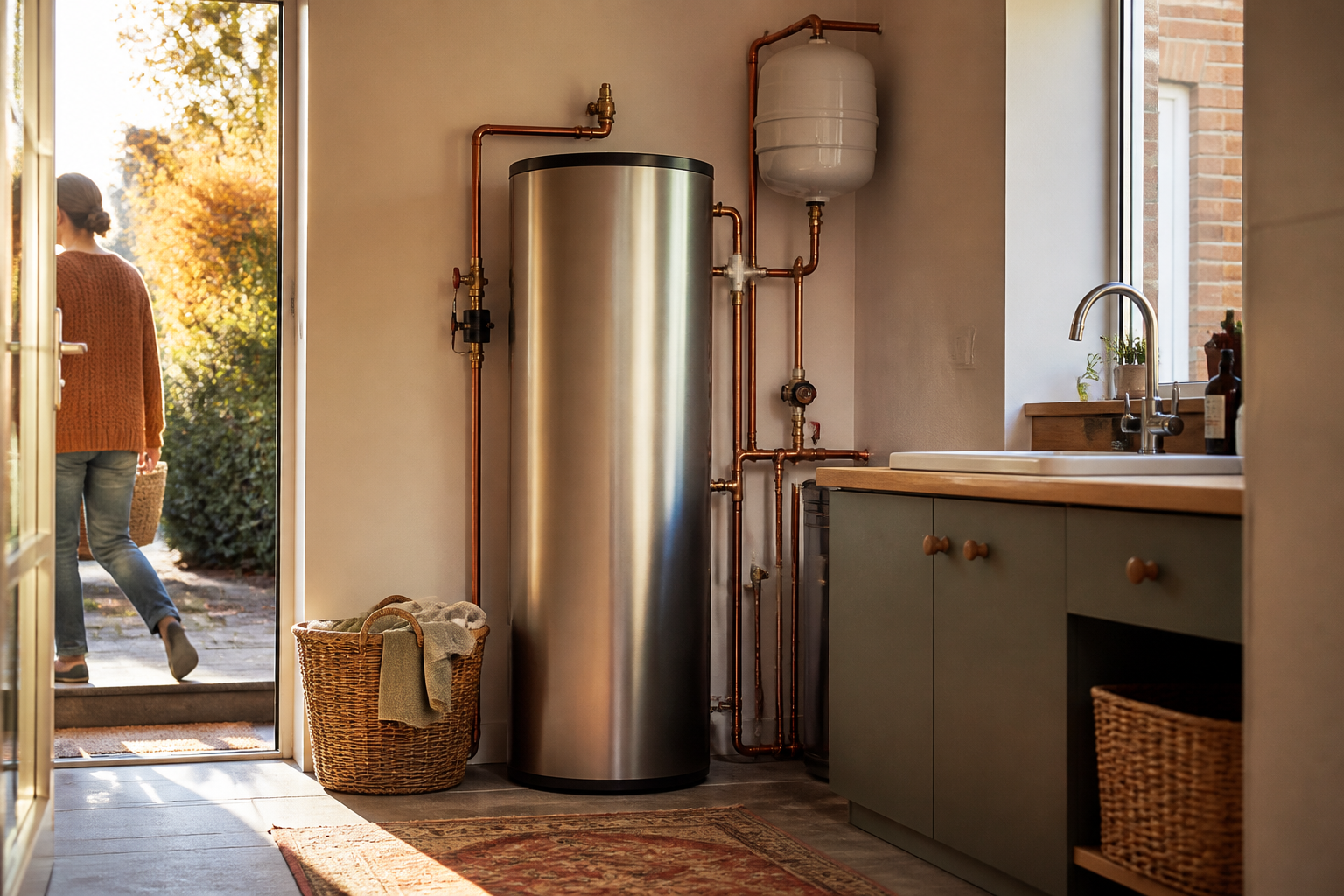
Modern low-carbon heating systems perform best when paired with an unvented stainless steel hot water cylinder. Unlike traditional gravity-fed cylinders, unvented units connect directly to the cold water mains supply, delivering hot water at mains pressure to taps and showers throughout the house. When designed for heat pumps, these cylinders feature larger internal heat exchanger coils that match lower operating flow temperatures. This practical guide explains how to assess your property, navigate safety regulations, select the right size, and manage the installation process.
Assessing Your Property for an Unvented Cylinder
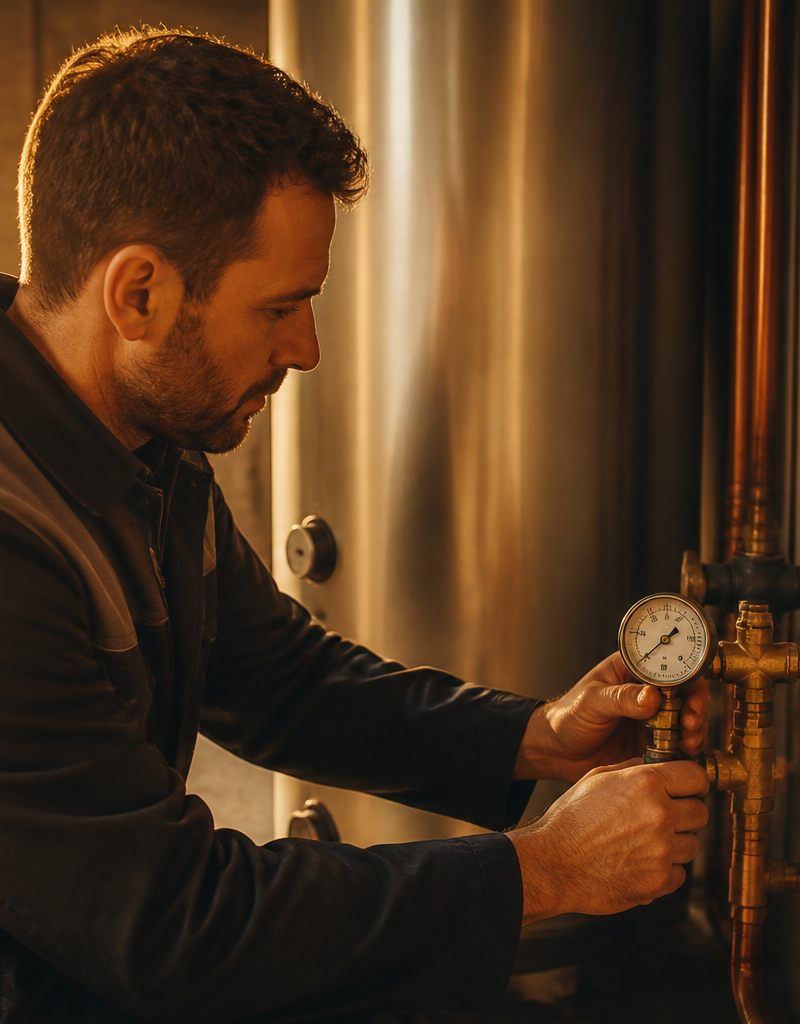
Before purchasing a cylinder, your installer must verify that your property meets the physical and hydraulic requirements for an unvented system.
Mains Water Pressure and Flow Rate
Because unvented cylinders depend on incoming mains pressure rather than gravity from a loft tank, your cold mains supply dictates performance. An installer will measure two key parameters at your external stopcock or incoming pipe:
- Static pressure: A minimum static water pressure of 1.5 bar is required, though 2.0 to 3.0 bar is ideal for multistory homes.
- Dynamic flow rate: A flow rate of at least 20 litres per minute is recommended for a single bathroom home, while homes with two or more bathrooms require 25 to 30 litres per minute to run multiple outlets simultaneously.
If your dynamic flow rate drops below 15 litres per minute, an unvented cylinder may deliver poor shower performance unless paired with an accumulator tank or a WRAS-approved mains boosting pump.
Space Requirements and Floor Loading
Unvented cylinders are insulated with high-density polyurethane foam, making their outer diameter roughly 550mm to 600mm. Height ranges from 1.2 metres for a 150-litre tank to over 2.0 metres for a 300-litre tank.
Weight is a vital structural consideration. Water weighs 1kg per litre, meaning a fully filled 200-litre stainless steel cylinder weighs upwards of 250kg. If the cylinder is positioned on a suspended timber floor, joists must be inspected and reinforced with double joists or structural noggins if necessary.
Discharge Pipe Alignment (Approved Document G3)
Because unvented cylinders operate under mains pressure, safety regulations mandate a dedicated discharge route. Under Approved Document G3 of the Building Regulations in England and Wales, the cylinder must feature a Temperature and Pressure Relief Valve (TPRV) connected to a tundish. The discharge pipework running from the tundish must fall continuously downwards to a safe exit point, such as a gully or soil stack capable of handling boiling water.
Regulations and Installer Accreditations
Installing an unvented hot water storage system is strictly regulated in the UK to prevent explosion risks from unvented thermal expansion or overheating.
- G3 Competence Certification: Anyone installing, commissioning, or servicing an unvented hot water cylinder over 15 litres must hold a valid G3 unvented hot water qualification. Installers registered with competent person schemes such as NICEIC, CIPHE, APHC, or NAPIT can self-certify the work under Building Regulations.
- Water Regulations Approval: Pipework and components must comply with the Water Supply (Water Fittings) Regulations 1999 to prevent backflow and contamination. Look for WRAS (Water Regulations Advisory Scheme) or KIWA certification on the cylinder and valves.
- MCS Accreditation: If the cylinder is installed as part of an MCS-accredited heat pump system under standards such as MIS 3005, the unit must be matched to the heat pump's output and low delta-T thermal transfer requirements to qualify for government grants.
Sizing and Equipment Costs
Selecting the correct cylinder volume depends on household occupancy, sanitary fittings, and heat source capabilities. Heat pump cylinders require larger internal surface areas for their coils, typically 1.5m² to 3.2m², compared to standard gas boiler cylinders (0.6m² to 1.0m²) to transfer heat efficiently at 50°C flow temperatures.
| Household Size | Bathrooms / Showers | Recommended Volume | Typical Equipment Cost | Estimated Total Installed Cost |
|---|---|---|---|---|
| 1,2 Bed Flat / House | 1 Shower | 150 Litres | £750 , £1,000 | £1,800 , £2,400 |
| 3 Bed House | 1 Bath, 1 Shower | 200 Litres | £950 , £1,300 | £2,100 , £2,800 |
| 4 Bed House | 2 Baths, 1 Shower | 250 Litres | £1,200 , £1,600 | £2,500 , £3,200 |
| 5+ Bed House | 3+ Baths | 300 Litres + | £1,400 , £2,000 | £2,900 , £3,800 |
Total installed costs include the cylinder unit, expansion vessel, tundish, motorized zone valves, pipework, electrical connections, labour, and Building Regulations notification fees.
The Installation Process Step-by-Step
A standard unvented hot water cylinder replacement or conversion typically takes 1 to 2 days for a qualified two-person heating team.
- Step 1: Site Survey and Hydraulic Test. The installer tests incoming mains pressure and flow rate, inspects the discharge pipe route to the exterior, and checks floor load-bearing capacity.
- Step 2: System Isolation and Decommissioning. The existing heating system is drained. Legacy vented tanks, header tanks in the loft, and old pipework are disconnected and removed.
- Step 3: Positioning and Pipework Setup. The new cylinder is positioned on a level base. Supply lines for cold mains feed, domestic hot water distribution, primary heating flow and return, and expansion vessels are routed.
- Step 4: Discharge Safety Piping. The installer mounts the tundish within 600mm of the TPRV. The discharge pipe is run using 22mm or 28mm copper pipe directly to an external drain, ensuring continuous fall and no plastic fittings that could melt under high temperatures.
- Step 5: Electrical and Control Wiring. Dual thermostats (control thermostat and high-limit safety cut-out thermostat) are wired to the heating controls and motorized zone valves. Dual immersion heaters are wired to isolated switched spur outlets or smart solar diverters.
- Step 6: Testing, Commissioning and Certification. The system is filled, purged of air, and pressure-tested. The installer tests the expansion vessel pre-charge pressure and triggers the relief valves manually to confirm discharge functionality. The installer completes the Benchmark commissioning checklist and submits the notification to local authority building control.
Key Questions to Ask Your Installer
Before signing a contract for an unvented cylinder installation, confirm these technical details with your heating engineer:
- Can you show proof of your valid G3 unvented hot water qualification and competent person scheme registration?
- What is the surface area in square metres of the internal heat exchanger coil, and is it sized specifically for heat pumps?
- Does the quoted price include the removal of old loft tanks, pipework modifications, and Building Regulations self-certification?
- Is the discharge pipe path fully compliant with Approved Document G3 guidelines without restricted turns?
- Does the cylinder feature secondary immersion sockets for pairing with off-peak electricity tariffs or solar immersion diverters?
If you are planning home energy improvements, the Net Zero Home Scheme offers employees access to member pricing on home heat pump installations and battery storage through accredited installer networks across England, Scotland, and Wales. Employers can also explore broader workforce sustainability solutions via The Electric Car Scheme for electric vehicle salary sacrifice.
What this means for you
Upgrading to a high-efficiency unvented hot water cylinder delivers high-pressure hot water to all outlets while laying the foundation for low-carbon heating. Matching cylinder sizing and coil surface area to your heating system ensures your heat pump operates at peak seasonal efficiency, keeping running costs down while providing abundant hot water for your home.
Frequently asked questions
Can I install an unvented cylinder if I currently have a combi boiler?
Yes, converting from a combi boiler to an unvented cylinder is common when upgrading to a heat pump or accommodating high hot water demand across multiple bathrooms. However, you will need dedicated floor space for the cylinder and room to run the G3 safety discharge pipe.
What happens if my mains water pressure is too low?
If your static pressure is below 1.5 bar or flow rate is under 15 litres per minute, an unvented cylinder will not perform well on its own. Your installer may recommend installing a WRAS-approved mains boosting pump or an accumulator tank to store pressurized cold water.
How often does an unvented hot water cylinder need servicing?
Unvented cylinders must be serviced annually by a G3-qualified engineer. Annual servicing checks the internal safety relief valves, inspects the expansion vessel air charge, and cleans inline strainers to ensure safe operation and maintain manufacturer warranties.