Thermal Heat Battery Installation Guide for UK Homes
A practical step-by-step UK guide to installing a phase-change thermal heat battery, covering mains pressure checks, sizing, costs, regulations, and installer accreditations.
- Written by
- Net Zero Home Scheme editorial team
- Last updated
- Topic
- energy efficiency, home energy, heat pumps
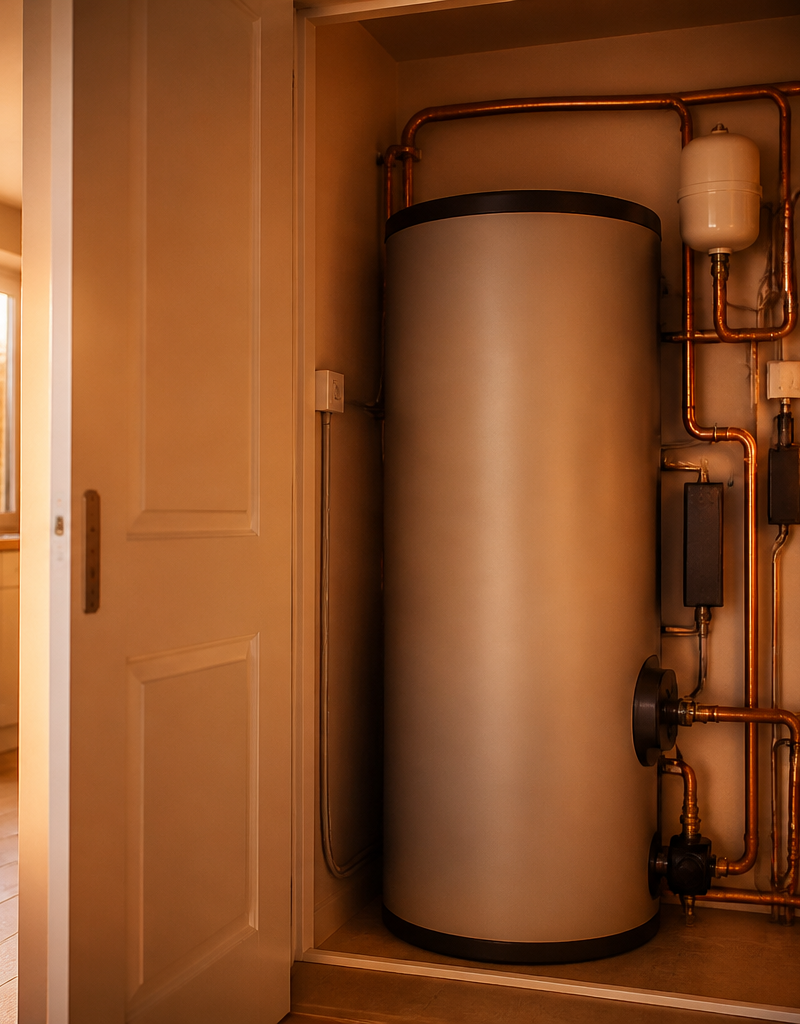
Replacing a conventional hot water cylinder or adding heat storage to a low-carbon heating system often creates a space dilemma in UK homes. Traditional unvented hot water cylinders require significant floor space, vertical clearance, and external tundish pipe runs to satisfy Building Regulations Part G3. Phase-change thermal heat batteries offer a compact alternative by storing heat energy in non-toxic salt hydrates rather than water. These units provide hot water on demand using internal heat exchangers while occupying up to four times less volume than a water cylinder of equivalent output.
This guide explains how thermal heat batteries work in UK properties, what technical prerequisites exist, how to size a unit, and what to expect during installation.
What is a phase-change thermal heat battery?
A thermal heat battery uses phase-change materials (PCM), typically sodium acetate trihydrate, to store thermal energy. When the material is heated above 58 degrees Celsius, it melts and absorbs latent heat energy. As hot water is requested by a tap or shower, mains cold water flows through an internal stainless-steel heat exchanger surrounding the PCM. The PCM solidifies, releasing its stored heat into the cold water instantly to provide mains-pressure domestic hot water.
Unlike traditional cylinders, the stored medium in a thermal battery is not potable water. Because mains cold water passes through sealed heat exchangers only when hot water is drawn, water is not held stationary at elevated temperatures. This eliminates the risk of Legionella bacteria growth and removes the requirement for high-temperature anti-legionella pasteurisation cycles, reducing standby heat losses. According to testing criteria established by the Energy Saving Trust, high-density insulation around PCM cores limits standby energy loss to under 0.7 kWh per 24 hours for typical domestic units.
Key checks before choosing a thermal heat battery

Before selecting a thermal battery, you must conduct a site assessment to verify that your home's water supply and electrical infrastructure can support the equipment.
1. Water mains pressure and flow rate
Thermal batteries operate as instantaneous mains-pressure systems. The output pressure and flow rate at your hot taps depend entirely on your incoming cold water mains supply.
- Dynamic mains pressure: A minimum of 1.5 bar dynamic pressure is recommended for optimal flow across internal heat exchangers.
- Cold water flow rate: You should measure a cold mains flow rate of at least 15 to 20 litres per minute at your kitchen tap. If your flow rate is below 12 litres per minute, a heat battery will deliver low hot water pressure, and a boosted main or accumulator may be required first.
2. Floor loading and structural support
While thermal heat batteries have a small physical footprint, their density is higher than standard water cylinders because of the salt hydrate chemical composition.
- A 7 kWh capacity battery typically measures 575 mm wide by 365 mm deep by 840 mm high, but weighs roughly 135 kg to 180 kg when fully charged.
- Larger 14 kWh units can weigh up to 300 kg.
- You must ensure timber floor joists in lofts or upper levels can support concentrated point loads. In many retrofits, installing the unit on a solid ground floor slab or reinforced joist section is required to comply with UK Building Regulations Part A (Structure).
3. Electrical and space requirements
Thermal batteries require an electrical supply to run their internal control boards and integrated heating elements.
- Electrical connection: Standard models require a dedicated 13A or 16A fused spur, whereas models with fast-charge backup heaters may require a 32A dedicated circuit fitted with a Type B RCD, compliant with BS 7671 (IET Wiring Regulations) and installed under Building Regulations Part P.
- Clearance and access: Allow 100 mm of clearance around side and top panels for pipework connections and servicing access.
Sizing a thermal heat battery for your home
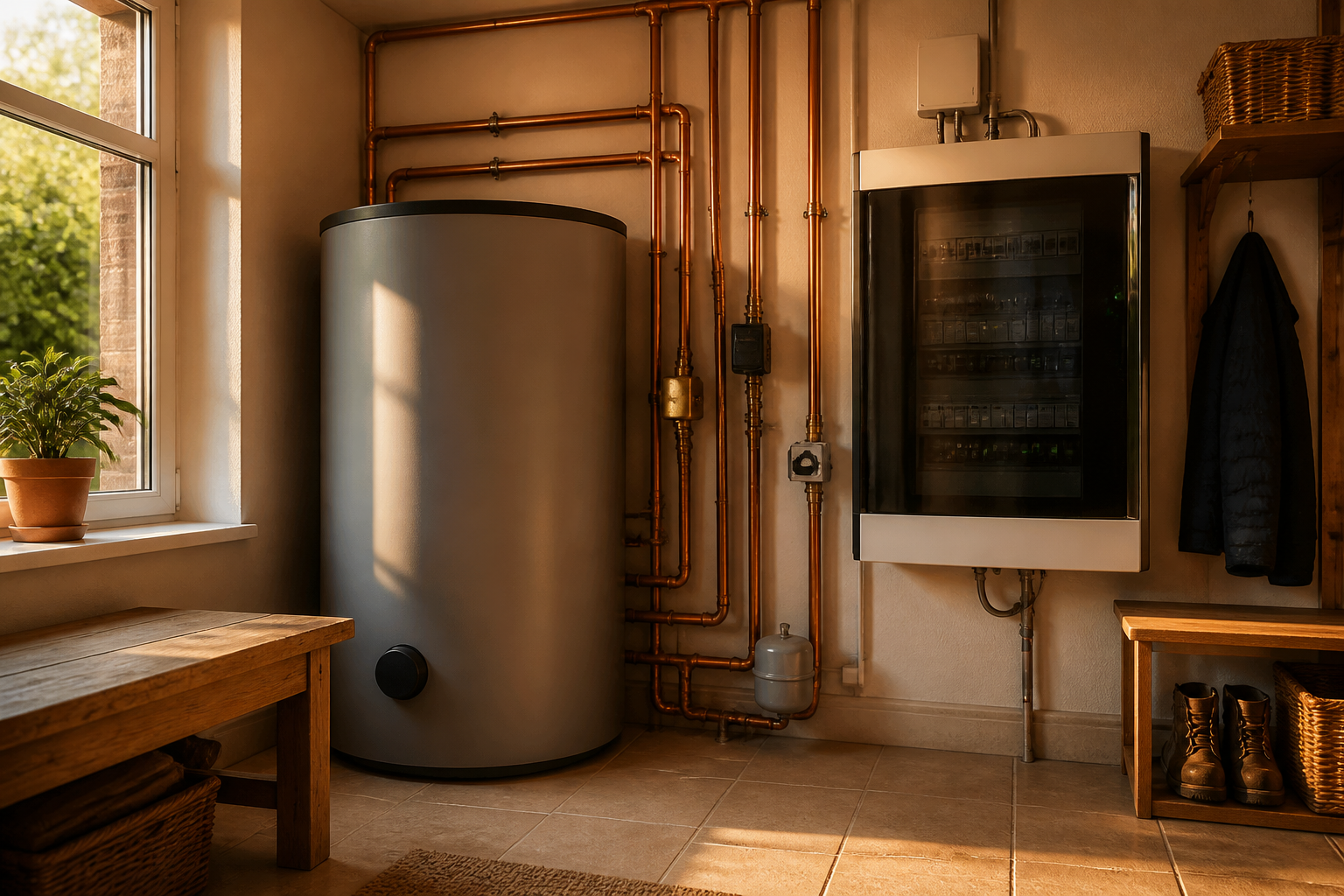
Thermal battery storage capacity is measured in kilowatt-hours (kWh) of stored thermal energy rather than volume in litres. To select the correct size, convert your household's daily hot water consumption into equivalent energy output.
| Household Size | Typical Daily Hot Water Use | Equivalent Hot Water Cylinder | Recommended Thermal Battery Size | Continuous Flow Rate (at 40°C rise) |
|---|---|---|---|---|
| 1,2 Bed Flat / 1 Bathroom | 100,120 Litres | 120,150 Litres | 5 kWh to 7 kWh | 9,12 Litres/min |
| 3 Bed House / 1,2 Bathrooms | 150,200 Litres | 180,210 Litres | 7 kWh to 10 kWh | 12,15 Litres/min |
| 4+ Bed House / 2+ Bathrooms | 220,300 Litres | 250,300 Litres | 10 kWh to 14 kWh | 15,20 Litres/min |
When sizing, account for peak demand periods, such as consecutive morning showers. A 10 kWh thermal battery provides roughly 210 litres of hot water at a 40 degrees Celsius temperature rise, which satisfies the morning peak for a standard family home before requiring a recharge cycle from a heat pump, solar immersion, or off-peak electricity.
Installer accreditations and UK regulations
Installing a thermal heat battery involves both plumbing and electrical alterations. To ensure safety and preserve manufacturer warranties, ensure your installer holds the following credentials:
- Building Regulations Part G3: Work on unvented or pressurised hot water systems must be carried out by a qualified person holding a valid G3 unvented hot water card.
- Building Regulations Part P: Electrical connections must be certified by a registered competent person through schemes such as NICEIC, NAPIT, or ELECSA.
- MCS Accreditation: If your thermal battery is being installed alongside a heat pump or solar thermal system funded by government schemes, the installer must be accredited under the Microgeneration Certification Scheme (MCS) and registered with a consumer code such as RECC or HIES.
- TrustMark Registration: Verifies that the installer complies with government-endorsed quality standards for home energy upgrades.
Step-by-step installation process and timeline
A standard thermal battery retrofit replacing an old hot water cylinder typically takes one to two days.
- Step 1: Site Survey and Technical Design (Pre-installation). The engineer checks dynamic mains pressure, assesses floor loading, plans pipe routes, and confirms electrical supply capacity.
- Step 2: System Decommissioning and Drain Down (Day 1 morning). The old cylinder or hot water tank is isolated, drained, and safely disconnected from power and water lines.
- Step 3: Mechanical Positioning and Plumbing (Day 1 afternoon). The thermal battery is positioned and levelled. Expansion vessels, pressure-reducing valves, and copper pipe connections for cold mains inlet and hot water outlets are fitted.
- Step 4: Electrical and Control Wiring (Day 2 morning). The installer connects the electrical supply, ties in temperature sensors, and integrates control wiring with your heat pump, solar immersion diverter, or boiler control circuit.
- Step 5: Commissioning and Testing (Day 2 afternoon). System pipes are pressure-tested, safety relief valves are verified, and the PCM core is brought up to initial charge temperature. The installer registers the system with building control and completes the benchmark logbook.
What a thermal heat battery costs in the UK
Total installed costs depend on battery storage capacity, space accessibility, and whether existing pipework needs modification.
- Equipment cost: A 7 kWh to 10 kWh phase-change heat battery unit costs between £2,200 and £3,800 including VAT.
- Installation labour and sundries: Mechanical plumbing, electrical wiring, pressure control valves, and commissioning typically add £800 to £1,500.
- Total installed cost: Expect to pay between £3,000 and £5,300 for a fully installed domestic thermal battery system.
While this initial purchase cost is higher than a standard £1,200 unvented stainless-steel cylinder retrofit, thermal batteries eliminate the need to run an external G3 discharge pipe through exterior walls, which can be costly or difficult in flatted developments, listed buildings, or conservation areas.
If you are exploring clean energy upgrades as part of workplace benefit offerings, the Net Zero Home Scheme gives employees access to member pricing on accredited home energy installations across England, Scotland and Wales.
Where relevant, householders evaluating home charging or clean transport can also explore options through sister platforms such as The Electric Car Scheme and The Charge Scheme.
Frequently asked questions
Can a thermal heat battery replace a gas boiler entirely?
A thermal heat battery stores heat for domestic hot water, but it is not a standalone heat generator. It must be charged by an external energy source such as an air source heat pump, an electric immersion element, solar PV generation, or a boiler.
Do thermal batteries require annual servicing like unvented cylinders?
Because thermal heat batteries operate with a closed phase-change material core and internal heat exchangers, they do not hold pressurised potable water in a large vessel. They do not require the mandatory annual G3 relief valve checks required for traditional unvented cylinders, though routine checks of external hydraulic valves and electrical connections during standard heating servicing are recommended.
How long does a phase-change thermal battery last?
Manufacturers test phase-change salt hydrate materials for over 10,000 charge and discharge cycles without degradation in thermal capacity, which equates to an operational lifespan exceeding 20 years under normal domestic usage patterns.
What this means for you
Upgrading to a phase-change thermal heat battery allows UK householders to reclaim valuable floor space while integrating efficient hot water storage with low-carbon heat sources. Before booking an installation, confirm that your cold mains water pressure reaches at least 1.5 bar, verify floor loading capacity, and choose an installer holding valid G3 and Part P accreditations to guarantee a safe, compliant installation.