Home Battery Round Trip Efficiency and Real World Losses
Home battery datasheets claim 95% efficiency, but real UK setups deliver 80% to 88%. Here is the physics behind battery losses and tariff economics.
- Written by
- Net Zero Home Scheme editorial team
- Last updated
- Topic
- battery storage, energy efficiency, home energy
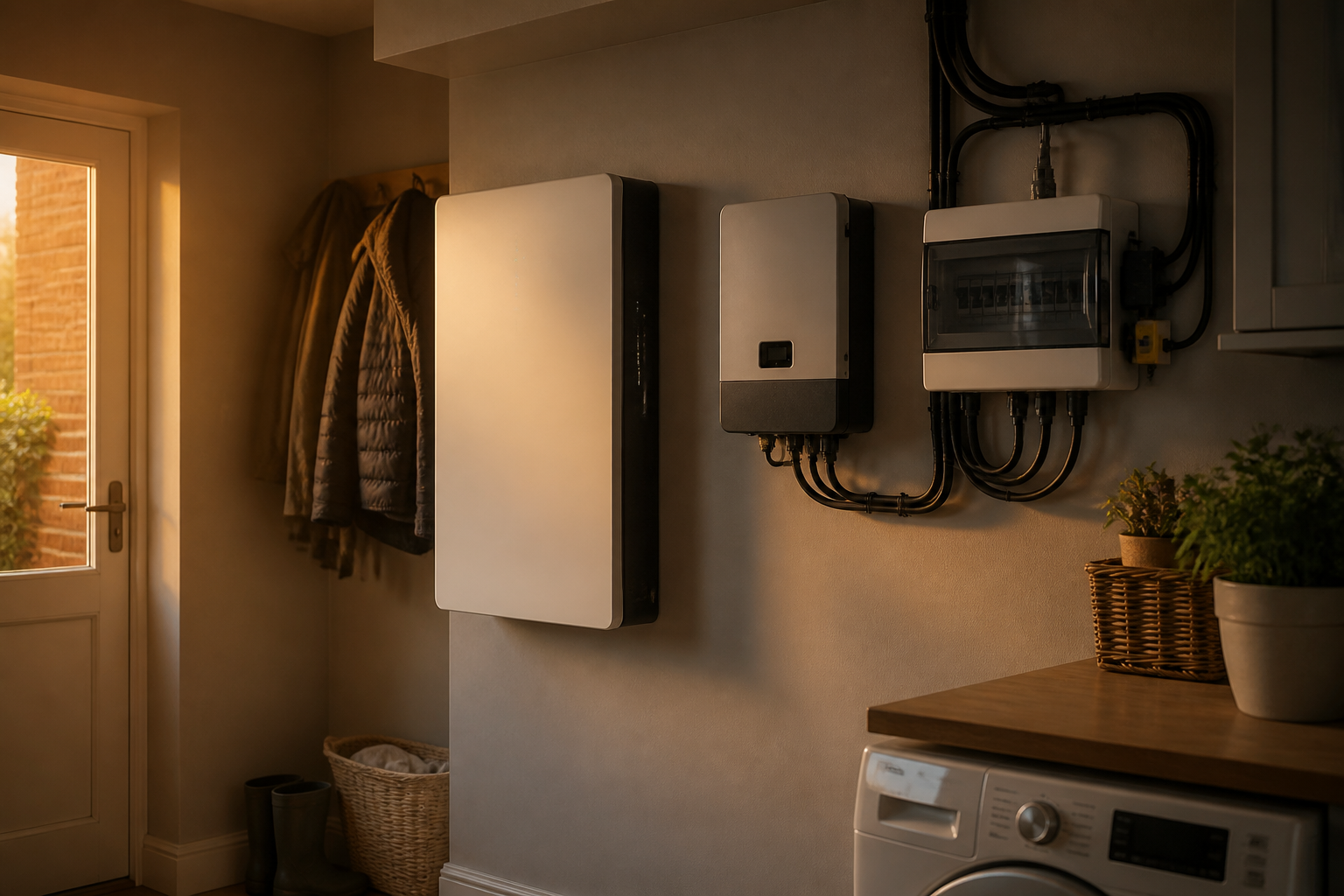
Home battery storage has become one of the most popular retrofits for UK householders looking to cut their electricity bills. By pairing a battery with solar panels or charging it overnight using cheap off-peak electricity tariffs, you can store lower-cost power and use it when grid prices are high. However, when reviewing technical datasheets, manufacturers frequently advertise round-trip efficiency figures above 95 percent.
In everyday UK residential operation, real-world meter readings often show an actual round-trip efficiency between 80 percent and 88 percent. This gap is not necessarily due to faulty equipment, but rather stems from fundamental physics, power electronics conversion stages, and continuous parasitic loads. Understanding where these losses occur is critical for accurately calculating financial payback, choosing system sizes, and getting the most value out of home energy storage.
What is round-trip efficiency and how is it measured?
Round-trip efficiency, abbreviated as RTE, is the ratio of useful energy retrieved from a storage system to the total energy supplied to charge it. Expressed as a percentage, the calculation is simple: divide the total kilowatt-hours (kWh) discharged into your home circuits by the total kWh drawn from the grid or solar array to charge the battery.
If a battery system draws 10 kWh during an overnight charge window and delivers 8.5 kWh back to your household appliances before running empty, its real-world round-trip efficiency for that cycle is 85 percent. The remaining 1.5 kWh has been dissipated as heat, used to power internal system electronics, or lost during electrical conversion.
Datasheet figures are typically calculated under ideal laboratory conditions, such as standard ambient temperatures of 25 degrees Celsius, continuous charge and discharge rates at optimal power bands (often 0.5C), and excluding standby power draw. In contrast, a home installation operates under variable temperatures, fluctuating household loads, and extended idle periods, all of which lower real-world performance.
Where do energy losses happen in a home battery system?
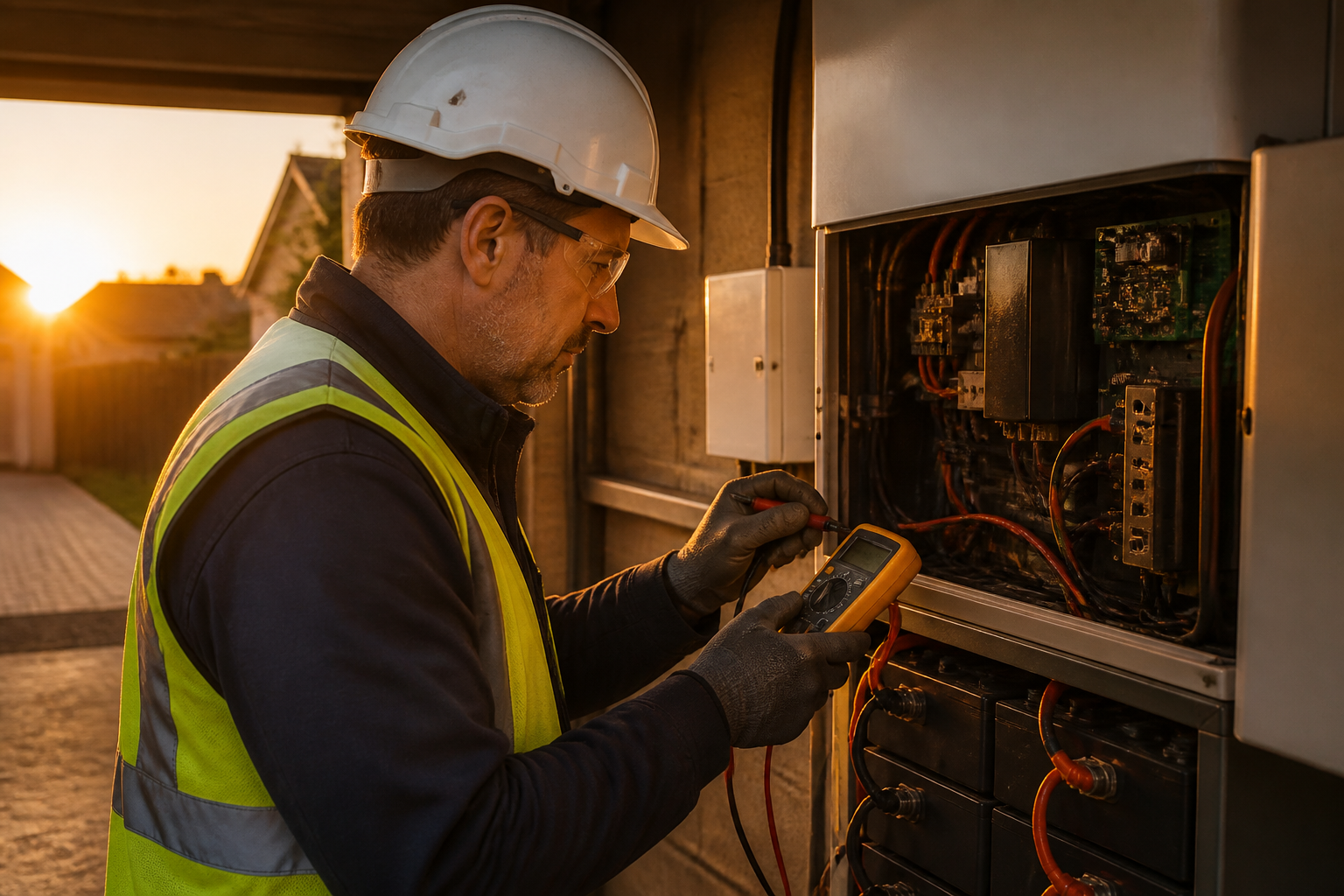
Energy losses in a domestic battery storage setup occur across three primary areas: electrochemistry, power electronics conversion, and parasitic standby loads.
1. Electrochemical internal resistance and heat
Modern residential batteries in the UK predominantly use Lithium Iron Phosphate (LFP) cell chemistry due to its long thermal stability and deep cycle life. When electricity flows into an LFP cell during charging, energy is stored chemically as lithium ions move from the cathode to the anode. During discharge, the process reverses.
This chemical process is highly efficient, typically achieving 96 percent to 98 percent Coulombic efficiency. However, internal resistance within the cells generates heat whenever current flows. According to Joule's first law, energy loss as heat increases with the square of the electric current. Rapid charging or high-power discharges (such as running an electric shower, heat pump compressor, or kettle) increase internal resistance losses, generating waste heat within the battery module.
2. Inverter power electronics conversion
Batteries store electricity as Direct Current (DC), whereas UK home appliances and the National Grid operate on Alternating Current (AC). Every time energy transitions between AC and DC, conversion losses take place within the system's inverter.
- AC-coupled systems: Electricity from the grid or a solar inverter enters as AC, is converted to DC by the battery inverter to charge the cells, and is converted back to AC when discharged into the house. This double conversion incurs two separate inverter losses, typically 4 percent to 7 percent per conversion stage.
- DC-coupled systems: Solar generation flows directly to the battery via a DC-to-DC charge controller, bypassing one AC stage during charging. However, grid charging overnight still requires AC-to-DC conversion, and all household discharges still require DC-to-AC conversion.
Inverters also feature efficiency curves. Peak inverter efficiency (often 96 percent to 97 percent) occurs when operating at 30 percent to 70 percent of their rated power capacity. When your home draws very low power overnight (such as a 100-watt baseline load for background electronics), the inverter operates at the low end of its curve, where conversion efficiency can drop below 75 percent.
3. Parasitic and standby power loads
A home battery system is never truly powered off. To monitor safety, manage cell balancing, run Wi-Fi communications modules, and control power transistors, the Battery Management System (BMS) and inverter consume background power continuously.
Depending on the brand and model, this parasitic draw ranges between 15 watts and 45 watts. While 30 watts may sound modest, over a 24-hour period it consumes 0.72 kWh of electricity purely to keep the system online. If your household only uses 6 kWh of stored energy per day, that 0.72 kWh background draw represents an immediate 12 percent drop in overall daily system efficiency.
The math of real-world efficiency: A worked UK example
To see how these cumulative losses affect daily performance, consider a typical UK home installation featuring a 10 kWh nominal capacity LFP battery connected to a 3.6 kW AC-coupled inverter.
| Stage of Energy Transfer | Nominal Energy Input / Loss | Remaining Usable Energy | Cumulative Efficiency |
|---|---|---|---|
| Grid Charging Input | 10.00 kWh | 10.00 kWh | 100.0% |
| Inverter AC to DC Charging Loss (6%) | -0.60 kWh | 9.40 kWh | 94.0% |
| Battery Chemical Heat Loss (3%) | -0.28 kWh | 9.12 kWh | 91.2% |
| 24-Hour Standby / BMS Load (25W avg) | -0.60 kWh | 8.52 kWh | 85.2% |
| Inverter DC to AC Discharge Loss (5%) | -0.43 kWh | 8.09 kWh | 80.9% |
In this realistic operational model, taking 10 kWh of off-peak electricity from the grid yields approximately 8.09 kWh of usable AC power at the plug socket, resulting in an effective round-trip efficiency of roughly 81 percent.
How round-trip efficiency impacts time-of-use tariff economics
Understanding RTE is essential when calculating financial returns on time-of-use electricity tariffs. Many UK householders rely on overnight off-peak tariffs (for example, charging at 7p per kWh for four hours overnight) to avoid peak daytime rates of 24p per kWh.
If you assume 100 percent efficiency, buying 1 kWh overnight for 7p saves you 17p compared to buying peak electricity at 24p. However, accounting for an 82 percent round-trip efficiency changes the underlying financial math:
- To deliver 1.0 kWh of useful power during the day, your system must draw 1.22 kWh from the grid overnight (1.0 divided by 0.82).
- The true cost of that delivered 1.0 kWh is 1.22 multiplied by 7p, which equals 8.54p.
- Your net saving per kWh delivered is 24p minus 8.54p, which equals 15.46p per kWh, rather than 17p.
While the financial return remains compelling in this scenario, ignoring round-trip efficiency overestimates annual bill savings by 10 percent to 20 percent. If the price spread between off-peak and peak rates narrows, low round-trip efficiency erodes savings rapidly.
Trade-offs and counter-arguments: Is battery storage still worth it?
Given that 12 percent to 20 percent of energy is lost in conversion and standby power, it is fair to examine the counter-arguments against installing home battery storage.
- High initial capital outlay: Quality residential battery systems in the UK typically cost between £4,000 and £8,000 installed, depending on capacity and inverter specifications. Depending on your annual electricity consumption, payback periods range from 7 to 12 years.
- Embodied carbon in manufacturing: Producing lithium-ion battery cells requires mineral extraction, refining, and energy-intensive manufacturing. If a battery charges primarily from carbon-heavy grid electricity during winter nights, its net lifetime carbon reduction is smaller than if charged purely from on-site solar PV.
- Degradation over time: Battery cells gradually lose storage capacity over their lifespan through chemical degradation, typically retaining 70 percent to 80 percent of original capacity after 10 years or 4,000 cycles.
Despite these clear trade-offs, home storage provides distinct advantages for UK households:
- Maximising solar self-consumption: Without a battery, standard UK solar households export 50 percent to 70 percent of their daytime generation to the grid at modest export rates. Storing that power locally keeps it within your home energy system.
- Grid flexibility and peak demand reduction: Shifting household electricity demand away from peak evening hours reduces stress on the UK distribution network and supports higher national integration of renewable power generation.
- Operational resilience: When installed with emergency power supply (EPS) switching, batteries provide essential backup power during localized grid outages.
What this means for you
If you are considering home energy storage or seeking to optimise an existing setup, you can take practical steps to minimise real-world conversion losses:
- Match battery and inverter capacity to household load: Avoid buying an oversized inverter if your baseline home consumption is low. Running a large 6 kW inverter to supply a continuous 150-watt background load forces the inverter into low-efficiency operation.
- Select reputable components and accredited installers: Ensure your installer holds Microgeneration Certification Scheme (MCS) accreditation and adheres to safety and electrical standards like PAS 63100 and BS 7671. The Competition and Markets Authority (CMA) has stressed the importance of robust consumer protection and clear performance disclosures across all UK home energy upgrade schemes (https://www.gov.uk/government/publications/cma-response-to-consultation-on-consumer-protection-for-home-upgrade-schemes).
- Optimize tariff charging schedules: Set charge windows to coincide fully with cheap off-peak hours, and avoid unnecessary micro-charging cycles throughout the day that incur standby overheads.
- Explore employee scheme support: Employees accessing benefits through the Net Zero Home Scheme can receive member pricing on MCS-accredited battery, solar, and heat pump installations without payroll deduction or salary sacrifice.
Frequently asked questions
Does battery efficiency degrade over time?
Yes. As lithium-ion cells age and undergo charge-discharge cycles, internal chemical degradation increases their internal resistance. This means slightly more energy is lost as heat during operation in year ten compared to year one, causing a slight drop in round-trip efficiency alongside the reduction in overall storage capacity.
Are DC-coupled batteries more efficient than AC-coupled batteries?
When storing direct daytime generation from rooftop solar panels, DC-coupled systems are typically 3 percent to 5 percent more efficient because they avoid one AC-to-DC conversion step. However, if you charge your battery primarily overnight using cheap grid electricity, both system types perform AC-to-DC conversion, making their efficiency nearly identical.
Can standby power consumption be turned off?
No. Standby power is required to run the Battery Management System (BMS), maintain battery safety monitoring, manage internal temperature regulation, and communicate with your inverter and smartphone app. Turning off standby power would isolate the battery from the electrical grid and prevent dynamic charging schedules from functioning.