Corporate Renewables Shortfall Exposes Energy Price Risks
Corporate warnings over clean power shortfalls highlight why home energy generation is becoming critical for household financial resilience.
- Written by
- Net Zero Home Scheme editorial team
- Last updated
- Topic
- energy efficiency, energy bills, policy
Global corporate leaders have warned that systemic market and procurement barriers are hindering access to clean power, leaving businesses exposed to volatile energy prices and unable to meet corporate net zero goals. In a report published on 21 September 2026 by industry publication edie, business coalitions highlighted that structural supply shortfalls in renewable energy are stalling corporate decarbonisation strategies across international supply chains.
The warning comes as commercial grid connections, planning delays and market procurement rules prevent organisations from sourcing enough renewable electricity to cover their operational footprint. For UK organisations and their workforces, these commercial bottlenecks underline how ongoing reliance on marginal gas generation continues to dictate power prices across both business and domestic energy sectors.
What the numbers say
Corporate climate commitments face growing hurdles as grid expansion lags behind electricity demand growth. Key facts reported in recent industry findings include:
- Corporate procurement barriers: As reported by edie on 21 September 2026, global businesses face severe market restrictions that prevent them from securing 100 percent renewable power contracts.
- Price exposure: The edie report on 21 September 2026 highlighted that procurement delays leave organisations vulnerable to persistent wholesale energy market volatility.
- Domestic solar capacity: Microgeneration Certification Scheme (MCS) data shows a typical 4 kWp UK home solar system produces between 3,400 kWh and 4,200 kWh of electricity per year, offsetting significant grid imports.
- Heat pump performance: Standards from the Building Research Establishment confirm that air source heat pumps operating at a Seasonal Coefficient of Performance (SCOP) of 3.5 deliver 3.5 units of heat for every unit of electricity consumed.
| Clean Energy Technology | Key Operational Benefit | Typical System Scale | Installation Timeframe |
|---|---|---|---|
| Rooftop Solar PV | On-site daylight power generation | 4 kWp to 8 kWp | 1 to 2 days |
| Home Battery Storage | Shifting grid intake to off-peak rates | 5 kWh to 13.5 kWh | 1 day |
| Air Source Heat Pump | Low-carbon hydronic central heating | 5 kW to 12 kW | 2 to 4 days |
| Plug-In Solar Kits | Supplementary base-load coverage | 400 W to 800 W | Less than 1 hour |
What this means for your home
When commercial grid access stalls, utility companies continue to rely on gas-fired generation to meet marginal demand. Because UK power market rules set wholesale electricity rates based on the most expensive generator required at any given hour, home tariffs remain directly linked to international gas price swings.
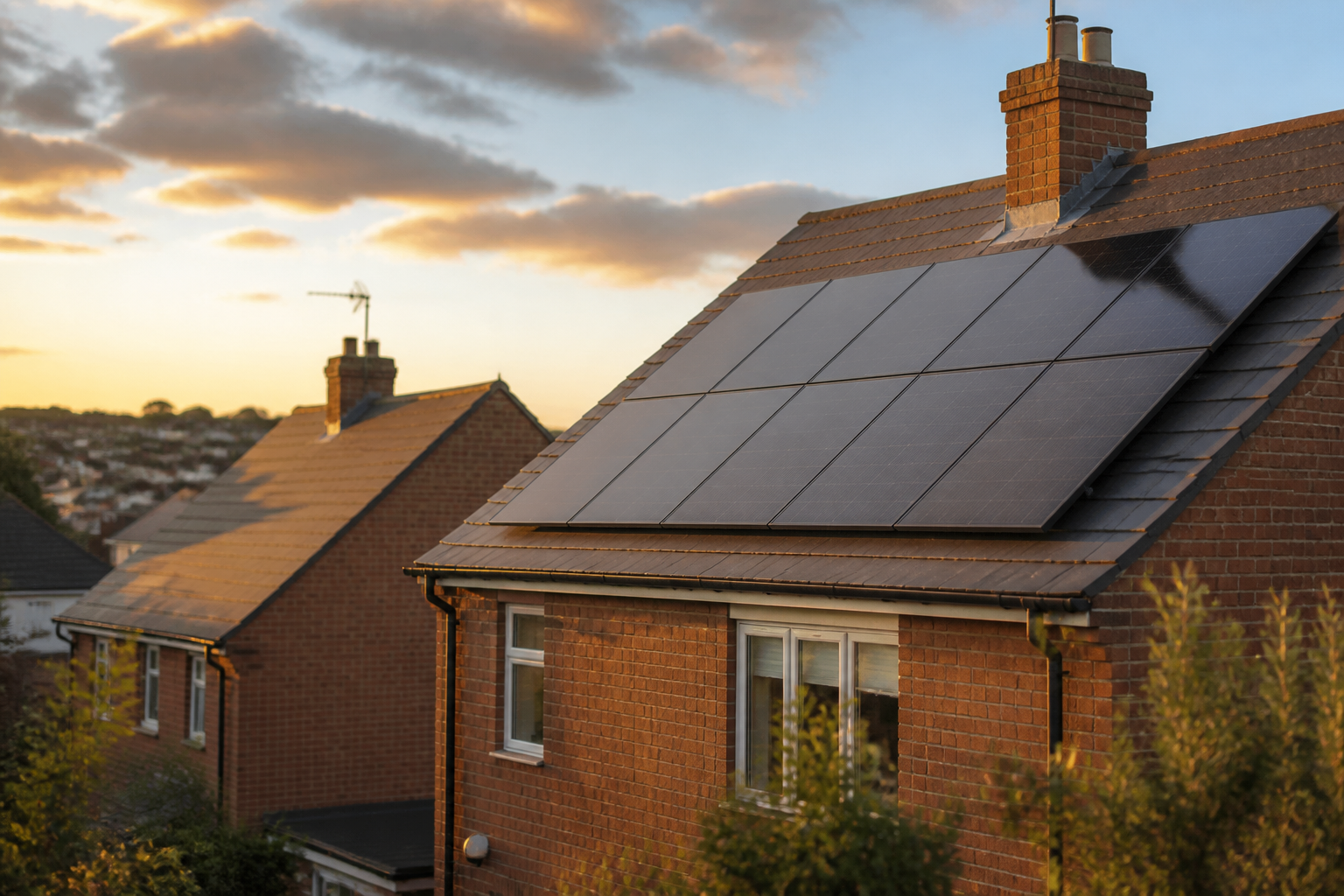
For households looking to protect monthly budgets, generating power at home offers a direct alternative to grid dependency. Installing rooftop solar PV allows you to generate electricity during daylight hours for immediate household use, such as running appliances, charging devices, or powering heat pumps.
Adding battery storage allows you to store unneeded daytime solar output or fill the battery using lower cost off-peak electricity tariffs overnight. This stored energy can then power your home during peak evening hours when grid electricity rates are highest. For households unable to install full roof arrays, plug-in solar modules provide a low barrier entry point to generate base-load power for everyday background appliances.
Upgrading to an air source heat pump replaces fossil fuel heating with electrified hydronic heating. When combined with home solar and smart tariffs, heat pumps lower overall energy exposure while meeting modern home efficiency standards.
What this means for employers
As organisations encounter procurement limits on their own operational Scope 1 and Scope 2 emissions, focus is shifting toward Scope 3 emissions, which include employee homeworking and commuting footprint. With volatile energy bills placing continuous pressure on household finances, staff financial wellbeing has become a primary priority for reward leads.
Employers seeking to support staff sustainability without expanding payroll costs are turning to practical home energy benefits. Offering structured access to accredited retrofits helps employees lower domestic bills while reinforcing corporate net zero targets.
To help workforces build household energy resilience, employers can offer the Net Zero Home Scheme, a benefit delivered by Net Zero Benefits alongside The Electric Car Scheme. The scheme provides employees with member pricing on accredited solar panels, heat pumps, battery storage and plug-in solar installations, with no fee, salary sacrifice or payroll administration required for the employer.
Frequently asked questions
How do corporate renewable supply bottlenecks affect domestic energy bills?
When large electricity consumers cannot secure direct renewable power purchase agreements, utilities burn more natural gas to power the national grid. Because marginal pricing rules set UK power rates based on gas power plant costs, retail electricity tariffs remain elevated for households.
Can home solar and battery storage reduce employer Scope 3 emissions?
Yes. When employees work from home, their heating and electricity use falls into the organisation's Scope 3 accounting. Installing home solar PV and batteries lowers grid electricity consumption during working hours, directly reducing reported work-from-home emissions.
Which quality standards protect employees installing home energy systems?
Installations should be completed by contractors registered with the Microgeneration Certification Scheme (MCS) and aligned with consumer protection bodies such as RECC or HIES. Electrical work must comply with BS 7671 standards and receive NICEIC or NAPIT sign-off.