Heat Pump Radiator Sizing: Physics and Retrofit Economics
Understanding how mean water temperature and radiator surface area dictate air source heat pump efficiency, heating output, and retrofit costs in UK homes.
- Written by
- Net Zero Home Scheme editorial team
- Last updated
- Topic
- heat pumps, energy efficiency, home energy
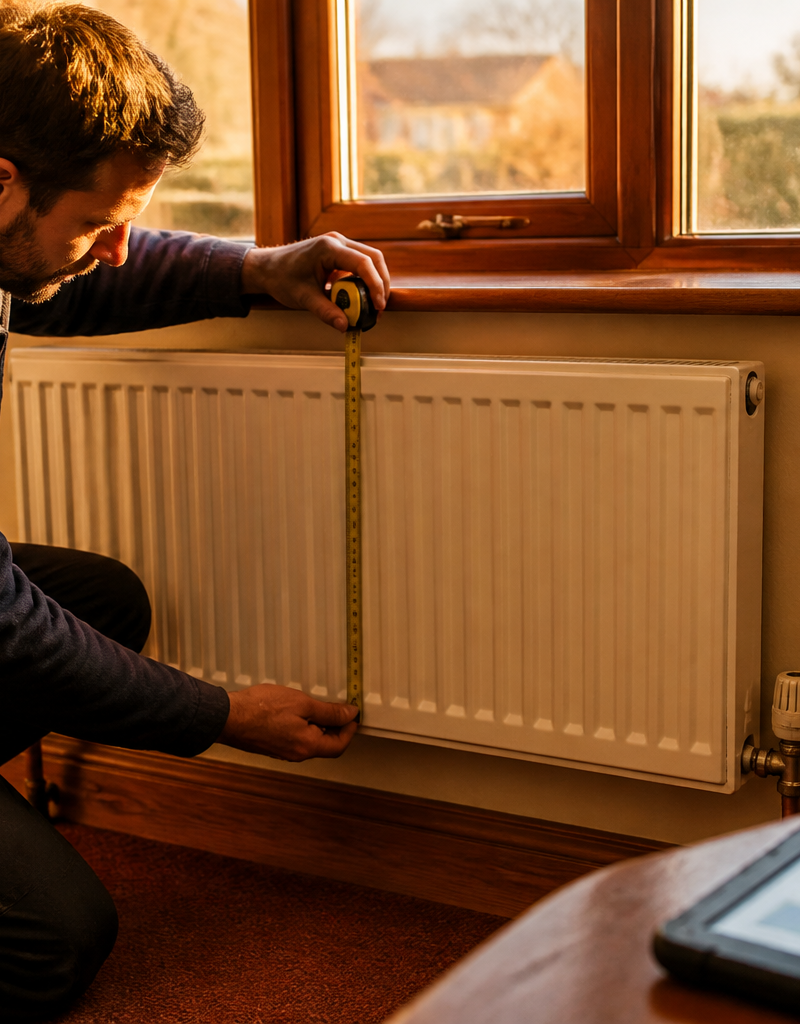
When upgrading from a traditional gas or oil boiler to an air source heat pump, homeowners frequently hear that their existing radiators are undersized. This requirement is not an arbitrary installer recommendation, but is rooted in thermodynamics and fluid mechanics. Gas boilers traditionally circulate water through radiators at high flow temperatures of 70°C to 75°C, whereas heat pumps operate most efficiently at lower flow temperatures between 35°C and 45°C. Understanding the physical relationship between flow temperature, radiator surface area, and compressor work is essential to achieving expected heating outputs and manageable running costs.
The Physics of Mean Water Temperature and Thermal Output
To calculate the heat output of a radiator, heating engineers rely on British Standard BS EN 442. Under this standard, manufacturers quote radiator heat output in Watts at a delta T of 50 Kelvin (ΔT50). This assumes a flow temperature of 75°C, a return temperature of 65°C, and an ambient room temperature of 20°C, yielding a mean water temperature (MWT) of 70°C.
When a heat pump is installed, the system is engineered for lower flow temperatures to maximize seasonal efficiency. If a heat pump operates at a flow temperature of 45°C and a return temperature of 40°C, the MWT drops to 42.5°C. In a 20°C room, the effective operating delta T falls from 50 K to just 22.5 K.
Heat emission does not scale linearly with temperature difference. The equation governing radiator heat output is Q = K × ΔT^n, where K is a constant specific to the radiator geometry and n is the characteristic exponent, typically 1.3 for modern panel radiators.
Applying this exponent shows that reducing the operating delta T from 50 K to 22.5 K reduces radiator thermal output to approximately 35% of its rated capacity. A standard single-panel radiator rated at 1,000 Watts under boiler conditions will deliver only about 350 Watts when fed with 45°C water from a heat pump.
The Efficiency Trade-off: Flow Temperature vs SCOP
Why not simply run the heat pump at 65°C to avoid changing radiators? The answer lies in the refrigeration cycle physics governed by Carnot efficiency principles.
An air source heat pump extracts heat from outdoor air and upgrades it to the temperature needed for internal space heating. The mechanical work required by the compressor increases as the lift, which is the difference between outdoor ambient temperature and indoor flow temperature, widens. According to engineering standards published by the Microgeneration Certification Scheme (MCS) in design document MIS 3005-D, every 1°C increase in flow temperature reduces system efficiency by roughly 2% to 3%.
- At a 35°C flow temperature, a modern heat pump using R290 or R32 refrigerant can achieve a Seasonal Coefficient of Performance (SCOP) of 3.8 to 4.2, delivering roughly 4 kWh of heat for every 1 kWh of electricity consumed.
- At a 55°C flow temperature, the SCOP drops to between 2.6 and 3.0.
Because UK domestic electricity costs roughly three to four times more per kWh than mains gas under the Ofgem energy price cap, achieving an SCOP of at least 3.2 to 3.5 is critical for a heat pump to deliver lower running costs than a modern condensing gas boiler. Retaining small, legacy radiators forces the heat pump to operate at high flow temperatures, eliminating potential bill savings.
Upgrading Emitters: Type 11, Type 22, and Type 33 Radiators
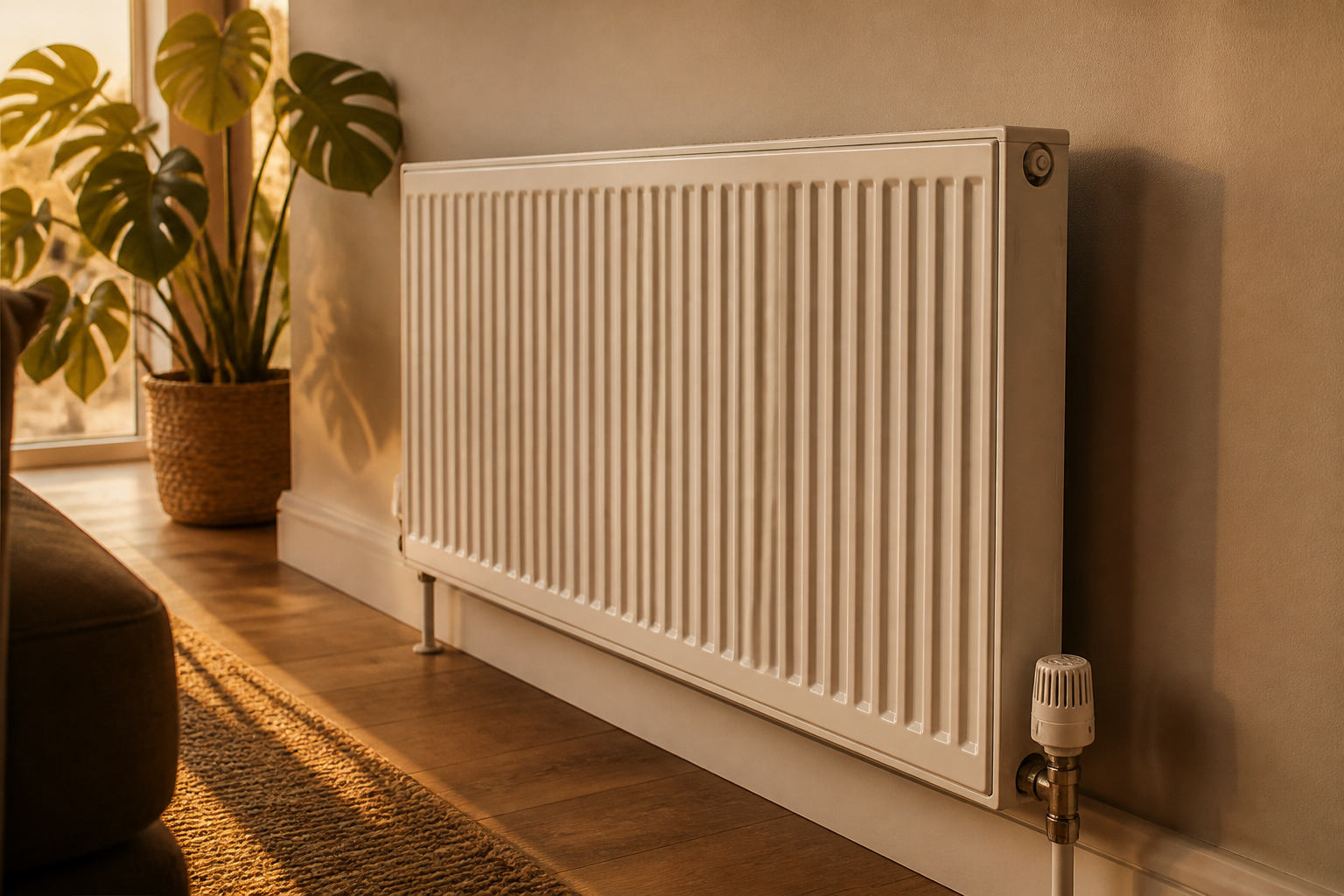
To compensate for lower flow temperatures without expanding radiator wall width excessively, installers increase heat emitter depth by fitting multi-panel, multi-convector models.
| Radiator Type | Depth (mm) | Rated Output at ΔT50 (Watts) | Output at ΔT22.5 (Watts) | Relative Output Retained | Typical Retrofit Application |
|---|---|---|---|---|---|
| Type 11 (Single Panel, Single Convector) | 50,65 | 1,000 | 354 | 35% | Bedrooms with low heat loss |
| Type 21 (Double Panel, Single Convector) | 70,90 | 1,000 | 354 | 35% | Small reception rooms |
| Type 22 (Double Panel, Double Convector) | 100,105 | 1,000 | 354 | 35% | Standard living rooms and hallways |
| Type 33 (Triple Panel, Triple Convector) | 160,165 | 1,000 | 354 | 35% | High heat-loss rooms with limited wall length |
Replacing a Type 11 radiator with a Type 22 of identical length and height increases physical surface area and convector fin density, roughly doubling thermal output per linear metre. Where wall length is constrained, Type 33 radiators provide three water panels and three layers of convector fins, delivering high heat output within a compact footprint.
Hydraulic Dynamics: Flow Rates, Pipe Diameters, and Microbore
Upgrading radiators addresses heat emission surface area, but installers must also evaluate hydraulic flow physics. Thermal energy transfer in a wet central heating system follows the equation Q = m × Cp × ΔT, where Q is heat output, m is mass flow rate, Cp is the specific heat capacity of water, and ΔT is the temperature difference between flow and return pipes.
Traditional gas boilers operate with a wide temperature differential (ΔT of 15°C to 20°C), requiring relatively low volumetric flow rates. Heat pumps operate across a much narrower differential (ΔT of 5°C to 7°C) to protect compressor stability and heat exchanger performance.
To transfer the same quantity of thermal energy at a 5°C delta T compared to a 20°C delta T, the heating system must circulate up to four times the volume of water per minute. This increase in volumetric flow rate has direct implications for pipework:
- 22mm and 28mm Copper Pipework: Ideal for main distribution legs, accommodating flow rates of 15 to 25 litres per minute without excessive velocity or noise.
- 15mm Copper Micro-Branches: Generally sufficient for individual radiator connections up to 1.5 kW output.
- 8mm and 10mm Microbore Pipework: Presents high hydraulic resistance and pressure drops. Forcing high volumetric flow rates through narrow microbore pipe can cause circulating pump overload, velocity noise, and flow starvation. Homes with microbore systems often require manifold upgrades or dedicated pipe replacement for high-demand circuits.
Practical Assessment under MCS MIS 3005-D
Under MCS MIS 3005-D standards, accredited heat pump installers must perform detailed room-by-room heat loss calculations based on structural U-values, air change rates, and local design temperatures. The calculation steps involve:
- Room Heat Loss Audit: Calculating maximum heat loss in Watts at local winter ambient temperatures, typically -2°C to -3°C in England and Wales, or -5°C in Scotland.
- Flow Temperature Optimisation: Selecting a target design flow temperature, such as 45°C or 50°C, to balance radiator replacement costs against long-term SCOP.
- Radiator Selection: Matching each room heat loss figure against radiator outputs at the chosen operating delta T using BS EN 442 correction factors.
- Hydraulic Balancing: Adjusting thermostatic radiator valves (TRVs) and lockshields to ensure uniform mass flow rate across every circuit.
What this means for you
For UK householders, radiator sizing is the central technical factor determining whether a heat pump retrofit delivers low running costs or disappointing performance. While replacing radiators adds to upfront installation complexity, it lowers long-term electricity bills by enabling low flow temperatures.
If your employer offers the Net Zero Home Scheme, you can access member pricing on heat pumps and clean home energy technology delivered by accredited installers across England, Scotland, and Wales. Employers can also complement home decarbonisation benefits with electric vehicle salary sacrifice schemes through The Electric Car Scheme and dedicated home charging via The Charge Scheme.
Frequently asked questions
Do all radiators need to be replaced when installing a heat pump?
No. In well-insulated homes or rooms with oversized existing radiators, some units may already be large enough to meet heat loss targets at 45°C flow temperatures. A room-by-room heat loss calculation under MCS MIS 3005-D determines precisely which radiators need upgrading.
Can underfloor heating replace the need for larger radiators?
Yes. Underfloor heating embeds pipework across a large floor surface area, allowing it to heat rooms effectively at very low flow temperatures of 35°C or lower. This maximizes heat pump SCOP, though ground-floor installation can involve higher upfront disruption than swapping wall radiators.
How does microbore pipework affect a heat pump installation?
Microbore pipework (8mm or 10mm) restricts water flow rates. Because heat pumps operate at narrower flow-to-return temperature gaps (ΔT of 5°C), they require higher water flow rates than gas boilers. Installers may need to upgrade main pipe trunks to 22mm or 28mm copper while managing branch connections to avoid excessive pump strain and flow noise.
Sources
- MCS MIS 3005-D Heat Pump Design Standard, Microgeneration Certification Scheme
- CIBSE Domestic Heating Design Guide, Chartered Institution of Building Services Engineers
- BS EN 442 Radiators and Convectors Standard, BSI Group