Ground Source Heat Pump Installation: A Step-by-Step UK Guide
A practical guide to installing a ground source heat pump in the UK, covering groundworks, horizontal loops, boreholes, BUS grant eligibility and installer checks.
- Written by
- Net Zero Home Scheme editorial team
- Last updated
- Topic
- heat pumps, energy efficiency, mcs
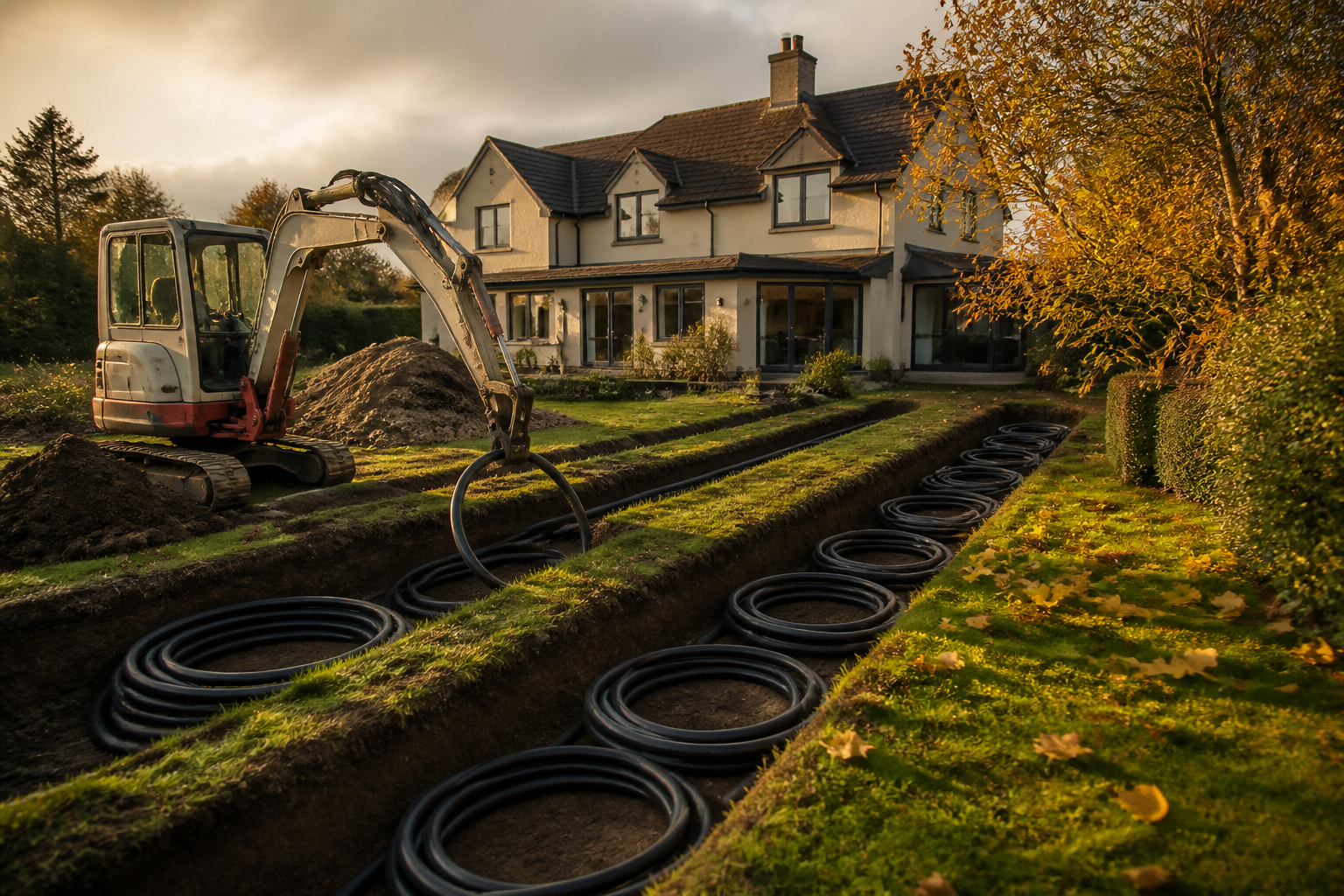
Ground source heat pumps (GSHPs) extract low-grade thermal energy stored in the earth to provide space heating and hot water. Because soil temperatures at a depth of one to two metres remain relatively stable between 8°C and 12°C throughout the year in the UK, ground source systems deliver high seasonal efficiency. However, the requirement for civil groundworks makes installation more complex and expensive than fitting an air source model.
This practical guide sets out the steps involved in planning, designing and installing a domestic ground source heat pump, including ground array options, system sizing, costs, grant eligibility and the questions to ask prospective installers.
Is your property suitable for a ground source heat pump?
Before engaging an installer, you must establish whether your land and building fabric can support a ground source system effectively.
First, assess your available outdoor space. Ground source heat pumps collect heat using fluid-filled polyethylene pipes buried either horizontally in shallow trenches or vertically in deep boreholes. A horizontal collector matrix requires an unshaded garden area roughly two to three times the total heated floor area of the property. For a typical 150 m² house, this translates to between 300 m² and 450 m² of accessible land. If land is limited, vertical boreholes require a footprint of only a few square metres, but the site must allow access for a heavy drilling rig weighing up to 10 tonnes.
Second, evaluate your home's thermal heat loss. Under Microgeneration Certification Scheme (MCS) standard MIS 3005-G, installers must perform a room-by-room heat loss calculation based on BS EN 12831. Ground source heat pumps operate most efficiently when producing low flow temperatures between 35°C and 45°C. Properties with high fabric heat loss require comprehensive loft, cavity or wall insulation, and potentially larger radiators or underfloor heating, to run efficiently at these lower flow temperatures.
Third, verify your electrical supply. Heat pump compressors require significant electrical input. Small domestic ground source units under 12 kW peak output generally run on a standard single-phase 230V grid connection. Larger properties requiring outputs above 12 kW may need a three-phase electrical supply or formal approval from the local Distribution Network Operator (DNO) prior to connection.
Ground array options: Horizontal collector vs vertical borehole
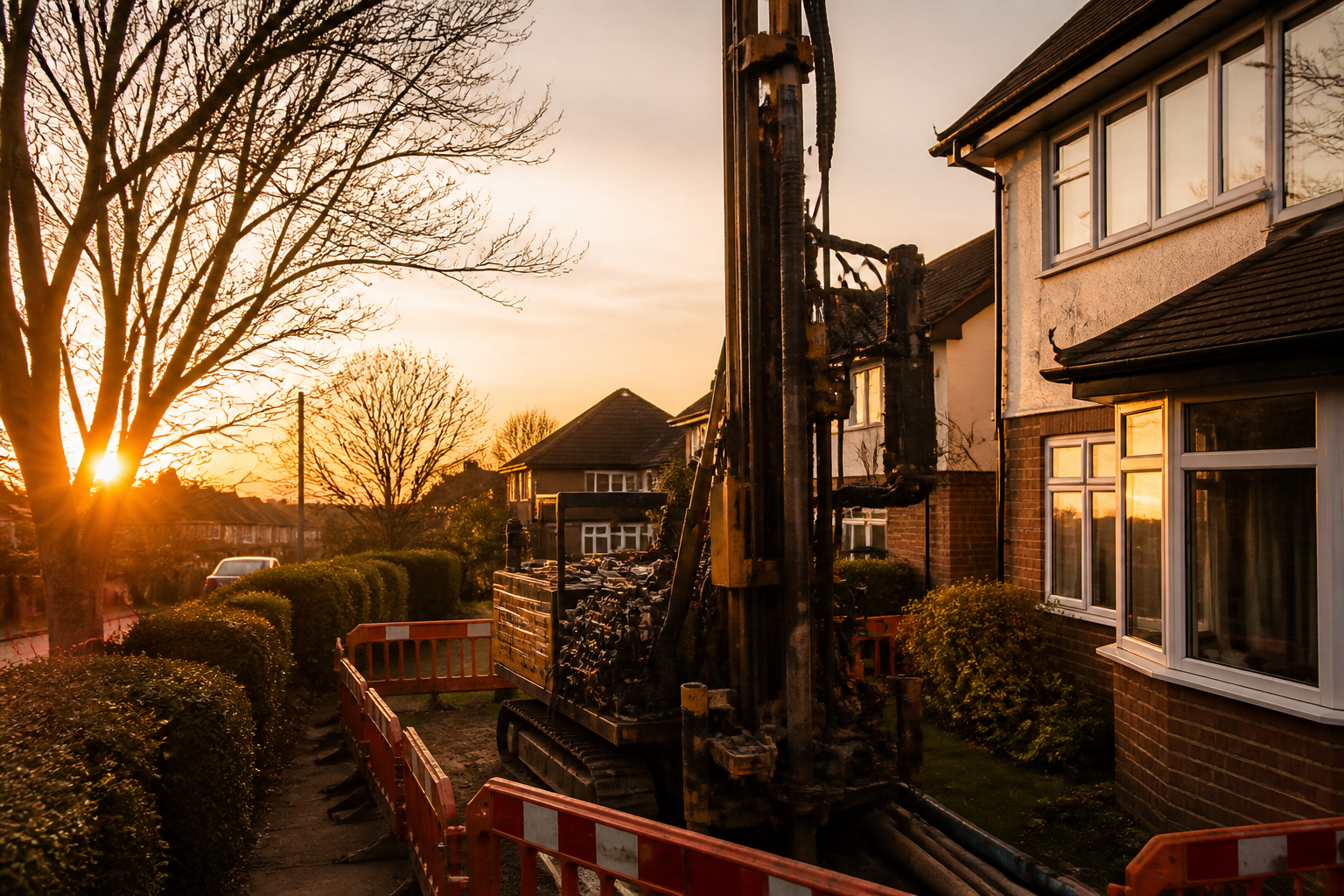
Choosing between horizontal ground loops and vertical boreholes depends on your land area, local geology and budget. The ground collector circuit circulates a water and food-grade glycol anti-freeze mixture to absorb heat from the surrounding earth.
Horizontal collectors are laid in trenches dug to a depth of 1.0 to 1.5 metres. The pipework is installed either as straight runs or coiled in overlapping circles known as slinkies. Horizontal systems are less expensive to excavate than drilling boreholes, but they cause widespread surface disruption to gardens and require suitable moist soil types, such as clay, which conduct heat efficiently.
Vertical boreholes involve drilling holes to a depth of 60 to 150 metres, into which a single or double U-shaped pipe loop is inserted and encased in thermally conductive grout. Boreholes deliver higher and more consistent fluid temperatures year-round, resulting in slightly higher efficiency, but initial civil engineering costs are substantially higher.
| Parameter | Horizontal Slinky / Straight Pipe | Vertical Borehole |
|---|---|---|
| Required Garden Land Area | 200 to 500 m² | 20 to 50 m² |
| Trench / Drill Depth | 1.0 to 1.5 metres | 60 to 150 metres |
| Typical Turnkey Cost (Before Grant) | £14,000 to £22,000 | £20,000 to £32,000 |
| Site Access Requirement | Standard mini-excavator | 5 to 10 tonne drilling rig |
| Ground Disruption | High (entire trench area) | Low (drill point area) |
| Typical Seasonal Performance (SCOP) | 3.8 to 4.4 | 4.2 to 5.0 |
Upfront costs, grants and operational economics
Total turnkey installation costs for a domestic ground source heat pump in the UK typically range from £14,000 to £22,000 for horizontal loop systems and £20,000 to £32,000 for vertical borehole systems. Total expenditure varies based on heat load, geology, pipework complexity and internal heating emitter upgrades.
In England and Wales, the UK Government offers capital support through the Boiler Upgrade Scheme (BUS), administered by Ofgem under Department for Energy Security and Net Zero (DESNZ) regulations. The scheme provides a single upfront grant of £7,500 towards eligible ground source heat pump installations, including shared ground loop systems. To qualify, the property must have a valid Energy Performance Certificate (EPC) with no outstanding recommendations for loft or cavity wall insulation, and the installation must be carried out by an MCS-certified contractor.
In terms of running costs, system performance is measured by the Seasonal Coefficient of Performance (SCOP). A system with an SCOP of 4.2 generates 4.2 kWh of heat energy for every 1 kWh of electricity consumed. If standard electricity costs 24.5p per kWh, the effective heat cost is roughly 5.8p per kWh, which compares favourably with modern condensing gas boilers operating at 90 percent efficiency on mains gas.
Step-by-step installation timeline and key milestones
A domestic ground source heat pump installation typically takes between four and ten weeks from initial site survey to final handover, following a structured workflow:
- Site assessment and heat loss design (Weeks 1 to 2): An MCS installer conducts room-by-room heat loss calculations, checks soil geology using British Geological Survey maps, selects between horizontal loops or boreholes, and submits a DNO application (G98 or G99 standard).
- Equipment specification and procurement (Weeks 3 to 4): The installer specifies the heat pump heat exchanger, buffer tank, domestic hot water cylinder, and ground pipe materials (typically PE100 high-density polyethylene).
- Groundworks and pipe laying (Weeks 5 to 6): Heavy machinery excavates trenches or drills boreholes. Pipe loops are laid, pressure tested with air and fluid to at least 6 bar under BS EN 805 standards, backfilled, and piped back to an external manifold box or plant room.
- Internal plant room and emitter fitting (Weeks 7 to 8): Engineers fit the main heat pump unit, hot water cylinder, circulating pumps, and controls. Radiators are resized or underfloor heating manifolds connected. Flushing and chemical water treatment are performed in line with BS 7593.
- Commissioning and accreditation (Week 9): The installer charges the ground loop with anti-freeze solution, balances flow rates, programs heating curves, registers the installation on the MCS database, and completes the BUS grant application redemption.
Essential questions to ask your installer
When evaluating installers for a ground source project, confirm that they hold valid MCS certification under MIS 3005-G and are registered with an approved consumer code, such as the Renewable Energy Consumer Code (RECC) or the Home Insulation and Energy Systems Contractors Scheme (HIES), alongside TrustMark registration.
Before signing a contract, ask the installer the following specific operational questions:
- Did you base the system design on a full room-by-room heat loss calculation compliant with BS EN 12831?
- What flow temperature will the system deliver at peak winter design conditions (typically -3°C external ground/air baseline)?
- Are civil groundworks, trenching, backfilling, and garden reinstatement explicitly included in the fixed quotation?
- How will ground collector pressure testing be verified before trenches are backfilled or boreholes grouted?
- What anti-freeze fluid concentration and corrosion inhibitor will be used in the ground circuit, and what is its expected service life?
What this means for you
Installing a ground source heat pump offers standard-setting efficiency and low operational carbon emissions, but requires substantial initial planning and site preparation. Establishing land suitability and working with MCS-accredited contractors ensures that design parameters match your household heat demand accurately.
If you are evaluating energy efficiency upgrades for your property, your employer may offer access to installer networks through the Net Zero Home Scheme, an employee benefit delivered by Net Zero Benefits alongside The Electric Car Scheme that connects householders with accredited installers across England, Scotland and Wales.
Frequently asked questions
Do you need planning permission for a ground source heat pump in the UK?
In England, Scotland and Wales, domestic ground source heat pumps are generally classed as Permitted Development provided all works remain within the property boundary and heat pump units conform to noise standard MCS 020. However, if your property is a listed building, situated within a conservation area, or requires works on designated land, you must check with your Local Planning Authority before commencing ground excavation or drilling.
Can ground source heat pumps work with existing radiators?
Yes, provided the radiators are sized appropriately for lower flow temperatures. Standard gas boiler systems supply water to radiators at 60°C to 70°C, whereas ground source heat pumps run most efficiently at flow temperatures of 35°C to 45°C. To maintain comfortable room temperatures, existing standard radiators may need to be replaced with double-panel (Type 22) units or fan-assisted low-temperature radiators, unless underfloor heating is installed.
How long do ground loop pipes and boreholes last?
Underground heat exchanger pipes manufactured from PE100 high-density polyethylene have a design life exceeding 50 to 100 years when installed according to industry guidelines. The internal ground source heat pump unit itself contains moving parts like compressor motors and circulating pumps, giving it an operational life of 15 to 25 years, which is significantly longer than typical air source units or gas boilers.