East-West vs South Solar Panel Orientation: Physics and Costs
An technical explainer on how solar panel orientation, physics, angle of incidence, and load profiles affect generation and economics for UK homes.
- Written by
- Net Zero Home Scheme editorial team
- Last updated
- Topic
- solar, energy efficiency, energy bills
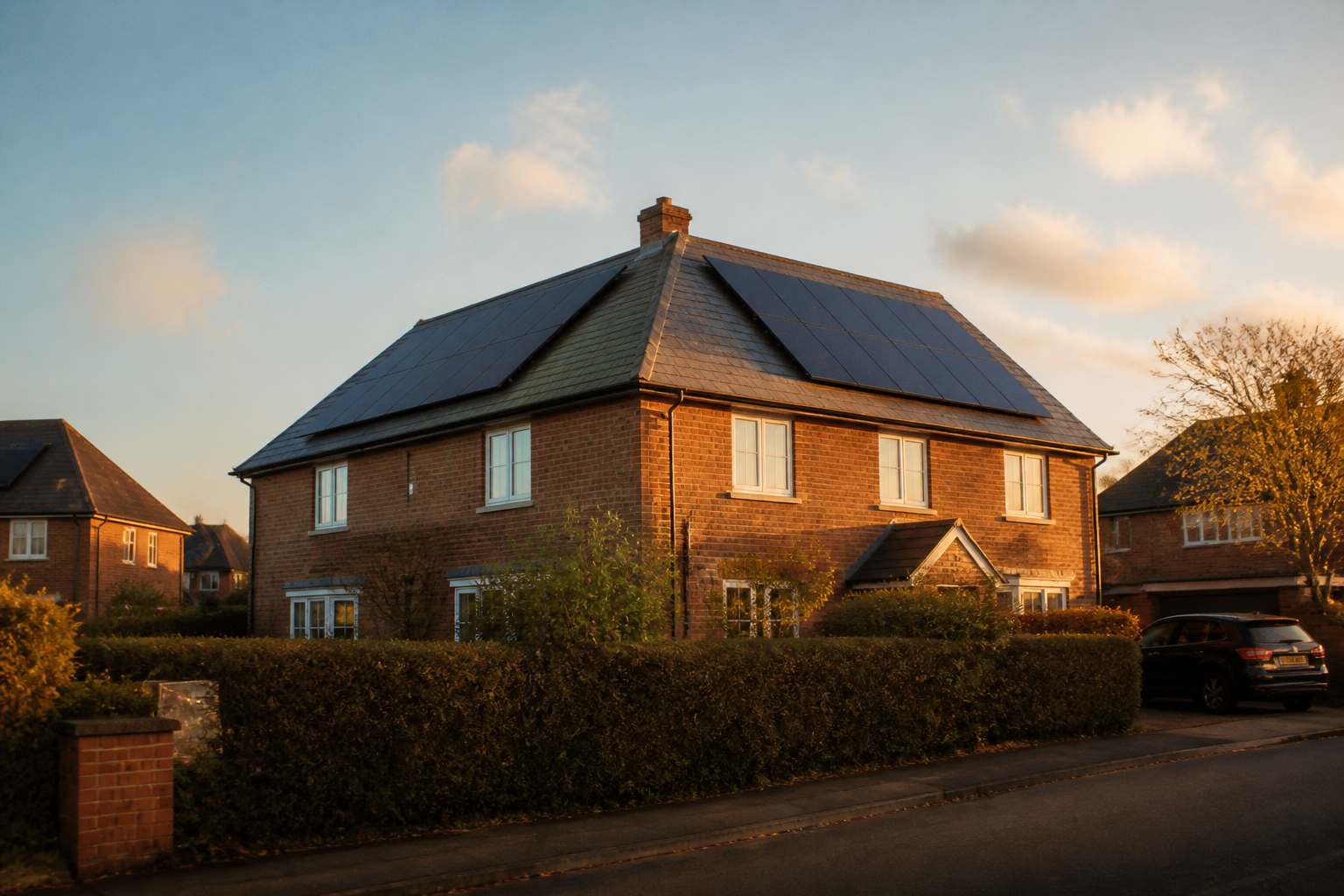
For decades, standard advice in the UK solar industry was straightforward: face panels due South at a 30 to 35-degree pitch to maximise total annual kilowatt-hour (kWh) generation. While facing South produces the highest absolute volume of electricity over twelve months, shifting home energy patterns, dynamic grid tariffs, and rising hardware options have reshaped solar design. Understanding the underlying physics of solar irradiance, angle of incidence, and diurnal load profiles reveals why an East-West solar panel layout often delivers equal or superior economic value for UK households, despite producing lower peak annual yield.
The physics of solar irradiance and angle of incidence
Solar photovoltaics convert light energy into electricity through the photoelectric effect, with power output proportional to solar irradiance striking the panel surface in watts per square metre. The intensity of sunlight hitting a panel depends directly on the angle of incidence, defined as the angle between the sun's rays and a line perpendicular to the panel surface. According to the cosine law of illumination, output decreases as the angle of incidence widens away from 90 degrees.
In the UK, located between 50 and 58 degrees North latitude, solar radiation comprises both direct beam sunlight and diffuse sky radiation. On clear summer days, direct beam light predominates, meaning orientation strongly dictates instantaneous generation. On overcast days, diffuse radiation accounts for up to 60 percent of total light, making panel pitch and orientation less dominant.
A South-facing array set at an inclination of 30 to 35 degrees maximises direct beam irradiance at solar noon (roughly 12:00 UTC), when the sun reaches its highest point in the southern sky. Conversely, an East-West array splits panel capacity across two roof aspects, usually pitched between 15 and 30 degrees. The East-facing aspect captures low-angle morning sunlight when the sun rises in the East, while the West-facing aspect generates power into the late afternoon and early evening as the sun sets in the West.
Diurnal generation profiles and self-consumption rates
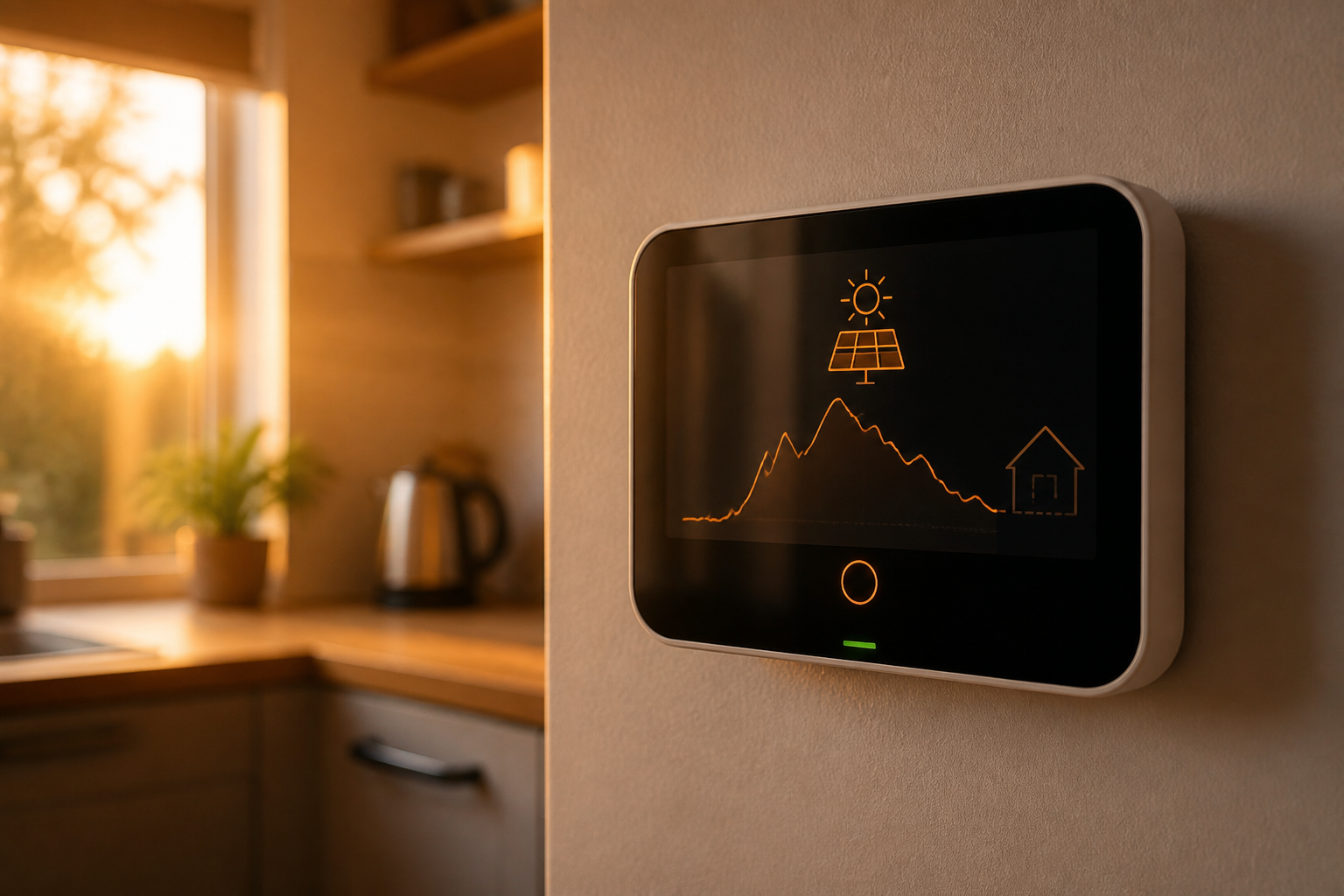
The fundamental difference between South and East-West solar arrays lies in their daily generation curve, known as the diurnal profile. A South-facing array generates power in a steep bell-shaped curve that peaks sharply between 11:00 and 14:00. An East-West system flattens this peak into a broader generation plateau that begins earlier in the morning and extends later into the evening.
According to Microgeneration Certification Scheme (MCS) performance calculation methodology using Standard Assessment Procedure (SAP) irradiance tables:
- A 4 kilowatt-peak (kWp) South-facing solar PV system in central England angled at 35 degrees produces approximately 3,800 to 4,000 kWh per year.
- An identical 4 kWp system split evenly into 2 kWp East and 2 kWp West produces roughly 3,200 to 3,400 kWh per year, representing a total yield reduction of 12 to 15 percent.
However, annual output in kWh does not directly determine financial return. For homes without battery storage, direct self-consumption, the proportion of generated solar power used directly within the building, is critical. Unmanaged South-facing arrays typically achieve self-consumption rates of 20 to 25 percent, because generation spikes at midday when typical household occupancy and energy demand are at their lowest.
In contrast, an East-West system matches domestic routine more closely. Morning output coincides with breakfast kettle use, water heating, and appliance cycles, while late afternoon output covers evening cooking and home lighting loads. Without battery storage, East-West systems routinely achieve direct self-consumption rates of 35 to 45 percent.
Inverter sizing and clipping economics
Another major engineering advantage of East-West solar arrays involves inverter loading ratios and grid export limits. Inverter capacity is measured in kilowatts (kW) of alternating current (AC), while solar arrays are rated in kilowatt-peak (kWp) of direct current (DC).
Because South-facing panels experience peak sunlight simultaneously, their combined DC output approaches maximum nameplate rating at solar noon. To avoid wasting excess energy, installers must size the AC inverter close to the peak DC rating, typically using a DC-to-AC ratio of 1.1:1 or 1.2:1.
On an East-West roof split, East and West strings reach peak output several hours apart. At 09:00, the East string operates near full output while the West string receives minimal direct light. By 16:00, the reverse occurs. Combined instantaneous DC output rarely exceeds 70 to 75 percent of the system's total DC rating at any single moment.
This physics allows engineers to significantly oversize the DC array relative to the AC inverter. For example, a homeowner can install 5 kWp of DC panels across East and West roof aspects paired with a standard 3.68 kW AC inverter. Under Energy Networks Association (ENA) G98 rules, systems with an inverter capacity up to 3.68 kW per single phase can be installed via simple notification after commissioning, avoiding lengthier prior approval applications required under G99 rules for larger inverters.
Comparing South vs East-West solar performance
| Parameter | South-Facing System (35° Pitch) | East-West Split System (15,30° Pitch) |
|---|---|---|
| Annual Specific Yield | 950,1,050 kWh per kWp | 800,880 kWh per kWp |
| Peak Output Window | 11:00 to 14:00 | 08:00 to 11:00 (East) & 15:00 to 18:00 (West) |
| Direct Self-Consumption (No Battery) | 20% to 30% | 35% to 45% |
| Optimal DC-to-AC Inverter Ratio | 1.1:1 to 1.2:1 | 1.3:1 to 1.4:1 |
| ENA Grid Connection Rules | Subject to G98/G99 export constraints | Extended export window under G98 limits |
| Electrical Requirement | Single MPPT string inverter | Dual MPPT tracker inverter required |
Trade-offs, counter-arguments, and structural limits
Despite clear operational benefits, East-West installations present trade-offs that require careful evaluation:
- Battery storage parity: If a household installs a home storage battery, the self-consumption advantage of East-West arrays diminishes. A battery captures midday solar spikes from a South-facing system for use in the evening, making high total kWh yield the priority.
- Smart export tariffs: Under Smart Export Guarantee (SEG) schemes, energy suppliers pay households for exported power. If export remuneration rates are high, maximised annual kWh generation from a South array generates higher total financial income.
- Hardware and installation complexity: Split arrays require mounting hardware on two separate roof elevations and dual Maximum Power Point Tracking (MPPT) inverter channels to manage differing string voltages independently, slightly increasing installation labor.
- Roof pitch sensitivity: Steeper roof pitches above 35 degrees penalise the off-axis array severely. East-West systems perform best on shallow roof pitches between 15 and 25 degrees, where light reduction from off-axis sun angles remains moderate.
What this means for you
Evaluating solar orientation depends on your roof geometry, budget, and energy usage patterns:
- Do not discount an East-West roof layout; the smoother generation curve matches typical domestic electricity usage patterns better than a South-facing system.
- If installing an East-West system, ensure your installer specifies a dual MPPT inverter so each roof face operates at its optimum power point.
- If you plan to install a large home battery, a South-facing aspect remains ideal to capture the maximum volume of clean energy for storage.
- Work with MCS accredited installers who model shading and yield using geographic irradiance data to confirm payback timescales.
- For employees seeking member pricing on home renewables, the Net Zero Home Scheme offers access to accredited solar, heat pump, and battery installations through workplace benefit programs.
Frequently asked questions
Can I connect East and West solar panels to the same inverter?
Yes, provided the inverter features dual Maximum Power Point Tracking (MPPT) inputs or separate string channels. Because East and West strings experience peak sunlight at different times, their operating voltages differ. Dual MPPT trackers allow the inverter to optimize power extraction from each roof face independently without cross-string electrical losses.
Do East-West solar panels require planning permission in the UK?
In England, Scotland, and Wales, installing solar panels on residential roofs typically falls under Permitted Development rights, whether installed on one roof face or two. However, rules differ if your property is listed, located in a Conservation Area, or if panels project more than 200 millimetres from the roof plane. Always verify local planning guidelines and ensure structural load compliance under MCS 012.
Is an East-West solar array worth installing without a battery?
Yes. An East-West solar array is often particularly advantageous without a home battery, because its generation profile spreads across morning and late afternoon hours when household electricity consumption is naturally higher. This alignment increases direct self-consumption of generated electricity, improving energy bill savings without requiring immediate investment in battery storage.
Sources
- Microgeneration Certification Scheme PV Standards, MCS
- Energy Networks Association Engineering Recommendation G98, Energy Networks Association