How Heat Pump Acoustic Physics Affect UK Planning Rules
Understanding decibels, sound propagation physics, and MCS 020 distance rules helps homeowners meet UK heat pump planning limits without sacrificing system efficiency.
- Written by
- Net Zero Home Scheme editorial team
- Last updated
- Topic
- heat pumps, energy efficiency, policy
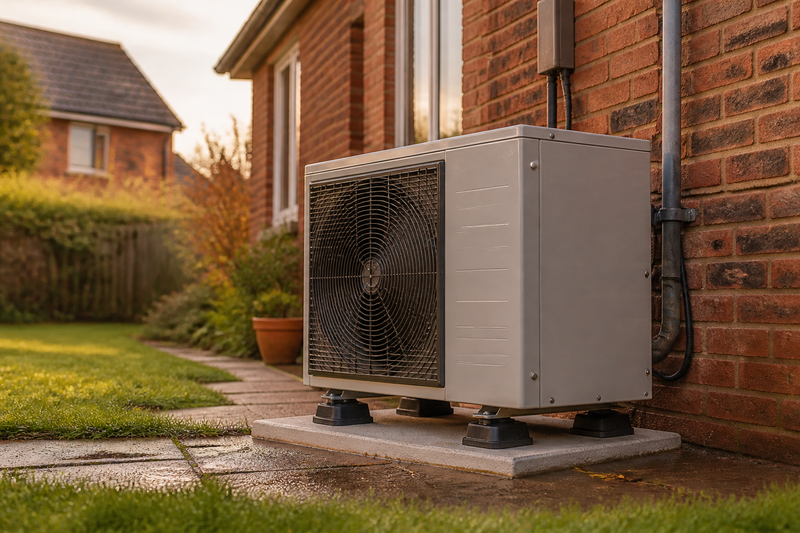
A common misconception among UK householders is that outdoor heat pumps operate like noisy industrial air conditioners, humming loudly through the night and disturbing neighbours. Another popular myth goes to the opposite extreme, claiming that modern air source units are completely silent under every operating condition. The reality is grounded in acoustic physics, ambient temperature changes, and how sound energy moves across garden boundaries.
Understanding how sound travels from outdoor heat units is not just an academic exercise. It dictates whether an installation qualifies under Permitted Development Rights across England, Scotland, and Wales, or whether you must submit a formal planning application to your local council.
1. Decoding decibel ratings and sound power versus sound pressure
When comparing unit specifications, householders often confuse sound power level with sound pressure level. Sound power level, measured in decibels (dBA) and denoted as Lw, is the total acoustic energy emitted by the heat pump unit at its source. Sound pressure level, denoted as Lp, is the actual sound intensity you hear at a specific distance from the machine.
Manufacturer brochures typically quote sound power levels between 55 dBA and 65 dBA for modern monobloc units. However, sound intensity decreases naturally as it spreads across open space. In free-field conditions without reflecting surfaces, acoustic energy follows the inverse square law of physics, which dictates that sound pressure level drops by 6 dBA every time your distance from the source doubles.
The human ear processes sound on a logarithmic scale. A 3 dBA increase represents a doubling of acoustic sound power, but most people perceive a 10 dBA increase as a doubling of loudness. Typical daytime background noise in a suburban UK garden ranges from 40 dBA to 50 dBA, while a quiet residential street at night drops to between 30 dBA and 35 dBA. Understanding this baseline helps put heat pump acoustic emissions into real-world context.
2. Evaluating the MCS 020 acoustic planning calculator
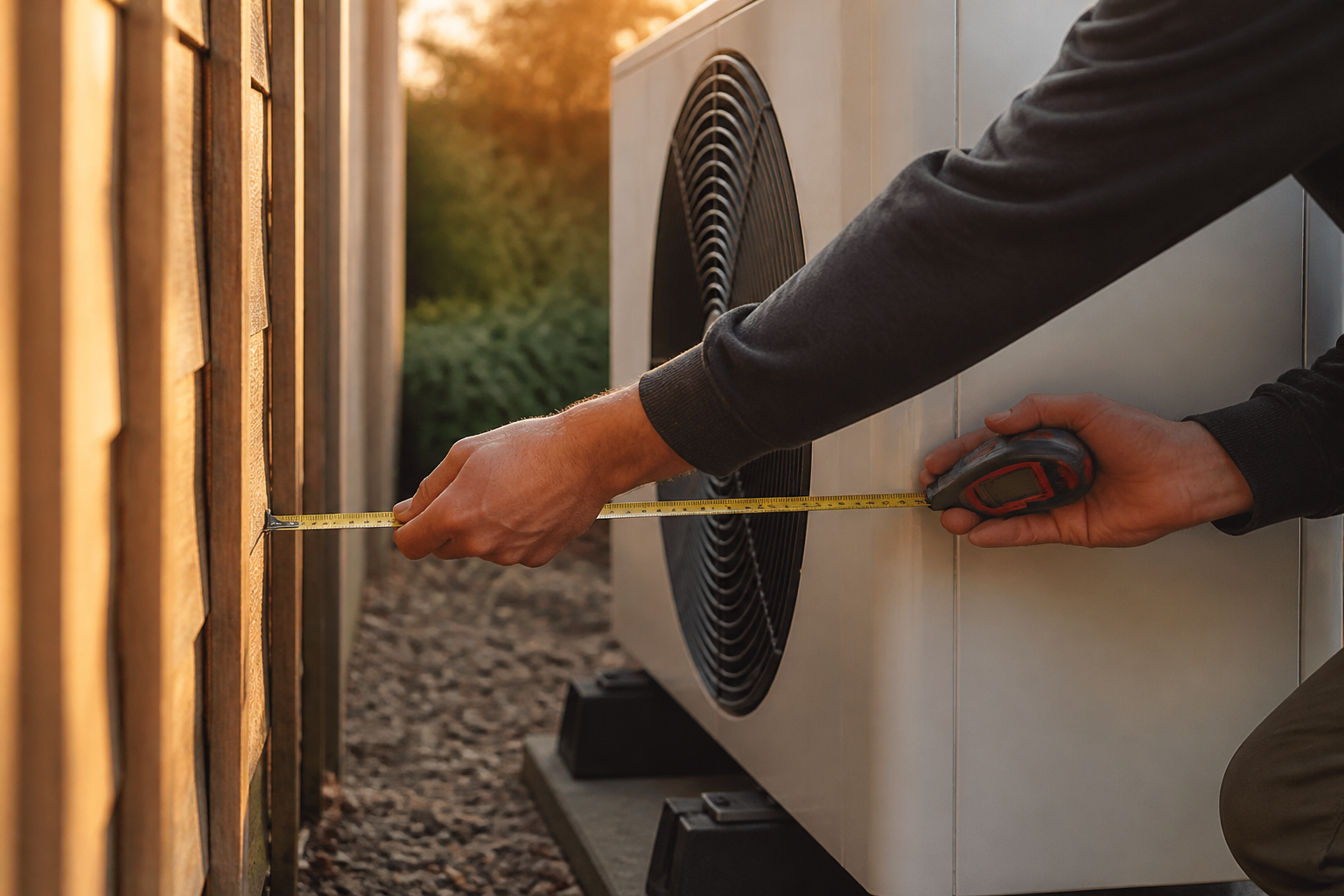
To install an air source heat pump without formal planning permission under Permitted Development Rights in England and Wales, the installation must comply with the Microgeneration Certification Scheme standard MCS 020. Under these regulations, the sound pressure level generated by the heat pump must not exceed 42 dBA at the nearest assessment position, which is defined as a door or window of a neighbouring habitable room.
In Scotland, the Town and Country Planning (General Permitted Development) (Scotland) Order similarly sets acoustic limits to protect residential amenity. Calculating compliance requires applying specific adjustments to the manufacturer's tested sound power level based on site geometry.
The MCS 020 calculation accounts for three primary physical variables: distance to the assessment point, reflection from surrounding vertical surfaces (known as the Q-factor or directivity), and shielding provided by solid barriers such as brick walls or solid timber fences.
| Distance from Heat Pump (Metres) | Direct Free Field Pressure (dBA) | Single Wall Reflection (dBA) | Wall Corner Reflection (dBA) |
|---|---|---|---|
| 1.0 | 50.0 | 53.0 | 56.0 |
| 2.0 | 44.0 | 47.0 | 50.0 |
| 3.0 | 40.5 | 43.5 | 46.5 |
| 5.0 | 36.0 | 39.0 | 42.0 |
| 10.0 | 30.0 | 33.0 | 36.0 |
Note: Figures assume a typical outdoor monobloc unit emitting a starting sound power level of 58 dBA.
Positioning a heat pump against a flat exterior wall adds 3 dBA to the noise level measured at a distance because sound waves that would otherwise radiate backwards reflect off the brickwork. Placing the unit in a corner bounded by two walls increases the sound pressure by 6 dBA, requiring a greater physical distance to reach the 42 dBA threshold at your boundary.
3. Accounting for cold weather physics and peak fan speeds
Heat pump noise is not static throughout the year. The compressor and fan speed vary based on outdoor temperatures and your household heating demand. In mild weather, when outdoor temperatures are 10 to 12 degrees Celsius, the inverter-driven compressor operates at partial load, and the fan turns slowly, resulting in sound pressure levels well below maximum ratings.
During winter, two physical factors cause sound emissions to rise. First, cold outdoor air is denser, requiring higher fan speeds to draw sufficient air volume across the evaporator coils. Second, as outdoor temperatures drop toward freezing, heat demand from your radiators increases, forcing the compressor to run at higher speeds to maintain system flow temperatures.
Defrost cycles introduce temporary changes in sound character. When frost builds up on outdoor evaporator fins in temperatures between minus 2 and plus 5 degrees Celsius, the heat pump temporarily reverses its cycle to melt the ice. During defrosting, the outdoor fan stops while the compressor operates under high load, accompanied by a brief whooshing sound as four-way directional valves switch refrigerant flow.
Physical mounting also influences acoustic transfer. If an installer anchors a unit directly to an exterior house wall without vibration isolation, mechanical energy can transfer into structural brickwork, turning internal plasterboard into a sounding board. Placing the unit on a free-standing ground slab fitted with heavy-duty anti-vibration rubber mounts decouples mechanical movement from the building fabric entirely.
4. Resolving layout trade-offs and acoustic mitigations
Achieving acoustic compliance often creates physical trade-offs with thermal efficiency and installation costs. Placing a heat pump far away from the house in a garden corner easily meets the 42 dBA limit at the boundary, but running long insulated heat pipes underground increases hydraulic resistance and minor thermal line losses.
Installing acoustic enclosures around outdoor units can reduce sound levels by 3 dBA to 10 dBA, but tight enclosures restrict airflow. If air circulation is choked, the evaporator cannot draw sufficient heat energy from ambient air, lowering the system Seasonal Coefficient of Performance (SCOP) and raising electricity consumption. Any acoustic barrier must maintain clearance distances specified by manufacturers to avoid recirculating cold discharge air back into the intake.
Solid garden barriers act as effective acoustic shields, provided they have no gaps and possess a surface density of at least 10 kilograms per square metre. A solid brick wall or heavy acoustic timber fence that breaks the direct line of sight between the heat pump and a neighbour window subtracts up to 10 dBA from the calculated sound pressure level under MCS 020 rules. Soft vegetation like hedges or bushes provides visual screening but offers negligible sound attenuation at low frequencies.
5. Planning sign-off and installer documentation
Before installing an air source unit, an MCS-certified installer must complete and sign off an MCS 020 acoustic assessment sheet. This document forms part of your installation compliance record and proves to local planning authorities that the system meets Permitted Development Rights.
If your property layout makes it impossible to reach the 42 dBA threshold at a neighbour's window, the installation cannot proceed under Permitted Development. In such cases, you must apply for formal planning permission from your local planning authority, which may require a detailed acoustic survey or specific mitigation measures.
For employers looking to support staff who want to lower household bills by upgrading home energy systems, bringing clear options into the workplace requires minimal operational effort. Through The Net Zero Home Scheme, employers can give staff access to savings of up to 15% on swapping your boiler for a heat pump installed by accredited installers, with zero management overhead and no payroll integration needed.
Does a heat pump need full planning permission if it fails the MCS 020 noise test?
Yes. If your proposed installation location cannot meet the 42 dBA sound pressure limit at the nearest neighbouring window or door under MCS 020 calculations, it does not qualify for Permitted Development Rights in England, Scotland, or Wales. You must apply for formal planning permission from your local council before fitting the unit.
How does severe frost affect outdoor heat pump noise?
During severe frost, heat pumps operate fan and compressor components near maximum speed to meet building heat loads, which slightly raises continuous sound levels. Additionally, periodic defrost cycles occur every 30 to 90 minutes, stopping the fan and temporarily changing the acoustic tone while the system melts ice from outdoor coils.
Can you put a heat pump in a garden shed to cut sound levels?
No. Heat pumps require vast volumes of fresh ambient air to extract thermal energy. Enclosing a unit inside a standard garden shed starves the evaporator coil of airflow, causing performance to collapse, increasing energy bills, and causing system errors due to cold air recirculation.
Sources
- MCS 020: Sound Insulation Standard for Heat Pumps, Microgeneration Certification Scheme
- The Town and Country Planning (General Permitted Development) (England) Order 2015, UK Legislation