£150bn Grid Megaproject to Raise Near-Term Energy Bills
The Guardian reports a £150bn grid upgrade will build five times more power infrastructure by 2030, raising short-term bills to secure long-term energy independence.
- Written by
- Net Zero Home Scheme editorial team
- Last updated
- Topic
- energy bills, policy, tariffs
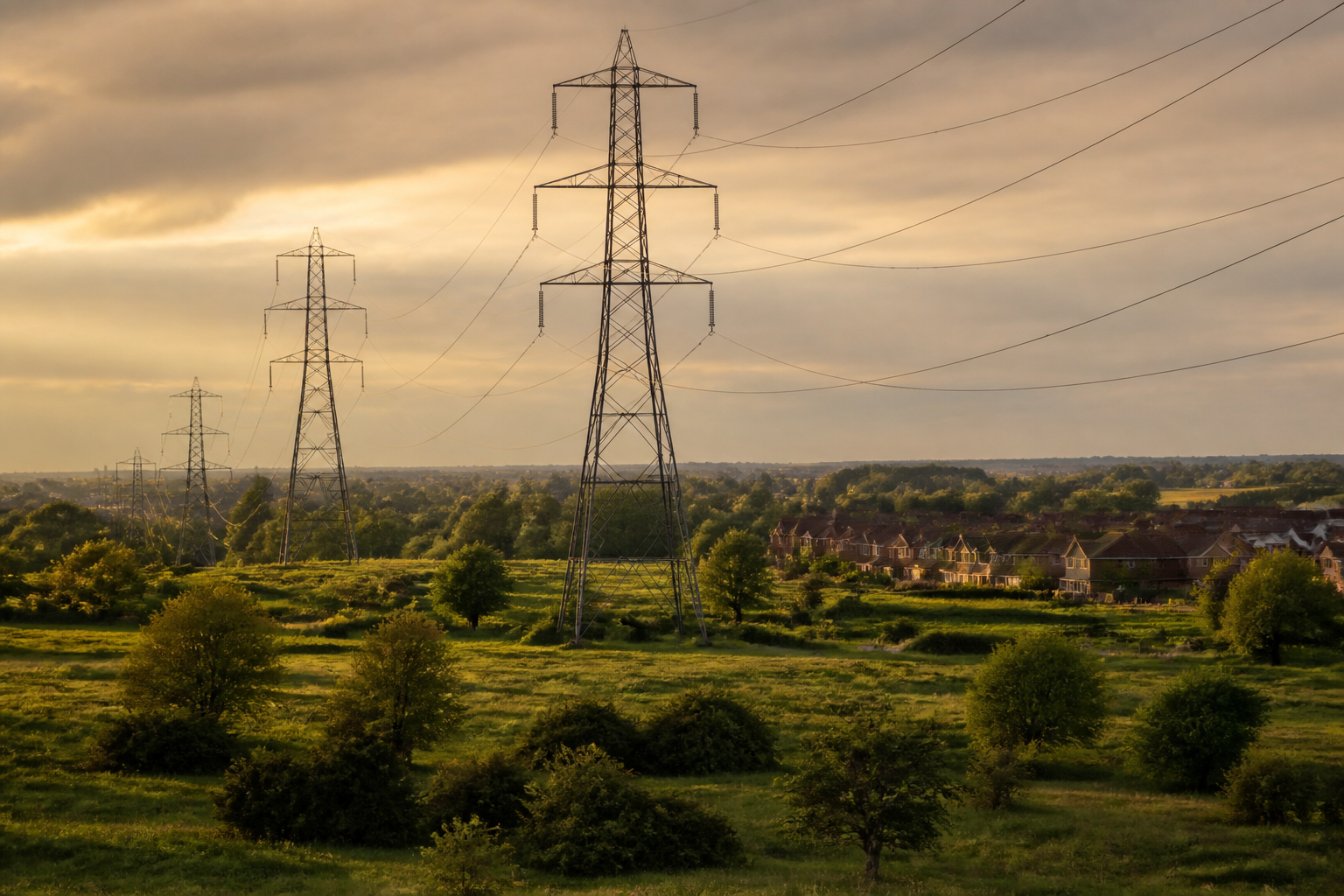
The Guardian reported on 13 September 2026 that Britain has commenced a £150 billion megaproject to overhaul the national electricity grid, aimed at insulating the country against future international energy shocks. The plan involves constructing five times more grid infrastructure by 2030 than was built across the entire previous three decades, including thousands of miles of subsea cables, high-voltage pylons, and converter stations.
While the investment is intended to lower long-term wholesale power costs by connecting renewable generation to major demand centres, energy industry regulators and analysts confirm that consumers will face higher electricity bills in the short term. Upfront construction costs are recovered through regulated network charges on household energy bills, increasing delivery tariffs before lower-cost renewable generation fully comes online.
Grid expansion plans and local network costs
The scale of the £150 billion transmission upgrade reflects decades of underinvestment in cross-country electrical links. As offshore wind farms in North Sea waters and onshore solar projects expand, existing transmission corridors lack the capacity to carry power southwards toward urban population hubs. Without upgraded lines, grid operators must pay wind farm developers constraint payments to switch off generation during high-wind periods, while firing up gas power stations closer to cities, adding millions of pounds to consumer bills.
To resolve these bottlenecks, the megaproject requires an unprecedented construction effort across England, Scotland, and Wales. New subsea high-voltage direct current (HVDC) links will bypass congested land routes, alongside new overland pylon corridors and heavy-duty substations. However, the mechanism used by Ofgem to finance major infrastructure permits transmission operators to recoup capital expenditure directly through network charges. These network fees, which comprise both transmission (TNUoS) and distribution (DUoS) levies, form a substantial part of every domestic electricity tariff standing charge and unit rate.
What the numbers say
The figures published by The Guardian on 13 September 2026 outline the scale, timeline, and financial footprint of Britain's grid expansion project.
| Metric or Headline Figure | Reported Value | Source & Date |
|---|---|---|
| Total Infrastructure Investment | £150 billion | The Guardian, 13 September 2026 |
| Target Construction Window | 5x previous 30 years' build by 2030 | The Guardian, 13 September 2026 |
| Primary Infrastructure Types | Subsea cables, pylons, converter stations | The Guardian, 13 September 2026 |
| Short-Term Consumer Impact | Increased household energy bills | The Guardian, 13 September 2026 |
| Primary Operational Goal | Protect Britain from global energy price shocks | The Guardian, 13 September 2026 |
The reporting highlights that while the long-term economic case relies on replacing expensive imported natural gas with domestic clean power, the timing of capital expenditure creates a temporary cost surge for billpayers. Network charges will rise steadily over the next four years to service the capital debt taken on by transmission companies.
Why network charges increase short-term household bills
Domestic energy bills consist of three main components: wholesale energy costs, policy levies, and network charges. Wholesale costs represent the purchase price of electricity generated by gas, wind, solar, or nuclear facilities. Network charges cover the physical delivery of that electricity through national transmission pylons and regional distribution cables to consumer property meters.
When network operators build new converter stations or lay subsea power lines, Ofgem sets allowable revenue allowances under its price control frameworks. Distributors collect these allowances from retail energy suppliers, who pass them directly to consumers within daily standing charges or unit rates per kilowatt-hour (kWh). Because infrastructure construction takes several years to complete, consumers pay for grid expansion before benefiting from the reduced wholesale costs that clean power generation brings.
For households with high electricity consumption, rising grid delivery tariffs make reliance on standard grid supply increasingly expensive. Understanding how these capital costs feed into daily billing helps homeowners evaluate self-generation and storage options that bypass grid delivery fees during peak hours.
What this means for your home
Rising grid delivery charges alter the financial calculations for home energy upgrades, increasing the value of generating and storing electricity on site.
- Solar PV Systems: Generating electricity locally with rooftop solar panels completely avoids network charges on self-consumed power. Every kilowatt-hour produced by your roof and used directly in your home saves the full retail rate, including grid delivery levies and taxes.
- Home Battery Storage: Combining solar PV with a domestic battery allows you to store excess daylight generation for evening use. Alternatively, on dynamic half-hourly tariffs, a battery can be charged from the grid during overnight off-peak windows when wholesale rates drop, shielding your household from peak evening grid prices.
- Heat Pump Efficiency: As gas prices remain vulnerable to global market fluctuations and grid electricity delivery fees rise, operating a heat pump at high seasonal efficiency (SCOP of 3.5 or above) becomes essential. Pairing a heat pump with rooftop solar or off-peak battery storage keeps heating costs lower than legacy gas or direct electric systems.
- Plug-In Solar: For renters or households without space for full roof arrays, plug-in solar micro-systems offer an accessible entry point to reduce daytime baseline grid import fees.
Homeowners planning energy improvements this year should focus on maximising self-consumption, ensuring system sizing matches daily usage patterns rather than over-exporting to the grid at low export rates.
What this means for employers
Sustained pressure on household energy bills directly affects employee financial well-being and workplace performance. As grid transmission costs push up domestic standing charges and unit rates over the next several years, workers face persistent living cost pressures even when wholesale fuel markets stabilise.
HR professionals and reward directors are increasingly looking beyond conventional pay reviews to practical benefits that reduce recurring household overheads. Providing access to home clean energy technology allows staff to lower their monthly energy expenditure permanently.
Employers can support their workforce through the Net Zero Home Scheme, an employee benefit that gives workers member pricing on accredited installations of solar PV, heat pumps, battery storage, and plug-in solar across England, Scotland, and Wales. The scheme is completely free for employers to introduce, involves no salary sacrifice or payroll deductions, and provides staff with a structured, verified pathway to home energy independence.
Frequently asked questions
Will electricity bills rise immediately because of grid upgrades?
Network charges are adjusted periodically by Ofgem under set regulatory price controls. While the £150 billion megaproject capital is deployed between now and 2030, network fees will be phased into standard tariffs, contributing to incremental bill rises over the coming years rather than a single overnight spike.
How does home battery storage protect against grid delivery charges?
Home battery storage allows you to import grid electricity during off-peak hours when wholesale prices are low and grid networks are underutilised. By discharging stored power during peak morning and evening windows, you avoid importing high-cost grid power when network charges and unit rates are highest.
Do network charges apply to solar energy generated on my roof?
No. Network delivery charges only apply to electricity imported from the public distribution grid through your supplier meter. Power generated by your rooftop solar panels and consumed inside your home bypasses the distribution network entirely, incurring zero transmission charges, levies, or retail unit fees.