Installing Fan-Assisted Radiators for Heat Pumps: A UK Guide
Learn how fan-assisted radiators deliver high thermal output at low heat pump flow temperatures without requiring oversized panels on your walls.
- Written by
- Net Zero Home Scheme editorial team
- Last updated
- Topic
- heat pumps, energy efficiency, home energy
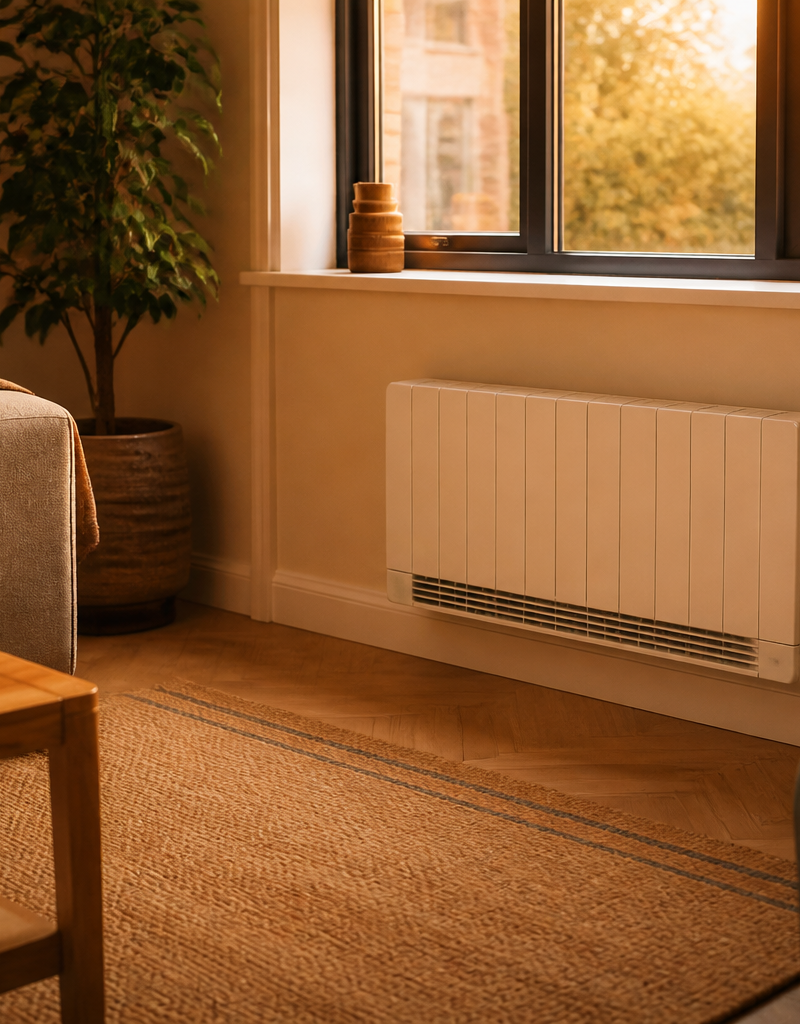
When retrofitting an air source heat pump into a UK home, running the system at a low flow temperature, such as 35°C to 45°C, delivers the highest efficiency and lowest running costs. According to guidance from the Energy Saving Trust, lowering system water temperatures allows a heat pump to operate at a higher Seasonal Coefficient of Performance (SCOP). However, cooler water produces less heat per square metre of surface area on traditional steel panel radiators.
To compensate, standard static radiators often need to double or triple in physical size, which can present a problem in rooms with limited wall space under windows or in narrow hallways. Fan-assisted radiators, also known as fan convectors or hydronic fan coil units, offer a practical alternative by using internal micro-fans to increase airflow over compact heat exchangers, yielding high heat outputs from a minimal wall footprint.
How Fan-Assisted Radiators Work
Unlike traditional panel radiators that rely on natural air convection and thermal radiation, fan-assisted radiators contain an internal copper coil with aluminium fins paired with ultra-low energy brushless direct current (DC) fans. Water from the heat pump flows through the internal heat exchanger while the integrated fans draw room air across the coil and release warm air into the room.
Because forced convection transfers heat far more rapidly than passive movement, a fan convector operating at a low flow temperature of 40°C can match or exceed the heat output of a standard static radiator that is twice its length and depth. The fans automatically modulate their speed based on the temperature of the incoming water and the target room temperature, drawing minimal power while remaining quiet during normal operation.
What to Check Before Installation
Before specifying fan-assisted radiators for your home, several technical factors must be evaluated by a qualified heating engineer.
- Room-by-room heat loss: Heat loss calculations must follow CIBSE Guide A methodology to establish the required heat output in Watts for each room based on a standard UK design outdoor temperature, typically -3°C.
- Electrical power availability: Unlike conventional radiators, fan convectors require a electricity supply to run their internal fans and digital thermostats. You will need a switched fused connection unit (FCU) wired nearby, compliant with BS 7671 electrical safety rules.
- Acoustic requirements: Sound levels are measured in decibels, dB(A), under standard BS EN 12102 testing. In quiet living areas or bedrooms, select units certified to operate below 25 dB(A) on low or nighttime mode.
- Existing pipework sizing: High flow rates are required to maintain low delta T temperature differences across heat pump emitters. Existing 15mm copper or barrier pipework is usually suitable, but microbore pipework under 10mm may restrict flow and require upgrading.
Comparing Emitter Options for Low-Temperature Systems
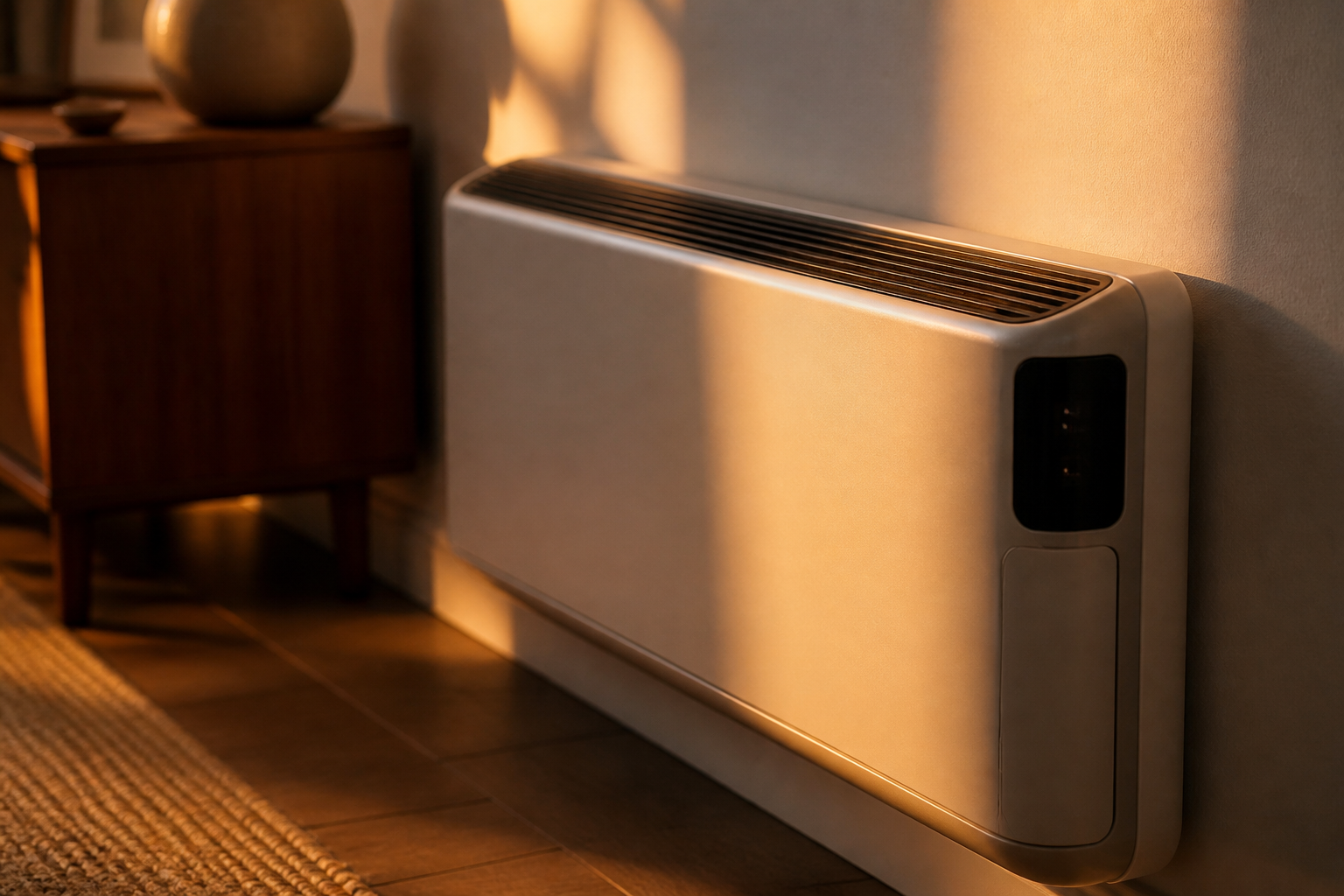
The table below outlines the physical size, heat output, power requirements, and typical hardware costs for standard static radiators versus fan-assisted units when operating at a heat pump flow temperature of 45°C.
| Emitter Type | Typical Dimensions (Length x Height x Depth mm) | Heat Output at 45°C Flow (Watts) | Electrical Supply Required | Estimated Hardware Cost per Unit |
|---|---|---|---|---|
| Standard Type 22 Panel Radiator | 1000 x 600 x 100 | 450 W | No | £90 - £160 |
| Oversized Type 33 Panel Radiator | 1400 x 600 x 160 | 1,100 W | No | £190 - £320 |
| Compact Fan-Assisted Convector | 1000 x 600 x 120 | 1,200 W | Yes (230V FCU or 24V supply) | £380 - £650 |
| High-Output Fan-Assisted Convector | 1400 x 600 x 120 | 2,200 W | Yes (230V FCU or 24V supply) | £550 - £880 |
Installation Steps and Realistic Timelines
Replacing standard radiators with fan-assisted units during a heat pump retrofit involves both plumbing and electrical work. The entire process for a typical three-bedroom home follows a defined sequence over three to five working days.
- Detailed Heat Loss Assessment (Days 1 to 2): An engineer assesses building fabric, measures rooms, and calculates exact Wattage requirements for each space under MCS MIS 3005-D standards.
- Electrical First-Fix Wiring (Day 3): A certified electrician installs local fused spurs or runs low-voltage cabling from a central power supply to each intended radiator position in accordance with Part P of the Building Regulations.
- Electrical Connection and Controls Setup (Day 4): Radiators are wired into local spurs, and onboard electronic controllers are linked to room thermostats or central heating controls.
- Commissioning and Balancing (Day 5): The hydronic circuit is filled, vented, and pressure tested. Hydraulic flow rates are balanced, and fan speed settings are verified across high, medium, and silent operating modes.
Accreditation and Standards to Look For
When hiring professionals to specify and fit fan-assisted radiators alongside a heat pump system, verify that installers hold recognized UK accreditations.
- Microgeneration Certification Scheme (MCS): Ensures the total system design, emitter sizing, and heat pump integration comply with MCS MIS 3005-D standard.
- NICEIC, NAPIT, or ELECSA: Confirms that the electrician installing fused spurs holds registered competent person status under Part P of the Building Regulations.
- Renewable Energy Consumer Code (RECC) or HIES: Provides consumer protection, clear contract terms, and deposit protection for home energy installations.
- TrustMark: Demonstrates government-endorsed quality standards and adherence to consumer service standards.
What this means for you
Choosing fan-assisted radiators allows you to run your heat pump at lower water flow temperatures, maximizing efficiency without compromising space or aesthetics in smaller rooms. While individual unit costs are higher than standard steel panel radiators and require nearby electrical connections, they resolve spatial constraints in retrofits where larger Type 33 radiators simply cannot fit.
If your employer participates in the Net Zero Home Scheme, you can access member pricing on heat pump installations and complementary home energy upgrades through accredited installers operating across England, Scotland, and Wales.
Frequently asked questions
Are fan-assisted radiators noticeable or noisy in bedrooms?
Modern fan convectors use variable-speed brushless DC motors designed for quiet domestic operation. On low or nighttime modes, quality units produce sound levels between 19 dB(A) and 24 dB(A) at a distance of one metre, which is comparable to a soft whisper or a quiet refrigerator. They are suitable for bedrooms when sized correctly so the fan only needs to run at low speeds.
How much electricity do the internal fans consume?
Internal micro-fans draw very little power, typically consuming between 2 Watts and 10 Watts per radiator depending on fan speed. Over an entire heating season, a typical household running four fan convectors will add less than 20 to 30 kWh to their total annual electricity consumption, which is far outweighed by the efficiency gains of running the heat pump at lower flow temperatures.
Can fan-assisted radiators be used with an existing gas boiler?
Yes. Fan-assisted radiators operate effectively at higher water temperatures such as 60°C or 70°C, providing rapid warm-up times. Installing them while keeping your current boiler allows you to size room emitters for future low-temperature operation, making a subsequent transition to an air source heat pump simpler and less disruptive.