Guide to Installing Decentralised MVHR in UK Homes
A practical step-by-step guide to retrofitting decentralised MVHR fans in UK homes, covering costs, wall checks, installer questions and timelines.
- Written by
- Net Zero Home Scheme editorial team
- Last updated
- Topic
- energy efficiency, home energy, energy bills
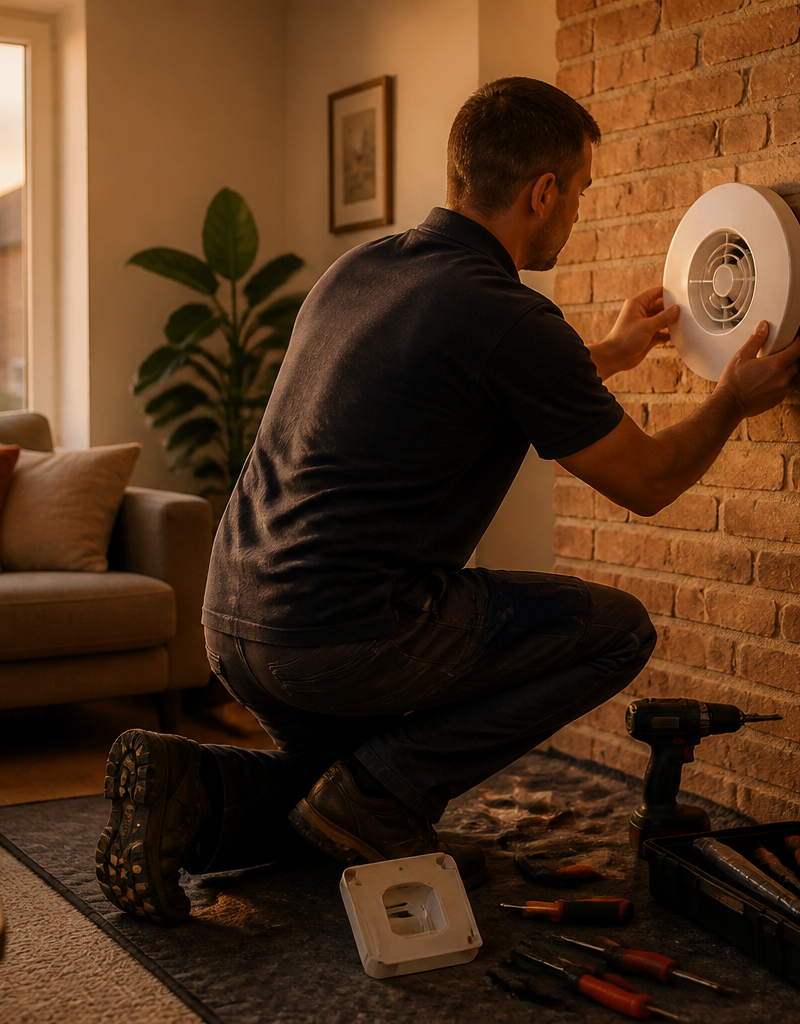
When retrofitting insulation or draught-proofing in older UK properties, improving airtightness without upgrading ventilation often causes humidity buildup, condensation and mould. While whole-house centralized Mechanical Ventilation with Heat Recovery (MVHR) offers high thermal efficiency, installing rigid ductwork through existing ceilings and floor joists is expensive and invasive. Decentralised MVHR (dMVHR), also known as single-room or through-the-wall heat recovery ventilation, offers a practical alternative. These compact units fit directly into an external wall penetration, extracting moist air and recovering heat to warm incoming fresh air without requiring any internal ducting.
According to Energy UK in its 23 August 2026 report on household energy pressure, UK homes continue to face elevated energy costs, making heat retention a priority during building retrofits. Retaining space heating while delivering fresh air makes dMVHR an increasingly popular upgrade for flats, Victorian terraces and single-room damp remedies.
What to check before installing decentralised MVHR
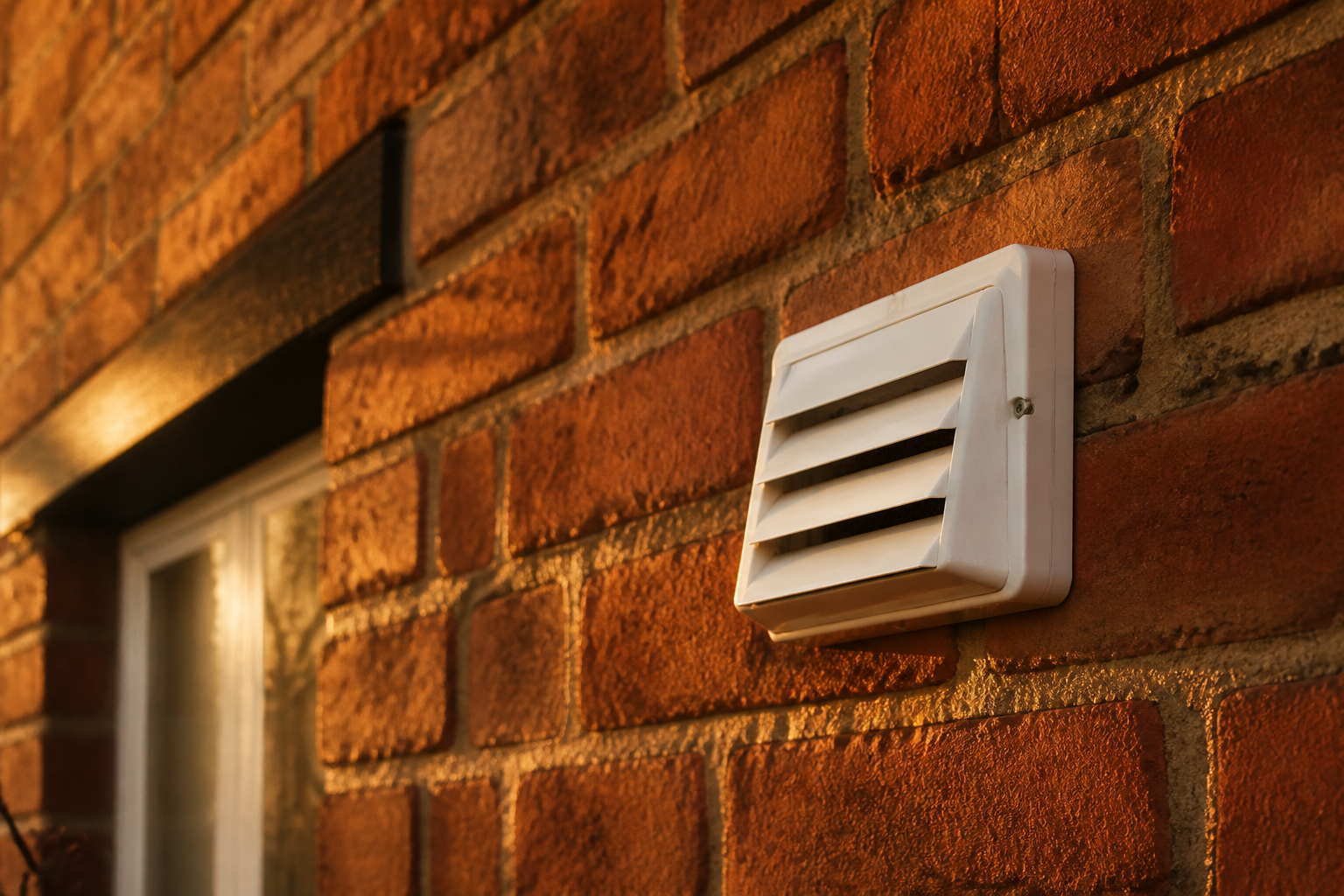
Before buying dMVHR units or hiring an installer, householders must assess several structural and electrical factors to ensure the system delivers adequate airflow and heat recovery.
- Wall thickness and construction: Most dMVHR units require an external wall opening of 100mm to 160mm in diameter. The wall duct tube must stretch through the entire wall build-up, typically requiring a wall thickness between 250mm and 500mm. Solid brick, stone, cavity brick and timber frame walls are all suitable, but narrow walls under 200mm may require external shroud extensions.
- Electrical supply proximity: dMVHR fans require a continuous 230V mains power connection, usually taken from a local fused spur tapped into a nearby socket circuit or lighting loop. Units in bathroom zones must meet IPX4 ingress protection ratings and connect via an RCD-protected supply.
- Single unit versus paired push-pull operation: Single continuous units use a concentric duct or micro heat exchanger to extract and supply air simultaneously. Alternating push-pull units operate in synchronized pairs. One fan extracts warm air for 70 seconds to heat a ceramic core, while the paired unit in an adjacent room supplies fresh air. The units then reverse airflow simultaneously. Paired setups provide higher thermal efficiency and balanced air pressure across rooms.
- Room volume and Building Regulations Part F: Under UK Building Regulations Approved Document F (Ventilation), habitable rooms like bedrooms and living rooms require background ventilation rates of roughly 0.3 to 0.5 air changes per hour. Wet rooms like kitchens and bathrooms require trickle ventilation alongside boosted extract rates (typically 15 litres per second for bathrooms and 30 to 60 litres per second for kitchens). Ensure the dMVHR unit's trickle and boost speeds match these statutory requirements.
System costs and running expenses
Decentralised MVHR hardware varies in price depending on ceramic thermal efficiency, filtration levels, noise insulation and smart control features.
- Hardware costs: A standard single-room dMVHR fan costs between £250 and £450 including VAT. Premium paired systems with Wi-Fi synchronization, humidity sensors and G3 or F7 pollen filters cost between £600 and £1,100 for a two-unit kit.
- Installation labour: Core drilling through brickwork or stone and running an electrical fused spur typically costs between £150 and £350 per unit in labour, depending on access and wall construction.
- Total package cost: Retrofitting a typical two-bedroom flat with four paired dMVHR units costs between £1,400 and £2,600 installed. Retrofitting a three-bedroom house with six units across bedrooms and living spaces costs between £2,200 and £3,800.
- Running costs: dMVHR fans consume minimal electricity, typically between 2W on trickle speed and 7W on boost speed. Running a unit continuously at an average load of 4W consumes roughly 35 kWh per year. At a standard electricity tariff of 24.5p per kWh, each unit costs less than £9 per year in power while recovering up to 85% to 90% of thermal heat that would otherwise be lost through open trickle vents or extract fans.
Comparing UK home ventilation options
Selecting the right ventilation system depends on property layout, disruption tolerances and budget. The table below outlines how dMVHR compares with other common retrofitting options.
| Ventilation System | Typical Installed Cost | Ductwork Needed | Thermal Heat Recovery | Best Suited Property Type |
|---|---|---|---|---|
| Decentralised MVHR (dMVHR) | £400 to £700 per room | None (through-wall duct) | 70% to 90% | Existing flats, retrofitted houses, room additions |
| Centralised MVHR | £4,000 to £9,000 whole house | Extensive (rigid/semi-rigid ducts) | 85% to 95% | New builds, major gut-renovations, timber frames |
| Positive Input Ventilation (PIV) | £800 to £1,500 whole house | Minimal (loft distribution box) | 0% (optional low-watt heater) | Houses with unconditioned lofts and central hallways |
| Continuous Mechanical Extract (dMEV) | £200 to £450 per room | None or short extract duct | 0% (extracts heat to outside) | Bathrooms and kitchens needing constant trickle extract |
| Passive Trickle Vents | £30 to £80 per window | None | 0% (direct cold air ingress) | Standard window upgrades without active heat loss mitigation |
What to ask your installer and key accreditations
Because installing dMVHR involves core drilling external masonry and connecting to domestic electrical circuits, choosing an accredited installer prevents weather penetration and electrical safety failures.
- What accreditations do you hold? Look for an electrician registered with a UK Competent Person Scheme such as NICEIC, NAPIT or ELECSA. Installers should also hold BPEC Domestic Ventilation certification to verify airflow commissioning capability.
- How will you core drill the external wall? Professional installers use diamond core drills with active dust extraction and wet or dry rigs to cut clean 100mm to 162mm penetrations without cracking external render or brick faces.
- How will the duct tube be sealed and sloped? The through-wall duct must be installed with a subtle 1 to 2 degree downward slope towards the exterior wall to ensure condensation drains outside rather than into room plasterwork. The perimeter gap must be sealed with expanding foam and weatherproof exterior cowls.
- Will you provide a Part F commissioning certificate? Building Regulations require ventilation systems to be measured with a calibrated vane anemometer to confirm extract and supply airflow rates match design calculations.
- What filter maintenance is required? Most dMVHR units contain washable foam dust filters or replaceable pollen filters. Ask the installer how easily the internal fascia can be unclipped for biannual cleaning.
Realistic installation timeline
Retrofitting dMVHR in an occupied UK home is non-invasive compared to major heating or ductwork projects. A typical installation follows a structured timeline over two to three weeks from initial inquiry to final handover.
- Week 1: Initial survey and specification. The installer visits to inspect wall structure, measure room dimensions, check existing consumer unit capacity, and specify air flow rates. They confirm core drill locations away from hidden cavity lintels, gas pipes and electrical cables.
- Week 2: Ordering and scheduling. Equipment is delivered, and building control notifications or landlord permissions (for leasehold properties) are finalized.
- Day of Installation (1 to 2 days):
- Morning: The electrician isolates circuits, runs local wiring from nearby socket rings to new switched fused spurs, and marks core drilling targets.
- Midday: Diamond core drilling is executed, through-wall sleeves are inserted with insulating seals, and exterior louvred cowls are fitted.
- Afternoon: Internal fan modules, ceramic heat exchangers and decorative fascias are mounted. Paired units are linked via low-voltage control cable or wireless RF or Wi-Fi pairing.
- Completion: The installer tests supply and extract flow rates using an anemometer, fills out the Part F commissioning sheet, and demonstrates filter removal.
Frequently asked questions
How noisy are decentralised MVHR units in bedrooms?
Modern dMVHR units run at very low sound levels on background trickle speed, typically between 11 dB(A) and 20 dB(A) at a three-metre distance. This is quieter than a soft whisper. However, on boost mode during high humidity events, sound levels can rise to 30 dB(A) to 40 dB(A). For noise-sensitive bedrooms, choose units with acoustic silencer inserts and brushless EC motors.
Do dMVHR units need drainage for condensation?
Alternating push-pull dMVHR units generally do not require dedicated wastewater plumbing. Moisture extracted during the warm exhaust phase condenses slightly on the ceramic heat core and is then evaporated back into the incoming cold air during the supply phase, maintaining healthy indoor humidity. Any excess moisture drains externally along the slightly sloped wall sleeve.
Can I install dMVHR in a flat or conservation area?
Yes, dMVHR is ideal for leasehold flats because it requires no structural floor joist alterations. However, leaseholders should check their lease agreements regarding external wall penetrations. In conservation areas or listed buildings, external cowls must match the brickwork colour or be fitted within discreet heritage grilles, and planning permission may be required for listed properties.
What this means for you
Installing decentralised MVHR allows UK homeowners to reduce draughts and prevent dampness while keeping space heat inside the building envelope. By delivering controlled, pre-warmed fresh air on a room-by-room basis, dMVHR solves indoor air quality problems in insulated homes without the disruption of installing central ducting networks.
If you are evaluating home improvements to reduce energy consumption and improve environmental performance, the Net Zero Home Scheme offers employees access to member pricing on solar panels, heat pumps, battery storage and plug-in solar kits from accredited UK installers.