Heat Pump Defrost Cycles and Winter Efficiency Explained
Discover how heat pump defrost cycles work, why damp UK winter air creates coil frost, and how proper hydraulic design protects your running costs.
- Written by
- Net Zero Home Scheme editorial team
- Last updated
- Topic
- heat pumps, energy efficiency, mcs
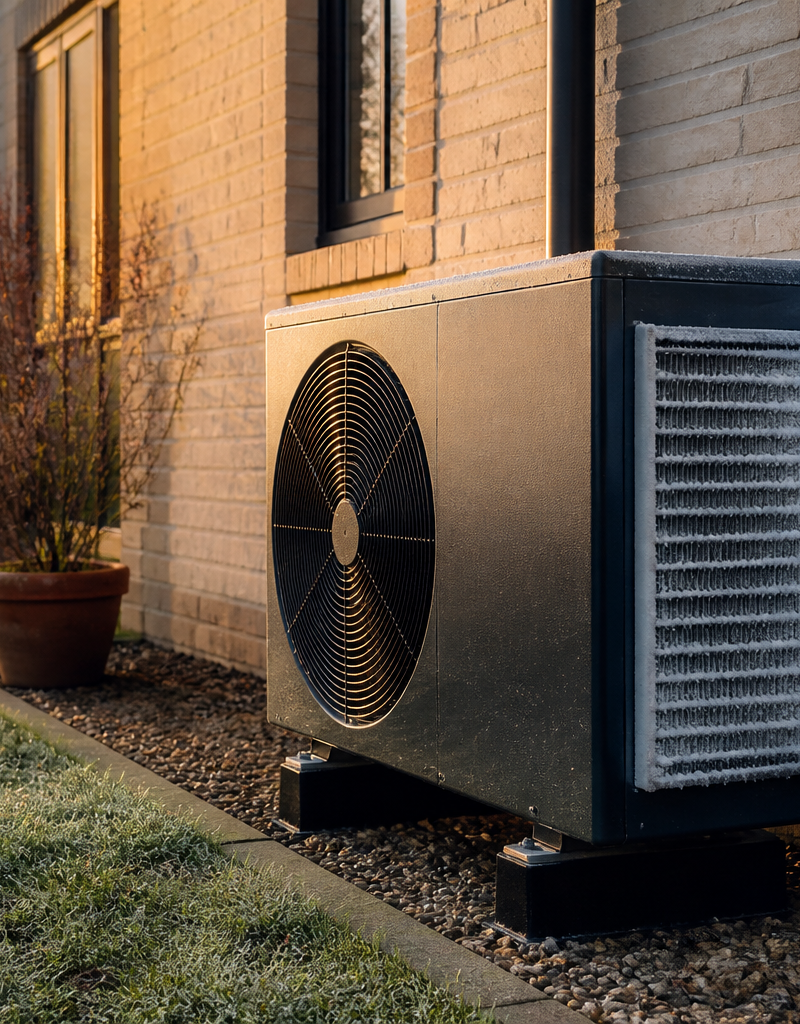
When winter temperatures drop between 0°C and 7°C in the UK, home energy forums often fill with queries from new air source heat pump owners. Many notice steam rising from their outdoor unit, hear an unfamiliar swishing valve sound, or observe the system briefly pausing space heating. These occurrences are part of a standard defrost cycle. Understanding the thermodynamics and operational mechanics of defrosting helps clear up common concerns about winter performance, energy penalties, and running costs.
Air source heat pumps gather heat energy from ambient outdoor air, even when conditions feel freezing to humans. However, the thermodynamic mechanism that extracts this heat creates localized freezing conditions on the heat exchanger. Knowing why frost forms and how systems clear it is essential to evaluating real-world seasonal efficiency.
How frost forms on an outdoor heat pump evaporator
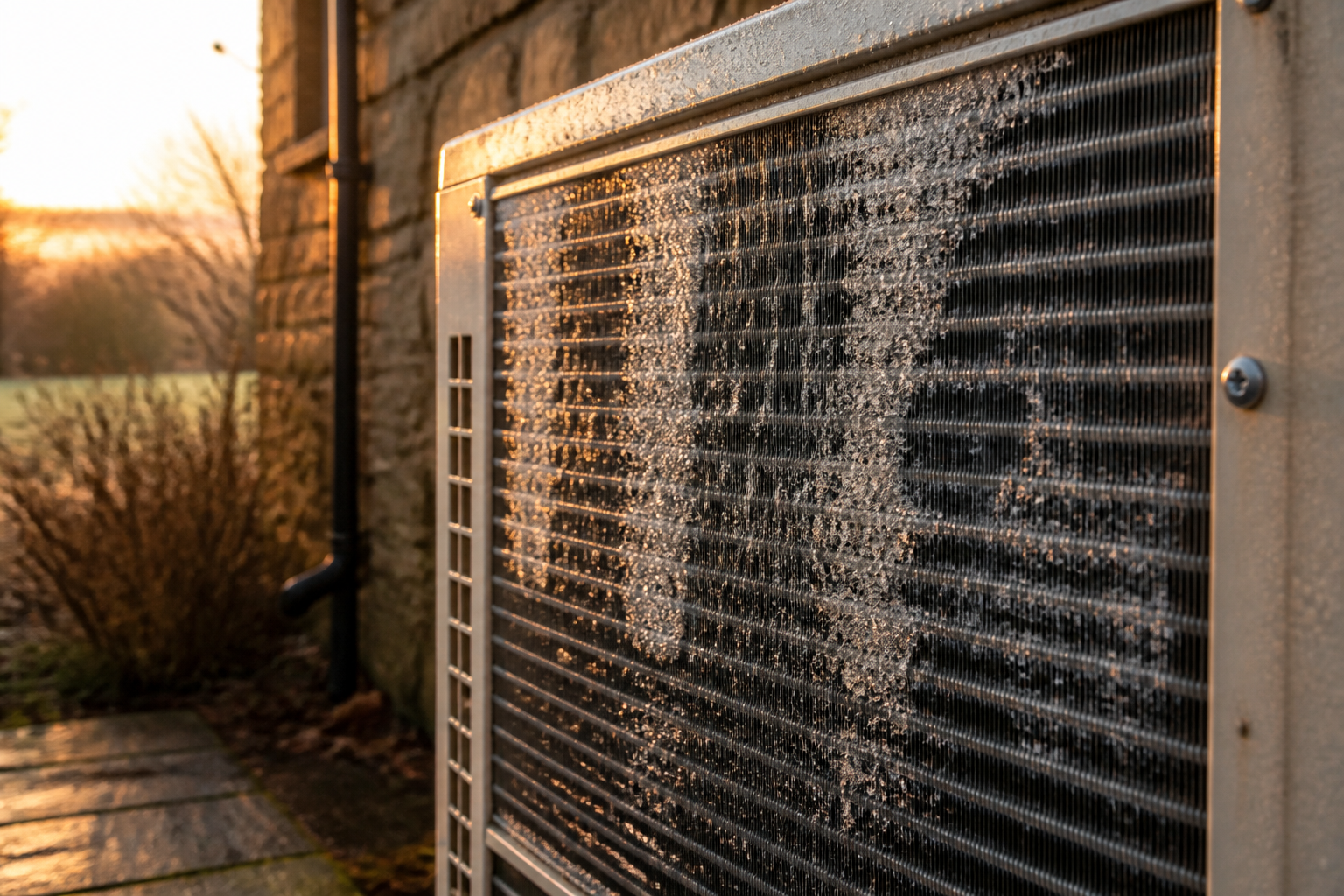
To transfer heat from outdoor air into liquid refrigerant, the heat exchanger coil in the outdoor unit must operate at a lower temperature than the surrounding air. In typical winter operation, the refrigerant flowing through the outdoor finned coils runs roughly 5°C to 10°C colder than the ambient temperature.
When outdoor air is at 4°C, the surface of the heat exchanger fins can easily drop to -3°C. The UK climate regularly experiences ambient relative humidity levels above 80% during late autumn and winter. As damp air passes across the cold evaporator fins, water vapour condenses onto the metal surfaces and rapidly freezes.
This accumulation of ice creates two distinct engineering problems:
- Thermal insulation: Ice has a thermal conductivity significantly lower than copper or aluminium, creating a barrier that slows the transfer of thermal energy from air to refrigerant.
- Airflow restriction: Frost fills the narrow gaps between the coil fins, increasing static pressure resistance and restricting the volume of air the fan can push through the unit.
If frost is left unchecked, the heat pump must lower its refrigerant evaporation temperature further to extract heat, causing system efficiency to drop sharply.
The physics and thermodynamics of reverse-cycle defrosting
Modern air source heat pumps resolve ice accumulation using reverse-cycle defrosting. When onboard sensors detect restricted airflow or a sufficient drop in evaporator coil temperature, the internal controls initiate a defrost sequence.
A four-way reversing valve switches the flow direction of the refrigerant. The heat pump temporarily converts from heating mode to cooling mode. High-temperature, high-pressure discharge gas from the compressor bypasses the indoor heating circuit and pumps directly into the outdoor coil, rapidly melting the ice.
Melting frost requires overcoming the latent heat of fusion for water, which stands at approximately 334 kilojoules per kilogram. To supply this thermal energy, the heat pump absorbs heat from the water circulating inside your central heating system. During a typical defrost cycle lasting between three and ten minutes, heat energy is drawn from the home's heating loop and discharged outdoors.
Once the coil temperature sensor confirms the ice has melted and reached a safe threshold, usually around 10°C on the outdoor pipework, the four-way valve reverses back, the fan restarts, and normal space heating resumes.
Measuring the efficiency penalty: seasonal COP versus peak defrost losses
Defrost cycles affect the instant Coefficient of Performance (COP) of a heat pump. If a system delivers an instantaneous COP of 3.2 in dry air at 2°C, that efficiency rating momentarily reverses while heat energy flows out of the building loop to clear the outdoor coil.
According to European performance standards EN 14511 and EN 14825, which govern standard heat pump ratings published by manufacturers, defrost penalties are explicitly factored into published Seasonal Coefficient of Performance (SCOP) figures. Heat pump testing protocols mandate continuous performance measurements that include automated defrost sequences in test chambers at controlled humidity levels.
Data from field studies compiled by the Energy Saving Trust shows that damp, oceanic climate conditions cause more frequent defrost events than dry, sub-zero continental conditions. A heat pump operating in mild, saturated UK air at 2°C and 90% humidity often defrosts more frequently than the same unit operating in dry air at -5°C in Scandinavia.
| Design Parameter | Minimum Standard | Optimised System | Operational Effect During Defrost |
|---|---|---|---|
| System Fluid Volume | 10 L per kW capacity | 20+ L per kW or buffer volume | Prevents noticeable indoor temperature drops |
| Outdoor Clearance | 150mm back clearance | 300mm+ back clearance, clear overhead | Reduces cold air recirculation and frost speed |
| Defrost Logic Control | Fixed interval timer | Demand defrost via delta-P sensors | Eliminates unneeded cycles, saving 5% to 10% seasonal energy |
| Radiator Sizing | Delta T 50 sizing | Oversized radiators (Delta T 30) | Allows lower flow temperatures, slowing frost formation |
How system design and installation minimise defrost impacts
Professional hydraulic design is critical to ensuring defrost cycles run cleanly without drawing noticeable heat from living spaces or triggering fault codes. Certified heat pump installations carried out under Microgeneration Certification Scheme (MCS) standard MIS 3005-D require minimum system water volumes to safeguard heat pump operation.
If a central heating loop contains too little water volume, drawing heat for a defrost cycle can cool the circulating water so quickly that the heat pump triggers a low-temperature safety shutdown. To avoid this, installers incorporate specific design features:
- Volumiser tanks or buffer vessels: Dedicated inline water volumes guarantee the heat pump has a reserve of thermal energy to melt outdoor frost without pulling heat from indoor radiators.
- Demand defrost algorithms: Advanced electronic expansion valves and pressure sensors measure the exact pressure drop across the evaporator fins, running a defrost cycle only when ice physically blocks airflow, rather than relying on crude hourly timers.
- Adequate outdoor physical clearance: Positioning the outdoor unit away from narrow alleys or roof dripping zones prevents recirculating freezing discharge air through the fan coil.
Genuine uncertainties, trade-offs and counter-arguments
While reverse-cycle defrosting is the industry standard for air source units, it involves trade-offs that homeowners and designers must evaluate.
Some manufacturers use electric trace heating elements built into the outdoor drain tray to prevent melted ice from refreezing into a solid sheet at the base of the cabinet. While this ensures meltwater drains safely away, these heating elements consume direct resistive electricity, slightly lowering winter efficiency.
Another alternative is hot-gas bypass defrosting, which channels a portion of hot compressor gas to the outdoor coil while continuing to provide space heating indoors. While this avoids pulling heat back from the home, hot-gas bypass systems are mechanically more complex, feature higher upfront equipment costs, and melt ice more slowly than full reverse-cycle designs.
Homeowners should also note that severe external weather can cause visible steam clouds and temporary operating noise as the unit shifts valves and melts ice. This is an intended mechanical process rather than a system fault.
What this means for you
For UK householders, understanding defrost physics highlights the importance of proper system design over simply picking a high-rated heat pump off a shelf. An air source heat pump installed without adequate water volume or fitted with incorrect clearance will clear frost less efficiently, leading to higher winter electricity consumption.
When evaluating a heat pump quotation, verify that your installer has calculated total system fluid volume in accordance with MCS guidelines and accounted for local weather conditions. Employees considering clean energy upgrades can access installer networks and competitive pricing through employer schemes such as the Net Zero Home Scheme, delivered alongside The Electric Car Scheme.
Frequently asked questions
Why does my heat pump blow cool air or stop heating during defrost?
During a reverse-cycle defrost, the heat pump briefly reverses direction to melt ice on the outdoor unit. Space heating stops for three to ten minutes, and fan speeds indoors lower or pause so cool air is not actively blown into living areas.
Does defrosting add a significant amount to winter electricity bills?
Defrosting consumes extra energy, but modern demand-defrost controls ensure that total annual energy penalties stay between 5% and 10% of total heating consumption. Standard SCOP metrics account for this consumption in annual running cost estimates.
How often should an air source heat pump defrost in cold weather?
In damp UK conditions between 0°C and 5°C with high relative humidity, a heat pump typically defrosts once every 45 to 90 minutes. If a unit defrosts every 20 minutes continuously, it may indicate a faulty temperature sensor, restricted airflow, or low refrigerant charge.
Sources
- Air Source Heat Pump Field Trials and Performance Data, Energy Saving Trust
- MCS Heat Pump Design Standards (MIS 3005-D), Microgeneration Certification Scheme
- Heat Pump System Efficiency and Testing Standards (EN 14511 / EN 14825), Chartered Institution of Building Services Engineers