Ground-Mounted Solar PV Systems: A Practical UK Guide
Ground-mounted solar PV offers an alternative when roof installations are unsuitable, requiring careful planning, trenching, and sizing.
- Written by
- Net Zero Home Scheme editorial team
- Last updated
- Topic
- solar, mcs, regulation
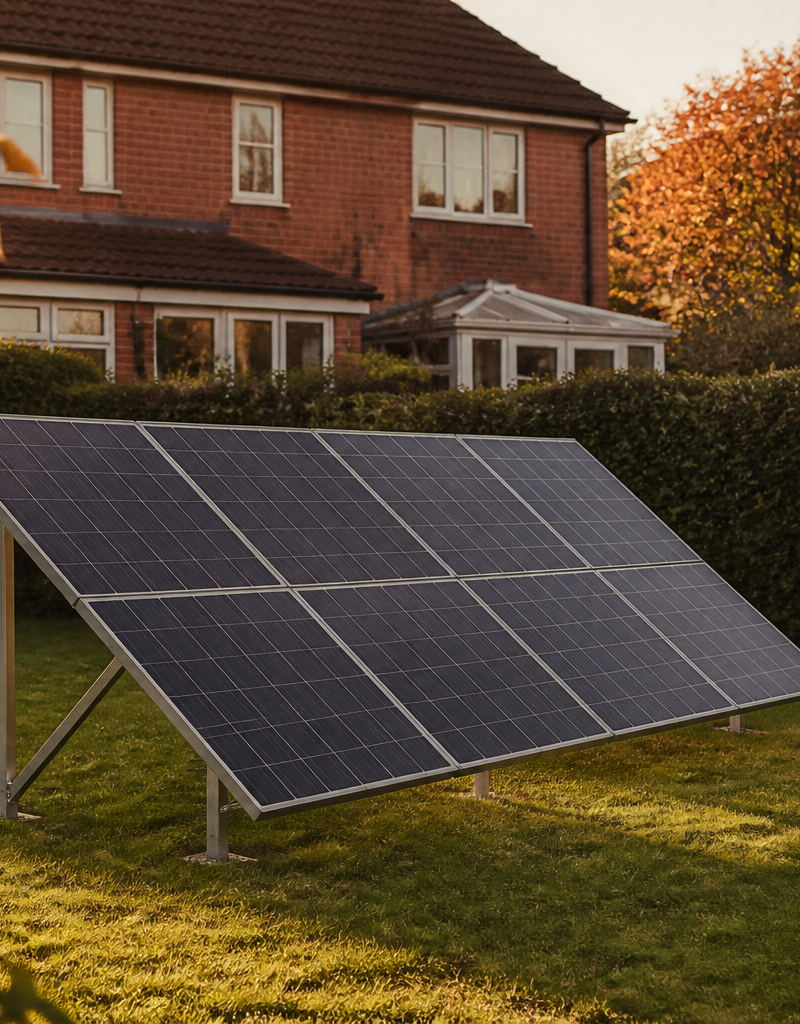
If your roof faces north, suffers heavy shading from nearby trees, or consists of delicate heritage slate, installing solar panels on your house roof may not be viable. A ground-mounted solar photovoltaic array provides a reliable alternative, allowing you to position solar panels at the optimum angle and orientation within your garden or land. However, ground installations involve distinct engineering, planning, and electrical considerations compared to standard roof installations.
Ground-mounted arrays require physical foundations, underground cabling, and careful site positioning to avoid structural or shading issues. Understanding these requirements beforehand helps you prepare your property, budget accurately, and engage effectively with certified installers.
Planning permission and permitted development limits
In England and Wales, installing a ground-mounted solar array is often permitted under Class A, Part 14 of the Town and Country Planning (General Permitted Development) (England) Order 2015. However, strict statutory limits apply before full planning permission becomes necessary.
According to Planning Portal guidelines, ground-mounted domestic solar arrays must adhere to the following rules to qualify as Permitted Development:
- Only one ground-mounted solar array is permitted within the curtilage of the dwellinghouse.
- The maximum height of any part of the array must not exceed 4 metres above ground level.
- The array must be situated at least 5 metres from any boundary of the property.
- The total surface area of the solar panel array must not exceed 9 square metres, which typically accommodates only two to three standard 400-watt solar panels.
Because a standard domestic system rated at 4 kWp usually requires between 18 and 22 square metres of surface area, most residential ground-mounted solar systems exceed the 9 square metre Permitted Development limit. Consequently, householders usually need to submit a formal planning application to their Local Planning Authority before work begins. If your property is a listed building or located within a Conservation Area, National Park, or Area of Outstanding Natural Beauty, Permitted Development rights are restricted further, and full planning permission is mandatory.
Ground mounting structures and ground conditions
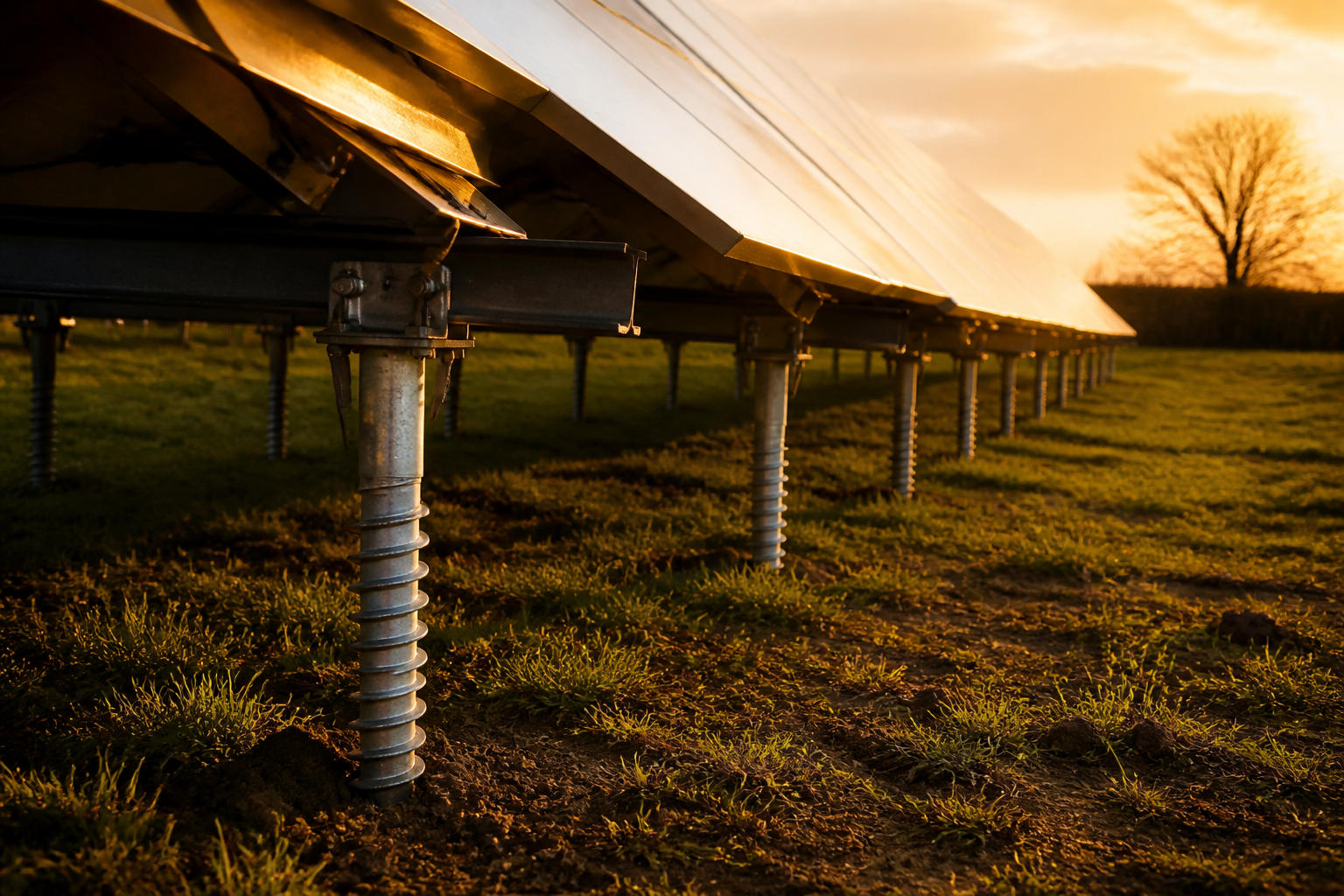
Unlike roof installations that secure panels to timber rafters, ground-mounted systems rely on dedicated racking anchored directly into the soil or onto a concrete foundation.
The choice of mounting system depends on soil condition, site access, and landscape aesthetics:
- Ground screws: Steel helical screws are driven into undisturbed earth using specialized machinery. They offer high uplift resistance, require no concrete curing time, and cause minimal disruption to surrounding grass.
- Concrete ballast blocks: Pre-cast concrete blocks sit directly on top of the ground, supporting the metal frame. Ballast systems are ideal where subsurface rocky ground prevents drilling, though they require a flat, level surface and sufficient weight to resist strong wind loads.
- Concrete strip foundations: Trenches are excavated and filled with concrete to create structural footings. This option provides extreme durability but involves wet construction work and longer preparation timelines.
Installers assess local wind uplift forces under standard BS EN 1991-1-4. Because ground arrays sit close to the earth, wind can push against the front face or create negative suction behind the panels. The structure must be engineered to withstand local gust speeds without shifting.
Electrical cabling and trenching requirements
Connecting a ground-mounted array to your home main consumer unit involves running underground cables through your garden or grounds. Proper trenching and cable selection are vital for electrical safety and system efficiency.
Under BS 7671 IET Wiring Regulations, all underground electrical cables must be protected against mechanical damage and moisture. Installers specify Steel Wire Armoured (SWA) cable laid inside a protective duct at a depth between 500 mm and 750 mm. A high-visibility yellow electrical warning tape must be placed roughly 150 mm above the cable inside the trench before backfilling.
Cable length directly affects electrical performance. Over long distances, electrical resistance causes voltage drop, which reduces solar generation efficiency and can trigger solar inverter over-voltage shutdowns. According to the Microgeneration Certification Scheme (MCS) standard MIS 3002, the voltage drop across the AC cable run should not exceed 1 percent where practical, and must remain below 2.5 percent under maximum generation conditions.
If the distance between your garden array and your consumer unit exceeds 30 metres, your installer must select thicker cable cores, such as upgrading from 4 mm² to 6 mm² or 10 mm² SWA cable, to limit losses.
| Specification Item | Technical Requirement | Operational Purpose |
|---|---|---|
| Trench Depth | 500 mm to 750 mm | Protects cable against garden digging and frost heave |
| Cable Type | Steel Wire Armoured (SWA) | Provides earth continuity and mechanical protection |
| Maximum Voltage Drop | Below 2.5 percent | Prevents energy loss and inverter tripping on long runs |
| Permitted Area (No Planning) | Up to 9 square metres | Threshold for Class A Permitted Development rights |
| Array Setback | Minimum 5 metres | Distance required from property boundaries under Class A |
Installation steps and realistic timelines
Installing a domestic ground-mounted solar PV system involves clear structural, civil, and electrical phases:
- Initial Site Survey (Week 1): An installer conducts a structural survey, assesses soil stability, evaluates shading profiles using a digital solar pathfinder, and measures the cable route length.
- DNO Application (Weeks 1 to 4): The installer submits a Distribution Network Operator (DNO) application under G98 rules (for systems up to 16A per phase) or G99 rules (for larger capacities).
- Trenching and Groundwork (Week 5): Excavation of the 500 mm to 750 mm deep cable trench occurs alongside foundation installation (ground screws or ballast preparation).
- Frame and Panel Mounting (Week 5 to 6): Installers assemble the aluminium or stainless steel frame, mount the PV modules, and set the tilt angle (typically 30 to 35 degrees facing due south).
- Electrical Termination and Testing (Week 6): The SWA cable is wired into the inverter and main consumer unit, followed by MCS commissioning tests, insulation testing, and hand-over documentation.
What to ask your solar installer
When evaluating quotes from solar installers, ensure they possess MCS accreditation and RECC or HIES consumer protection membership. Ask these key operational questions:
- What cable core size have you specified for the underground run, and what is the calculated voltage drop?
- Does the structural mounting frame comply with BS EN 1991 wind loading standards for my specific location?
- Is the proposed system size compliant with Permitted Development, or will you manage the full planning application on my behalf?
- Will the inverter be positioned outdoors on the mounting frame or inside an outbuilding or house?
- Do you provide a ground survey to check for underground utilities or drainage pipes before drilling ground screws?
What this means for you
A ground-mounted solar system allows you to generate renewable electricity even if your house roof is unsuitable or shaded. By matching your array size to your household electricity consumption, positioning panels facing south at an optimal 30 to 35 degree tilt, and ensuring robust trenching, you can maximize daily generation. According to figures published by the Energy Saving Trust, solar PV systems typically produce between 800 and 1,000 kWh per kWp of installed capacity annually in Great Britain. While ground systems incur higher site work and trenching costs than roof systems, they offer easier access for routine panel cleaning and maintenance.
If you are exploring home energy upgrades as an employee benefit, the Net Zero Home Scheme offers member pricing on accredited solar PV installations across England, Scotland, and Wales without salary sacrifice or payroll deduction.
Frequently asked questions
Can I install a ground-mounted solar array in a conservation area?
Yes, but you will almost certainly need full planning permission. Permitted Development rights for ground-mounted solar arrays facing a highway or located within the curtilage of a listed building or conservation area are restricted by local planning regulations.
Should the solar inverter be located outdoors near the array or inside the house?
Inverters can be mounted outdoors near the array inside a weatherproof IP65-rated enclosure, or indoors near your main consumer unit. Placing the inverter near the array allows high-voltage DC current to travel along the long garden cable, which reduces copper cabling costs compared to low-voltage AC runs.
How much more expensive is ground-mounted solar than roof-mounted solar?
Ground-mounted systems typically cost 15 to 25 percent more than equivalent roof-mounted systems. The additional expense covers structural foundation work, ground screw installation, manual trench excavation, and heavy-duty Steel Wire Armoured cabling over long distances.
Sources
- Standards and Guidance Library, Microgeneration Certification Scheme
- Solar Panels Planning Permission Guidance, Planning Portal
- Solar Panels Advice Guide, Energy Saving Trust