UK Unveils GB Grid Public Body to Boost Electricity Capacity
The UK government has announced plans for GB Grid, a public body funded to tackle grid capacity constraints and lower energy costs.
- Written by
- Net Zero Home Scheme editorial team
- Last updated
- Topic
- policy, energy bills, home energy
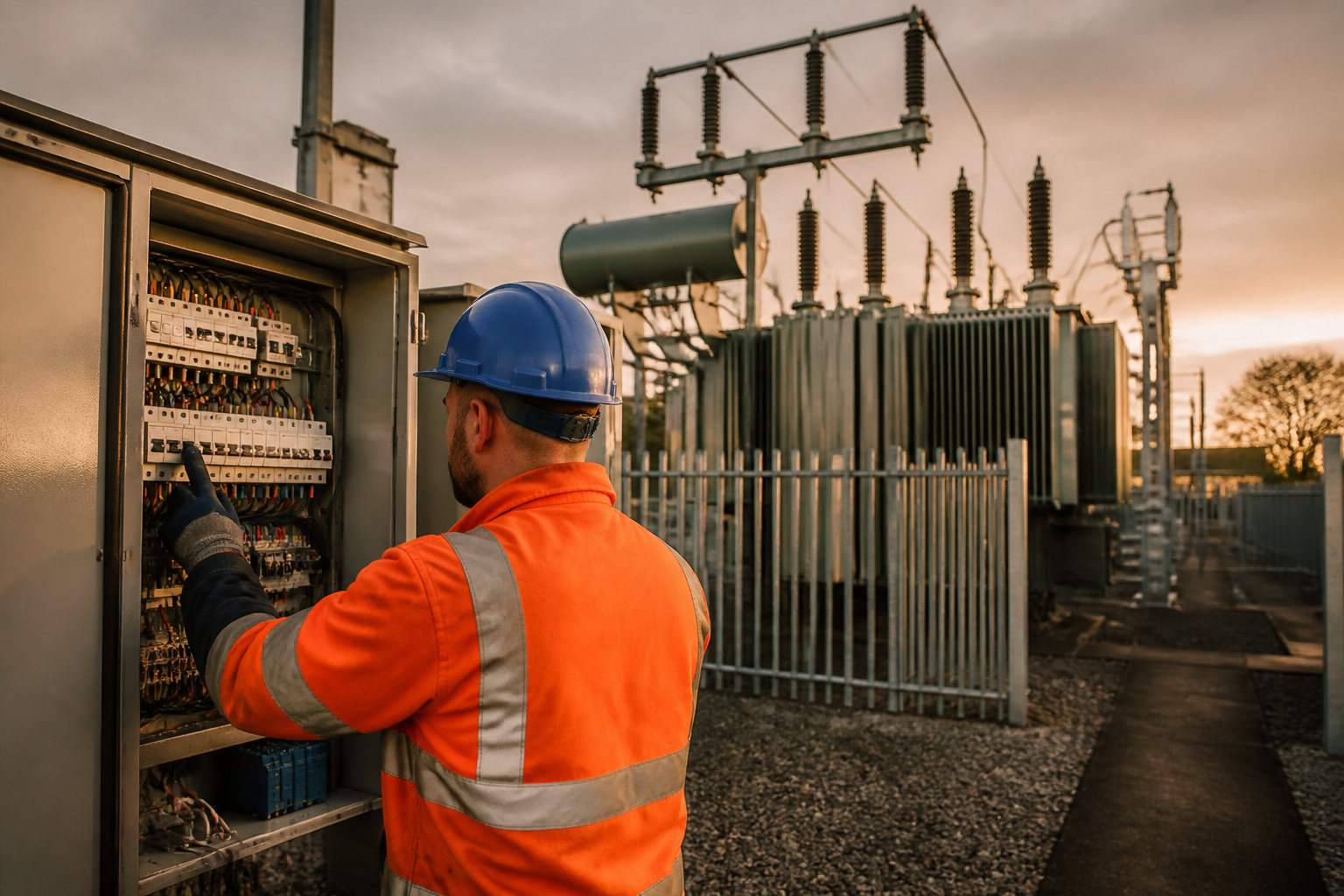
On 28 September 2026, at the Labour Party conference in Liverpool, plans were announced for a new public body named GB Grid to direct public investment into the UK electricity network. As reported by BBC News and The Guardian on 28 and 29 September 2026, the proposed entity will redirect funds previously assigned to Great British Energy to expand high-voltage distribution and transmission infrastructure across Britain.
The proposal aims to address network capacity bottlenecks that currently delay renewable energy connections and contribute to elevated standing charges on household energy bills. Energy Secretary Miatta Fahnbulleh told conference delegates on 28 September 2026, as reported by The Guardian, that lowering household energy bills remains the primary measure of success for the government clean power strategy.
How GB Grid aims to change network investment
Under the current system, local Distribution Network Operators (DNOs) manage regional power lines, while National Grid Electricity System Operator oversees high-voltage transmission. High demand for connections from utility-scale solar farms, battery projects and domestic microgeneration has created severe backlogs in grid queue management.
GB Grid is designed to act as a state-backed investment vehicle operating alongside existing private network operators. By deploying public capital directly into substation upgrades and transmission lines, the policy seeks to accelerate infrastructure projects that regional distribution network operators have been slow to deliver under existing regulatory price controls administered by Ofgem.
For households and installers, network constraints manifest primarily through connection limits set by DNOs. When home installations of solar PV, heat pumps or battery storage exceed standard thresholds, installers must submit formal notification or apply for prior consent under Energy Networks Association (ENA) rules.
| System Type | ENA Threshold | Default Process | GB Grid Target Impact |
|---|---|---|---|
| Domestic Solar PV | Up to 3.68 kW per phase | G98 notification post-install | Faster G99 approvals for larger arrays |
| Domestic Heat Pumps | Up to 16 A per phase | G100 notification / approval | Reduced local transformer constraints |
| Battery Storage | Up to 3.68 kW export | G98/G99 dual regime | Streamlined export limit approvals |
| EV Home Chargers | Up to 7.4 kW single phase | DNO notification | Smoother residential load management |
What the numbers say
Network investment figures and policy costs cited in recent announcements detail the scale of the challenge facing the UK electricity grid:
- According to reporting by The Guardian on 28 September 2026, GB Grid will repurpose funding originally earmarked for Great British Energy to target grid connection delays directly.
- As reported by BBC News on 29 September 2026, reducing energy bills remains the central focus, though no specific numerical timeline for bill reductions was guaranteed in the conference speech.
- Energy Secretary Miatta Fahnbulleh confirmed in conference interviews on 28 September 2026, reported by The Guardian, that energy bill reductions serve as the benchmark for policy delivery.
- Ofgem network charge data shows that network operation and investment costs currently make up approximately 15 percent to 20 percent of a standard domestic dual-fuel electricity bill.
Reporting from conference floor speeches did not specify the exact total capital allocation for GB Grid, nor the explicit date on which the legislation establishing the body will be introduced to Parliament.
Practical consequences for UK home energy installs

Grid capacity constraints directly affect how households install clean heat and generation technologies. While smaller domestic installations operate under simplified procedures, larger or combined clean energy systems frequently encounter regulatory barriers.
Standard G98 vs complex G99 applications
Under current Engineering Recommendation G98 rules administered by the Energy Networks Association, households can install micro-generation systems up to 3.68 kW (16 amperes per phase) without prior permission from their local DNO. Installers simply notify the DNO within 28 days of commissioning.
However, installations that combine a 4 kWp solar array with a 5 kW home battery inverter total 9 kW of potential generation, exceeding the G98 limit. These setups require prior application under Engineering Recommendation G99. In congested local grid areas, DNOs can take up to 45 working days to review G99 applications and may impose export limits or require network upgrades before granting permission.
Heat pump connection rules and cut-out fuses
Air source and ground source heat pumps introduce sudden electrical loads. Under ENA connection rules, installers must inspect the main domestic cut-out fuse, usually rated at 60 A, 80 A or 100 A. If a householder installs an 8 kW heat pump alongside a 7.4 kW EV charger, the local grid operator may mandate a main service fuse upgrade or require an automatic load-shedding device under G100 compliance.
If GB Grid successfully accelerates transformer and local substation upgrades, local distribution networks will gain capacity, reducing delays for G99 applications and enabling higher export limits for domestic solar and battery systems.
What this means for your home
If you are planning home energy upgrades, the announcement of GB Grid signals long-term network improvements, but current installation rules remain in force today.
- Continue following existing DNO notification pathways: For systems under 3.68 kW per phase, your accredited installer can proceed under G98 rules without prior grid approval.
- Factor G99 timelines into larger projects: If you plan to install a large solar array, high-capacity battery storage or multiple technologies, ask your installer to submit the G99 application early to avoid installation delays.
- Check your main electrical fuse: Before installing a heat pump or EV charger, ensure a qualified electrician assesses your main fuse size (60 A vs 100 A) and consumer unit capacity.
- Payback schedules depend on export tariffs: Modern smart tariffs pay between 15p and 24p per kWh for exported solar power, subject to DNO export approval. Increased grid capacity will eventually reduce export curtailment in constrained regions.
What this means for employers
Rising home energy costs and network transition news continue to heighten employee interest in practical household efficiency solutions. As grid reform progresses, staff are increasingly seeking direct assistance to reduce utility expenditure through verified clean technology.
Employers seeking to support staff with rising household energy costs can provide access to discounted home technology. The Net Zero Home Scheme, delivered alongside The Electric Car Scheme, gives employees member pricing on MCS-accredited installations of solar panels, heat pumps, battery storage and plug-in solar. The scheme is completely free for employers to offer, involves no salary sacrifice and requires no payroll deductions.
Frequently asked questions
Will the GB Grid proposal reduce my electricity bill immediately?
No. Grid infrastructure projects involve multi-year planning and construction timelines. While GB Grid aims to lower wholesale and transmission costs over time by unlocking cheaper renewable power, immediate bill impacts will not be felt in the current billing cycle.
Do I need permission from my grid operator to install solar panels?
For systems with an inverter capacity up to 3.68 kW per phase, prior permission is not required. Your installer submits a G98 notification after completion. For systems above 3.68 kW, a G99 application must be approved by your local Distribution Network Operator prior to installation.
How does grid capacity affect heat pump installations?
Heat pumps require substantial electric power. Installers must check your local fuse rating and inform the DNO under ENA rules. If your local substation is overloaded, the DNO may require a main supply upgrade before the heat pump can be commissioned.