Seaham Mine Water Heat Network Goes Live for 750 Homes
The Seaham Garden Village mine water heat network is live, using geothermal energy from disused coal mines to heat 750 homes in County Durham.
- Written by
- Net Zero Home Scheme editorial team
- Last updated
- Topic
- heat pumps, policy, energy efficiency

On 6 October 2026, GOV.UK announced that the mine water heat network at Seaham Garden Village in County Durham has officially gone live. The infrastructure project extracts geothermal heat from flooded, disused coal mine workings to deliver low-carbon heating and hot water to 750 new homes.
The launch marks a significant operational step in the deployment of heat network infrastructure across former industrial areas in Great Britain. Developed through collaboration between local authorities, energy developers and housebuilders, the Seaham scheme demonstrates how geothermal energy from legacy coal infrastructure can be harnessed for residential space heating and hot water without direct fossil fuel combustion on site.
How mine water geothermal heating works in practice
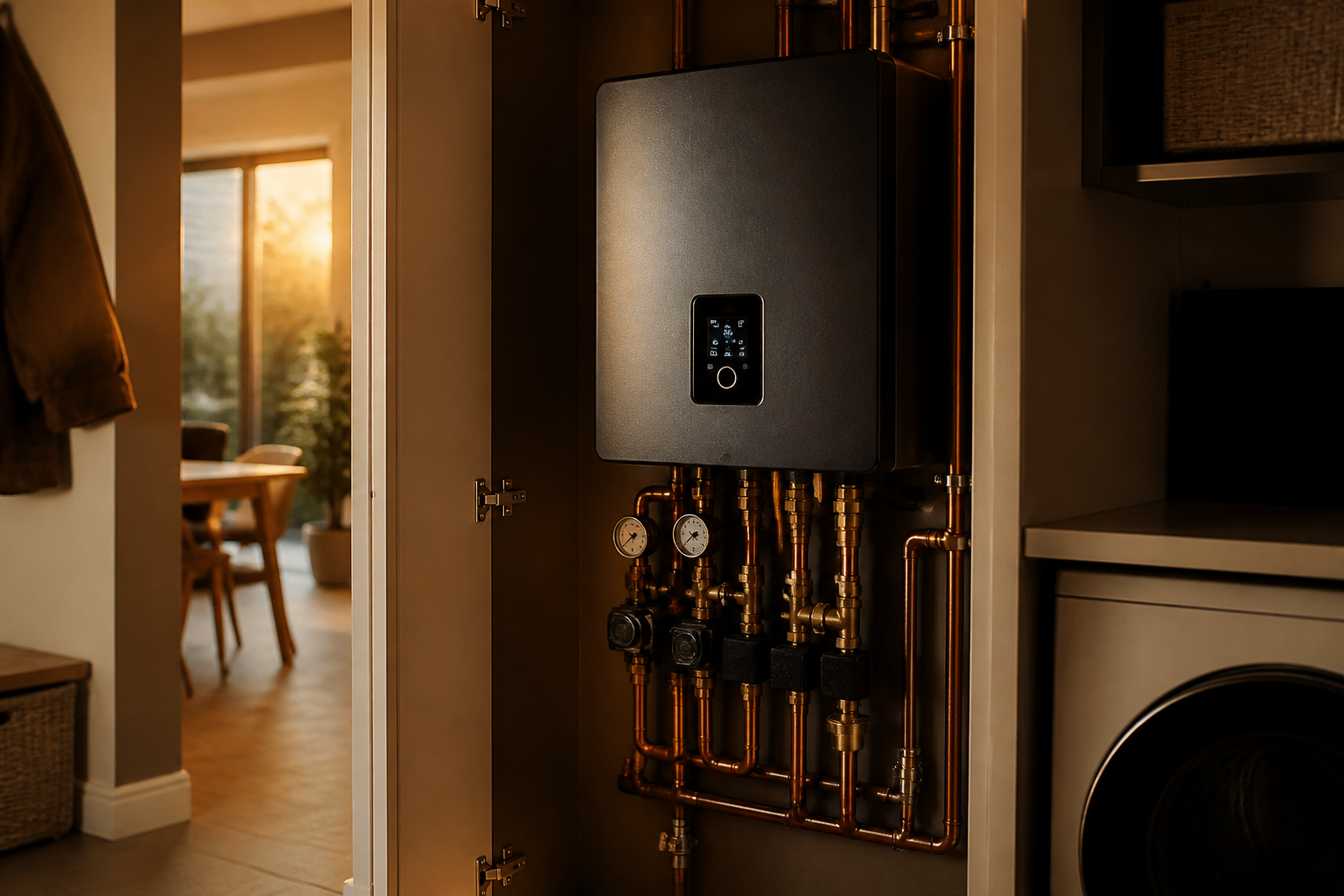
Mine water heating systems draw water from deep subterranean coal seams that flooded naturally after industrial mining ceased. At depths ranging between 100 and 400 metres beneath the surface, underground water temperatures remain remarkably stable throughout the year, typically staying between 12°C and 20°C across former UK coalfield regions.
A central abstraction pump brings warm mine water to the surface, where commercial-scale heat pumps extract the thermal energy. These large heat pumps boost the water temperature to between 55°C and 65°C before transferring the thermal energy into a local district heat network circuit. Highly insulated underground pipes distribute hot water directly to individual residential properties. Inside each connected home, a wall-mounted heat interface unit (HIU) replaces a traditional gas boiler, transferring heat from the district loop into domestic radiators or underfloor heating circuits. Once thermal energy is harvested, the cooled mine water is returned underground via a separate injection borehole, maintaining a balanced closed-loop geothermal system.
Because subterranean water temperatures stay constant regardless of freezing ambient winter weather, central heat pumps operating on mine water achieve consistently high seasonal coefficients of performance (SCOP), typically operating between 3.5 and 4.5. This provides reliable baseline thermal output without the efficiency drops that standard air source heat pumps can experience during severe sub-zero cold spells.
What the numbers say
Official reporting and government announcements provide concrete operational metrics for geothermal heat networks in the UK:
- On 6 October 2026, GOV.UK confirmed that the Seaham Garden Village development connects 750 new homes directly to the regional geothermal mine water network.
- As published by GOV.UK on 6 October 2026, the heating system taps into geothermal reserves located within disused coal mines beneath County Durham, offering a continuous thermal supply.
- According to statistics published by the Department for Energy Security and Net Zero (DESNZ) on GOV.UK on 22 May 2024, district heat networks currently provide space heating and hot water to approximately 2 percent of UK buildings, with national policy targets aiming to expand district heating coverage to 20 percent of heat demand by 2050.
- Operational assessments by the Coal Authority published on GOV.UK in 2025 indicate that flooded UK coal mines contain billions of cubic metres of warmed water, with temperature ranges of 12°C to 20°C accessible across significant areas of England, Scotland and Wales.
Where full long-term consumer tariff structures for the Seaham network remain unquantified in public summaries, billing practices and service delivery will be governed under Ofgem's expanding regulatory framework for heat networks.
Heat network infrastructure versus individual home technology
| Feature | Mine Water Heat Network | Individual Air Source Heat Pump | Individual Solar PV & Battery |
|---|---|---|---|
| Heat Source | Subterranean mine water | Ambient external air | Solar radiation |
| In-Home Equipment | Wall-mounted heat interface unit | Indoor unit & outdoor heat exchanger | Inverter, battery storage, roof panels |
| Maintenance Responsibility | Heat network operator | Individual homeowner or landlord | Individual homeowner |
| Primary Fuel / Power | Central electricity for heat pumps | Domestic electricity connection | Solar generation & grid backup |
| Typical System Efficiency | 3.5 to 4.5 SCOP (stable year-round) | 2.8 to 3.8 SCOP (weather dependent) | 80% to 90% battery round-trip |
| Indoor Space Required | Compact wall unit | Hot water cylinder & indoor unit | Loft/wall space for battery/inverter |
Technical standards and regulatory protection for heat networks
For householders connecting to district heating schemes like Seaham, regulatory oversight and technical standards are undergoing major statutory upgrades. Under powers granted in the Energy Act 2023, energy regulator Ofgem is establishing a formal consumer protection framework covering heat networks across England, Scotland and Wales.
Historically, heat network customers did not share the same statutory protections as direct mains electricity and gas consumers, such as mandatory price transparency, standardized billing structures, and automatic rights of appeal through the Energy Ombudsman. The regulatory regime being introduced by Ofgem enforces strict operational performance standards, clear pricing disclosures, and formal consumer redress mechanisms for network operators.
From an engineering perspective, district heat network design must adhere to the CIBSE/ADE Code of Practice CP1 (2020). This standard governs heat network design, pipework insulation requirements, hydronic balancing, and heat interface unit sizing to prevent network thermal losses and ensure return water temperatures remain low enough for central heat pumps to operate at optimal efficiency.
What this means for your home
If your property is located within a development served by a mine water or communal heat network, you do not need to install an individual heat pump or boiler. Space heating and hot water are supplied directly via the heat interface unit installed inside your home.
For householders living outside designated district heating zones, low-carbon home upgrades rely on individual equipment installations. If you are evaluating heat pumps or solar retrofits for your own property, consider the following steps:
- Check local authority planning publications to see whether your neighbourhood is designated as a future heat network zone under upcoming local heat zoning rules.
- If your property is unzoned or off the gas grid, evaluate individual air source or ground source heat pumps. The Boiler Upgrade Scheme provides a £7,500 capital grant toward eligible heat pump installations in England and Wales.
- Pair heat pump installations with rooftop solar PV and battery storage where possible. Self-generating electricity lowers the operational cost of running an electric heat pump during daylight hours.
- Review your home insulation status. Upgrading loft insulation and cavity wall insulation reduces heat loss, enabling lower flow temperatures and improving system efficiency whether heating is supplied by a heat pump or a heat interface unit.
What this means for employers
The expansion of mine water heat networks highlights the broader transition toward electrified domestic heating across the UK. With energy prices remaining a key driver of household expenditure, staff are increasingly seeking practical ways to reduce home running costs and lower personal carbon footprints.
Employers seeking to support staff financial wellbeing without creating administrative burdens or capital liabilities can evaluate structured workplace benefits that assist with home energy management. Providing staff with clear routes to accredited home energy upgrades directly supports corporate sustainability objectives while delivering tangible cost support to employees.
Through the Net Zero Home Scheme, delivered by Net Zero Benefits alongside The Electric Car Scheme, employers can offer their staff member pricing on accredited installations of solar panels, heat pumps, battery storage and plug-in solar. The scheme is completely free for employers to implement, involves no salary sacrifice or payroll deductions, and connects employees directly with accredited installers across England, Scotland and Wales.
Frequently asked questions
How does mine water heating compare in cost to a gas boiler?
Heat network energy tariffs vary by scheme operator, but regulatory oversight from Ofgem ensures prices remain competitive and transparent relative to alternative heating fuels. Because central mine water heat pumps operate at high efficiency, less electrical energy is required per unit of heat delivered compared to direct electric heating.
Can existing homes connect to a mine water heat network?
Connecting existing properties requires proximity to the network subterranean pipe route. While initial schemes like Seaham Garden Village focus on new-build developments, local authority heat zoning strategies plan to connect existing social housing stock and municipal buildings near former coalfields in future phases.
What maintenance is required for a domestic heat interface unit?
Heat interface units require minimal routine maintenance compared to gas boilers because they contain no combustion elements or flue systems. Annual technical inspections by qualified heating engineers ensure internal heat exchangers, strainers, and control valves function correctly.