Heat Pump Weather Compensation Physics and UK Energy Costs
An explanation of how weather compensation adjusts heat pump flow temperatures dynamically to lower energy bills, improve SCOP ratings and maintain home comfort.
- Written by
- Net Zero Home Scheme editorial team
- Last updated
- Topic
- heat pumps, energy efficiency, energy bills
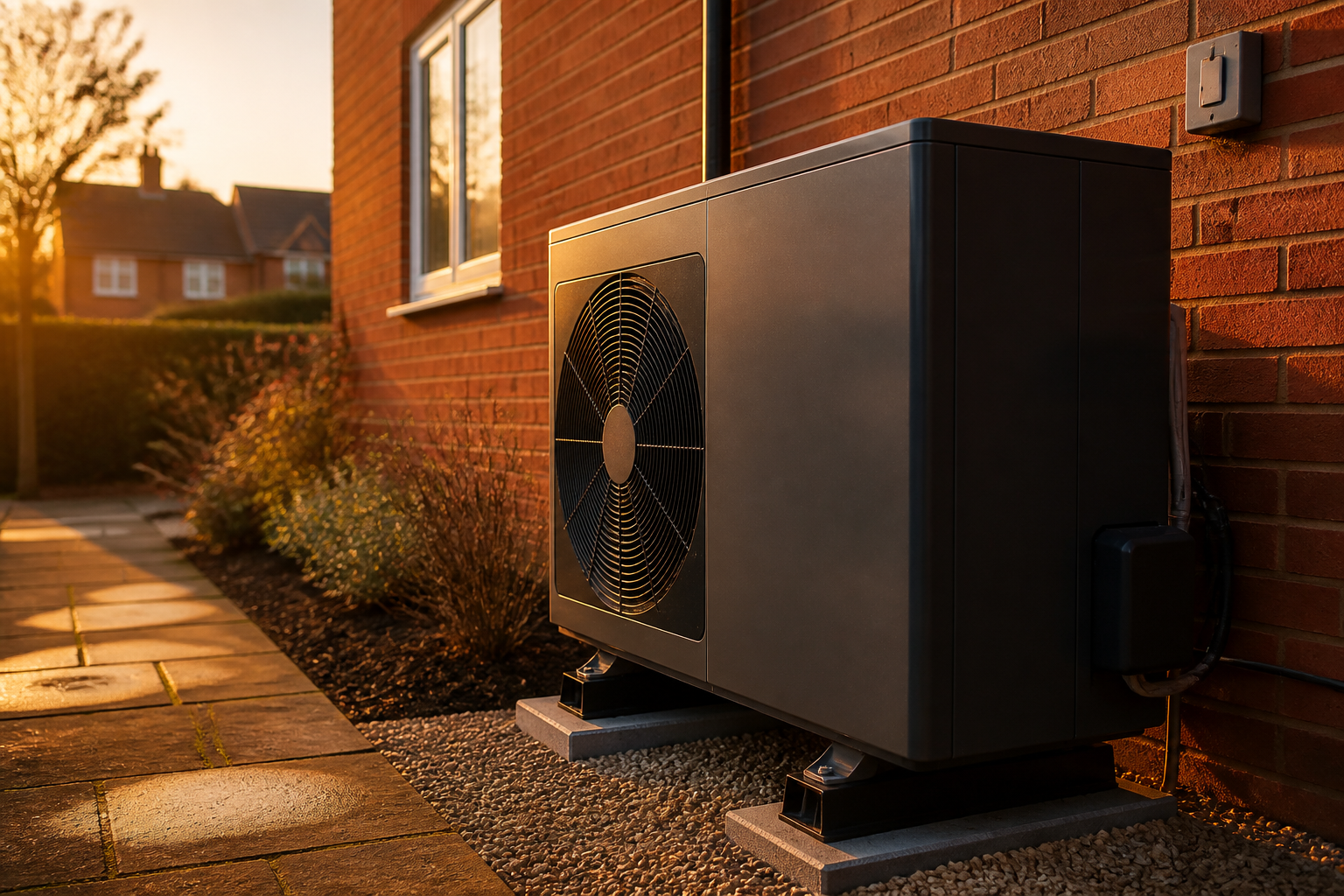
Unlike traditional fossil fuel boilers, which typically supply heating water at a fixed high temperature of 65°C to 70°C regardless of the weather outside, modern heat pumps perform best when supplying water at the lowest possible flow temperature needed to keep a property warm. Heat pump weather compensation is the automated control logic that continuously measures outdoor ambient air temperature and adjusts the system flow temperature up or down along a defined heating curve.
Understanding why weather compensation matters requires examining both thermodynamics and system economics. By avoiding unnecessarily high flow temperatures during mild autumn and spring days, weather compensation allows heat pumps to achieve significantly higher Seasonal Coefficient of Performance (SCOP) figures, lowering annual electricity consumption and reducing energy bills under the Ofgem energy price cap.
The Carnot Cycle and Heat Pump Thermodynamics
The physics governing any vapour compression heat pump relies on the Carnot refrigeration cycle. The Coefficient of Performance (COP) represents the ratio of thermal energy output to electrical energy input. Mathematically, the theoretical maximum COP of a heat pump is determined by the temperature lift, which is the difference between the heat source temperature (outdoor air or ground) and the heat sink temperature (the circulating radiator or underfloor water).
As the temperature lift widens, the heat pump compressor must work harder to compress the refrigerant gas to a higher pressure and temperature. For every 1°C increase in flow temperature required by the heating system, compressor power draw increases, which reduces system COP by approximately 2.5% to 3.0%.
When outdoor air is at 10°C on a mild November day, a house might only need a radiator flow temperature of 34°C to replace its heat loss. If the heat pump is fixed to deliver 55°C flow water regardless of weather, the compressor operates across a temperature lift of 45°C instead of 24°C. This extra lift drops operational efficiency from a potential COP of 4.5 down to 2.8, consuming roughly 60% more electricity for the exact same quantity of heat delivered into the living space.
How a Weather Compensation Curve Works in Practice
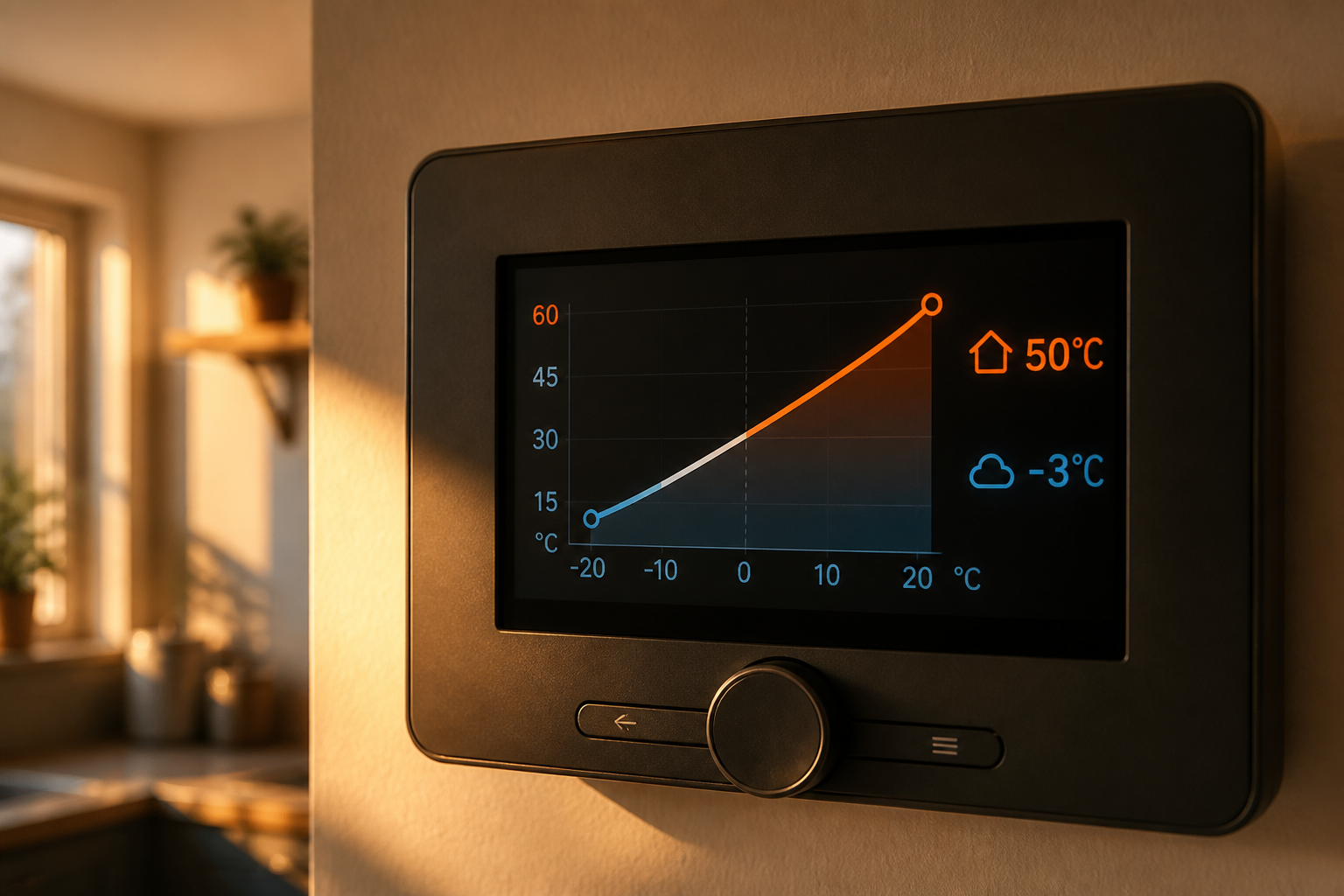
Weather compensation relies on an external dry-bulb temperature sensor installed on a shaded, north-facing wall, or high-accuracy local weather data integrated into the heat pump control software. The heating controller maps this outdoor reading directly to a target flow temperature using a programmed weather compensation curve.
Installers calibrate this curve during commissioning based on room-by-room heat loss calculations performed in accordance with CIBSE Guide A and MCS MIS 3005-D standards. The curve is defined by two primary parameters: slope (steepness) and parallel offset (shift). A poorly insulated house requires a steeper slope to boost flow temperatures rapidly as outdoor conditions drop, whereas a well-insulated property with low heat loss requires a flat curve.
The table below illustrates how a typical 1.2 slope weather compensation curve adjusts flow temperatures and operational COP across standard UK outdoor conditions for a mid-terrace house targeted at a 20°C indoor temperature:
| Outdoor Air Temperature (°C) | Target Flow Temperature (°C) | Expected Heat Pump COP | Electrical Power Draw for 4 kW Heat Output (kW) |
|---|---|---|---|
| 12 | 32 | 4.6 | 0.87 |
| 7 | 37 | 3.9 | 1.03 |
| 2 | 43 | 3.2 | 1.25 |
| -3 | 50 | 2.6 | 1.54 |
When outdoor temperatures drop from 12°C to -3°C, the controller automatically scales up flow water temperature from 32°C to 50°C. This ensures maximum comfort during freezing conditions while preserving extreme efficiency across the 80% of the UK heating season when outdoor temperatures sit between 4°C and 12°C.
Economic Savings and Real-World Evidence
The financial impact of weather compensation on UK household bills is substantial. According to field trials published by the Energy Saving Trust and independent monitoring by the Renewable Energy Consumer Code (RECC), space heating accounts for over 60% of average home energy consumption.
Consider a typical UK home requiring 12,000 kWh of space heating annually:
- Fixed high-flow regime (52°C constant flow): Delivers an average seasonal SCOP of 2.8, requiring 4,286 kWh of electricity per year.
- Weather-compensated regime (32°C to 48°C variable flow): Delivers an average seasonal SCOP of 3.8, requiring 3,158 kWh of electricity per year.
At the Ofgem price cap rate of 24.5p per kWh for electricity effective in late 2026, operating under weather compensation saves 1,128 kWh of electricity per year. This equates to a direct annual saving of £276 on heating bills. Over a heat pump's standard 15-year operational lifespan, effective weather compensation delivers over £4,100 in cumulative running cost savings without requiring additional capital equipment.
Trade-Offs, Counter-Arguments and Installation Realities
While the physics behind weather compensation is unequivocal, achieving optimal performance in UK retrofits presents practical challenges and design trade-offs:
- Radiator Sizing Constraints: Running low flow temperatures (35°C to 40°C) reduces thermal output from standard panel radiators. If existing radiators are not oversized or upgraded to low-temperature models during heat pump retrofits, rooms may struggle to reach setpoint temperatures on cold days.
- Slow Warm-Up Dynamics: Low-temperature heating transfers energy slowly into building fabric. Householders accustomed to rapidly turning boiler heating on and off must shift to low-and-slow continuous heating or minor nighttime setback (1°C to 2°C drop), which requires a change in user behaviour.
- Domestic Hot Water (DHW) Overrides: Weather compensation only applies to space heating. Domestic hot water cylinders must still reach 60°C periodically to prevent Legionella pneumophila growth in compliance with BS 7593 standards. The heat pump control logic must temporarily suspend weather compensation to perform scheduled high-temperature hot water cycles.
- Sensor Location Errors: If the external weather sensor is exposed to direct solar radiation or mounted near heat sources such as tumble dryer vents, the heat pump will misread ambient conditions and supply under-heated water to the house.
Frequently asked questions
How do I adjust the weather compensation curve on my heat pump?
Most MCS-accredited installers set the initial curve during installation based on heat loss calculations. Householders can adjust the curve through the heat pump user interface by changing either the curve slope or the parallel offset. If rooms feel cold during mild weather, increase the offset by 1°C or 2°C; if rooms feel cold during sub-zero freezing spells, increase the slope slightly.
Will radiators feel cold when weather compensation is running?
Yes, in mild outdoor weather, radiators operating on a weather compensation curve may feel warm or barely lukewarm (around 32°C to 35°C) to the touch. This is entirely normal. Because water circulates continuously at a lower temperature, the system steadily replaces room heat loss without needing scorching hot radiators.
Can weather compensation be retrofitted to older heat pump systems?
Most modern monobloc and split heat pumps sold in the UK since 2018 have built-in weather compensation control software. Retrofitting simply requires adding an external temperature sensor connected via a low-voltage signal cable or pairing the unit with an approved internet weather data gateway, provided the system controller supports variable weather-dependent flow targets.
What this means for you
For UK homeowners and landlords planning a low-carbon heating transition, weather compensation highlights why accurate system design matters more than simply buying a high-capacity heat pump unit. Ensuring your installer conducts full room-by-room heat loss calculations compliant with MCS MIS 3005-D ensures radiators are sized correctly for low flow temperatures, maximising year-round SCOP and bill savings.
Employers and HR leaders seeking to support home energy upgrades can offer accredited installations through benefits schemes. Employees can access member pricing on heat pumps, solar PV, and battery storage through the Net Zero Home Scheme, delivered alongside The Electric Car Scheme.
Sources
- MCS MIS 3005-D Heat Pump Standard, MCS
- Energy Saving Trust Heat Pump Guidance, Energy Saving Trust
- Ofgem Energy Price Cap Announcements, Ofgem