Installing Solar Panels on Flat Roofs: A UK Guide
A practical guide to planning permission, structural loading, array tilt angles, and realistic costs when installing solar PV on a flat roof in the UK.
- Written by
- Net Zero Home Scheme editorial team
- Last updated
- Topic
- solar, regulation, mcs
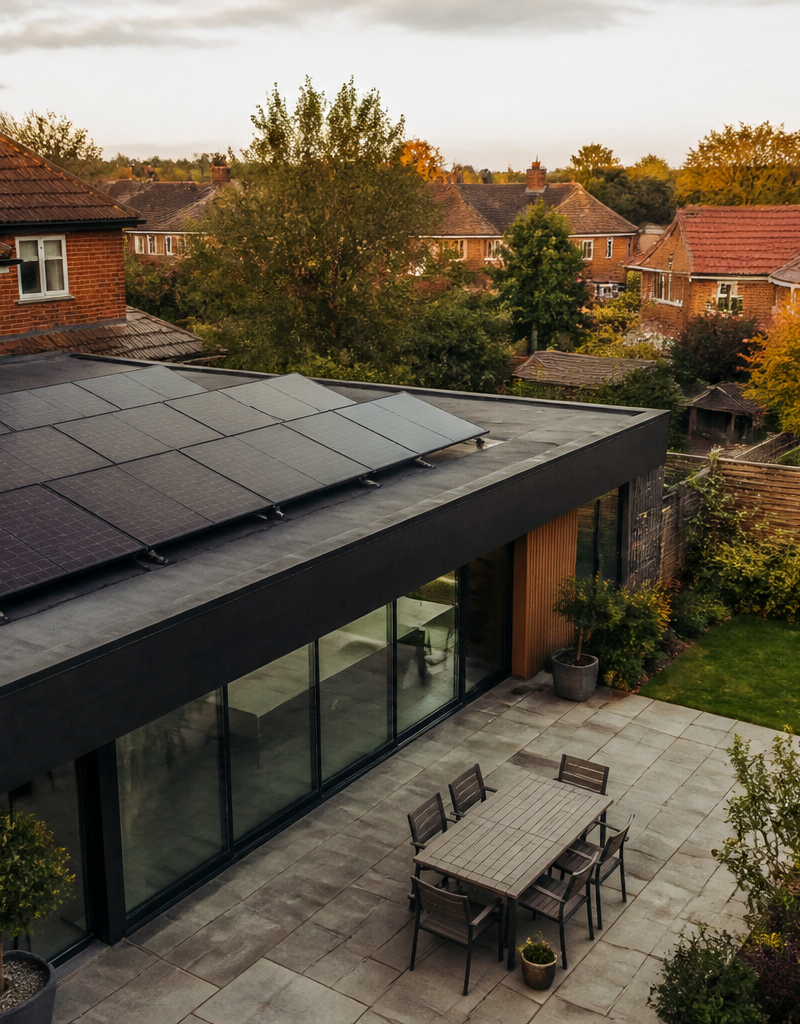
Installing solar PV panels on a flat roof provides householders with a flexible way to generate clean electricity from property extensions, garages, or flat-roofed main dwellings. However, flat roof installations differ fundamentally from standard pitched roof projects in structural engineering, mounting methods, wind mechanics, and planning regulations. Where pitched roof panels attach directly to timber roof rafters using hooks and rails, flat roof solar arrays rely on ballasted consoles or dedicated mechanical anchor points, requiring careful structural assessment and precise array spacing to prevent self-shading. Understanding the engineering, planning, and practical requirements ensures your system delivers reliable generation over its 25-year operational lifespan without risking roof membrane damage or regulatory non-compliance.
Planning permission rules for UK flat roof solar
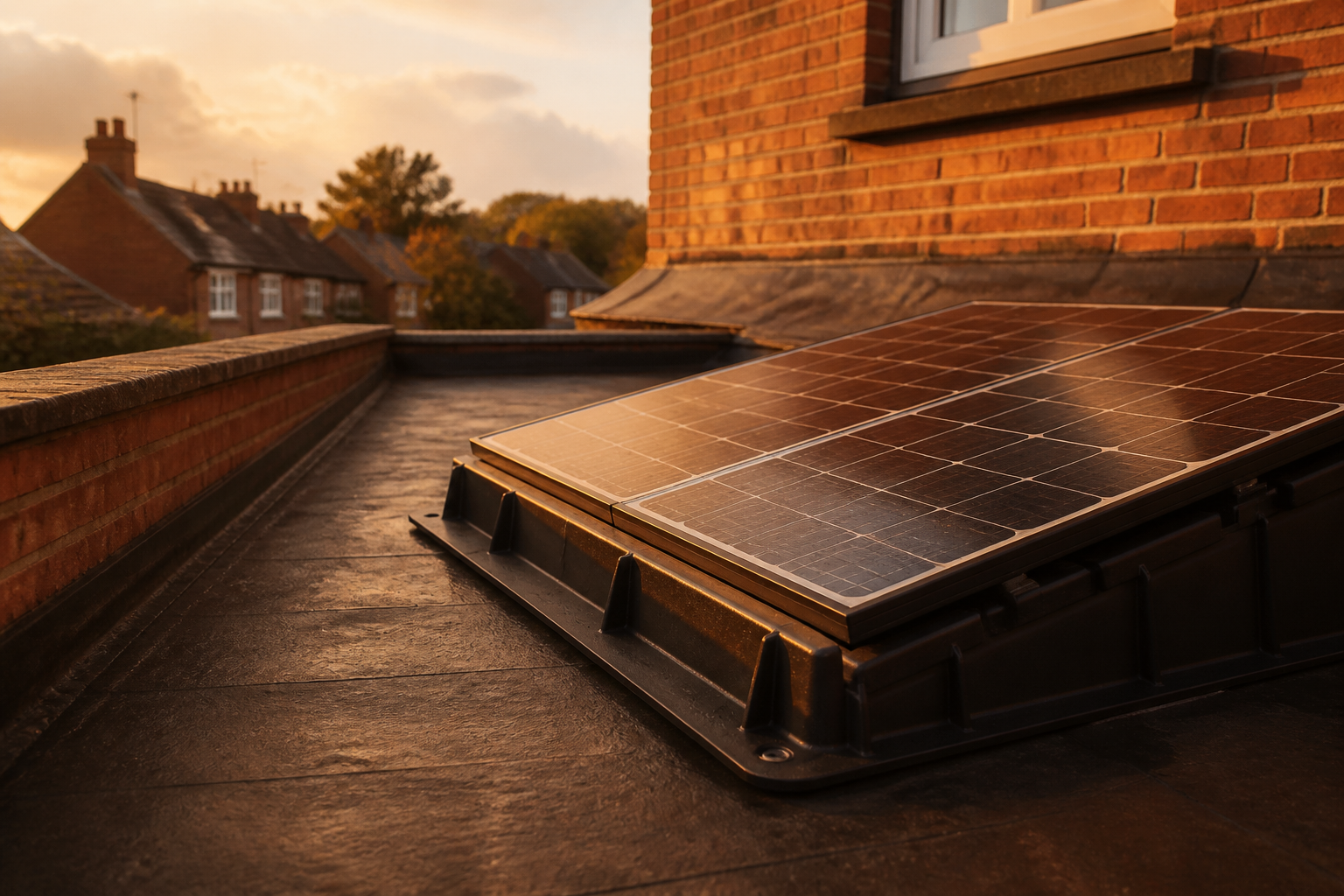
In England and Wales, residential solar installations generally fall under Permitted Development rights established by the Town and Country Planning (General Permitted Development) (England) Order 2015. However, flat roof installations face specific statutory limits. Under Class J of Part 14 of the order, solar equipment mounted on a building must not protrude more than 200 millimetres above the highest part of the flat roof plane, nor sit within 200 millimetres of the roof edge.
Because standard flat roof mounting frames tilt modules at 10 to 15 degrees to maximise yield and shed rainwater, the upper edge of the panel frame frequently exceeds this 200 millimetre limit. Planning Portal guidance indicates that any installation exceeding 200 millimetres above the flat roof surface typically requires a full planning application or a Lawful Development Certificate. Designated areas, such as Conservation Areas or National Parks, carry stricter rules; equipment mounted on a flat roof visible from a highway in a Conservation Area requires full planning permission.
Structural loading, wind uplift, and waterproofing
A core engineering requirement for flat roof solar is balancing structural loading against wind uplift. The Institution of Engineering and Technology Code of Practice for Grid-Connected Solar Photovoltaic Systems specifies that flat roofs must be formally assessed for dead loads and wind-induced forces before mounting hardware is placed.
Installations use either ballasted systems or mechanically anchored frames. Ballasted systems use concrete blocks or ballast trays inside composite frames to secure the array using gravity alone. This avoids puncturing the waterproof membrane, such as EPDM rubber, bitumen felt, or single-ply PVC. However, ballast adds weight. According to MCS standards, ballasted arrays add between 15 kg and 35 kg of dead load per square metre. An MCS-accredited installer or structural engineer must verify that joist dimensions, spans, and decking can support this combined load alongside winter snow loads. In high-wind locations, installers use mechanical anchors bonded to primary roof timbers, sealed with manufacturer-approved membrane boots.
Array design, tilt angles, and self-shading
While pitch angle on a standard roof is fixed by the building architecture, flat roof systems permit custom tilt angles and orientations. Energy Saving Trust data shows the optimal tilt angle for annual generation in Great Britain is between 30 and 35 degrees south-facing. However, mounting panels at 30 degrees on a flat roof creates significant wind resistance and long shadows behind each row.
To balance energy yield with structural safety, installers set flat roof arrays at tilt angles between 10 and 15 degrees. A 10-degree tilt reduces wind drag while maintaining sufficient slope for rainfall to clean away dust and debris. Energy Saving Trust figures indicate that panels tilted at 10 to 15 degrees retain roughly 95% to 97% of optimal annual output while enabling closer row packing.
Row spacing depends on winter sun angles. Installers calculate spacing using solar elevation at winter solstice, approximately 14 degrees in southern England. Alternatively, dual-pitch east-west framing mounts panels in a tent configuration at 10 degrees, eliminating inter-row shading and increasing installed capacity per square metre by up to 40%.
Flat roof solar installation checklist and costs
Before approving a quote, review the technical parameters, accreditation requirements, costs, and timeline.
| Factor | Standard Criteria | Operational Detail | Expected Range or Requirement |
|---|---|---|---|
| Structural Load | Structural Engineering Assessment | Evaluates joists, roof deck, and ballast capacity | 15,35 kg/m² extra dead load |
| Planning Status | GPDO Class J / Planning Check | Height limit of 200mm above flat roof surface | Permitted Development or 8-week application |
| Mounting Standard | MCS 012 Certification | Assesses wind uplift resistance and roof membrane protection | Mandatory MCS installation standard |
| Array Geometry | 10°,15° South or East-West Dual-Pitch | Prevents row self-shading while allowing self-cleaning | 95%,97% of peak annual yield |
| Typical Costs | 4 kWp Complete Ballasted System | Includes panels, ballasted mounting, inverter, and installation | £6,500 to £8,500 (0% VAT) |
| Timeline | Initial Survey to Handover | Survey, structural sign-off, DNO G98 notice, and mounting | 4 to 8 weeks end-to-end |
What to ask your solar installer before signing
When evaluating installer proposals for a flat roof project, ask these operational questions:
- How will you verify that my flat roof joists can support the extra ballast weight? Request a copy of the structural engineer's calculation.
- Is the mounting system certified under MCS 012 for wind uplift resistance? Confirm that wind load calculations match your property's geographic location.
- Will the installation method affect my roof membrane warranty? Ask for written confirmation that ballasted trays or flashing boots comply with membrane terms.
- What row spacing calculation was used to prevent winter shading? Ask for a layout diagram generated by design software like PV*SOL.
- Does the array height exceed 200 millimetres above the roof plane? Confirm whether planning permission or a Certificate of Lawfulness is required.
What this means for you
Installing solar panels on a flat roof is a practical way to generate renewable electricity from unused garage or extension roof space. By verifying structural capacity early, choosing an aerodynamic 10-to-15-degree frame, and checking planning height limits, you ensure a safe and compliant system. UK employees looking to install solar PV or battery storage can also access preferential pricing through employer benefits; the Net Zero Home Scheme offers employees member pricing on accredited home solar and energy storage installations with no salary sacrifice or payroll deductions.
Frequently asked questions
Do flat roof solar panels need planning permission in the UK?
If the highest point of the solar array frame protrudes more than 200 millimetres above the plane of the flat roof, formal planning permission or a Lawful Development Certificate is typically required from your local planning authority. If it stays under 200 millimetres and is outside protected areas, it usually falls under Permitted Development.
How much weight does a flat roof solar system add to a structure?
A ballasted flat roof solar system adds between 15 kg and 35 kg per square metre, depending on panel specifications, frame design, and local wind exposure. A structural engineer must assess the timber joists and roof deck under Building Regulations Part A before installation.
How long does it take to install solar panels on a flat roof?
On-site physical installation takes one to two days. However, the complete process, including structural engineering checks, DNO grid notification under G98 rules, planning verification, and equipment delivery, takes four to eight weeks from initial site survey to commissioning.
Sources
- Planning Portal: Solar Panels Permitted Development, Planning Portal
- MCS 012 Solar Mounting Standard, MCS
- Solar Panels Guide, Energy Saving Trust