Bank of England Warns G20 of Energy Shock Risks
Bank of England Governor Andrew Bailey warns the G20 of energy shock risks, as wholesale gas volatility drives up UK household energy bill concerns.
- Written by
- Net Zero Home Scheme editorial team
- Last updated
- Topic
- energy bills, tariffs, policy

Bank of England Governor Andrew Bailey has warned G20 finance leaders that escalating global energy market volatility poses a direct threat to economic stability. Reported by BBC News on 1 September 2026, the central bank chief highlighted how sudden energy supply shocks and international conflicts risk driving up wholesale fuel costs, adding fresh pressure to consumer inflation.
The warning comes as the UK energy system remains acutely sensitive to movements in international wholesale gas prices. Because gas-fired power stations frequently set the marginal price of electricity in Great Britain's wholesale market under current half-hourly settlement rules, spikes in fossil fuel prices quickly translate into higher wholesale electricity rates. For householders and businesses, this macroeconomic instability creates ongoing uncertainty around future utility bills and heating costs.
Complementing the central bank's macroeconomic warning, independent research published by edie on 28 August 2026 from the Energy and Climate Intelligence Unit (ECIU) demonstrated the immediate cost of grid vulnerability. The ECIU analysis calculated that ongoing wholesale gas price spikes are adding approximately £190 million per week in excess energy costs across Great Britain. These costs are ultimately recovered from consumers through future revisions to Ofgem's quarterly price cap and commercial contract renewals.
At the same time, domestic energy generation is demonstrating clear financial resilience. Research reported by The Guardian on 1 September 2026 showed that installing rooftop solar PV panels cuts household energy bills by at least £400 per year, even in the cloudiest regions of Great Britain. As wholesale electricity prices remain elevated, the relative value of self-generated solar power increases, shortening payback periods for homeowners.
What the numbers say
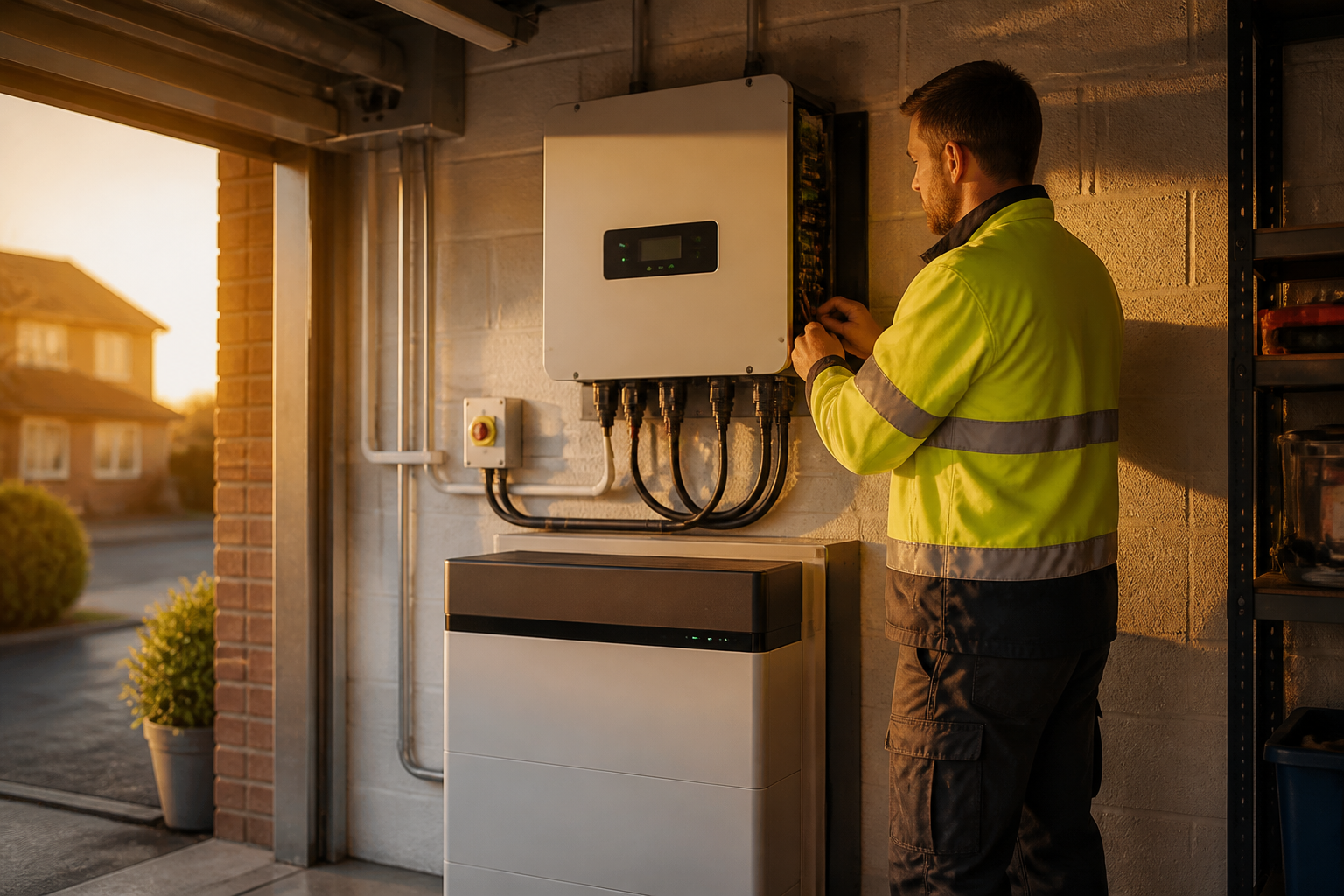
Understanding how macro energy shocks filter down to household bills requires examining wholesale price mechanics alongside domestic generation benchmarks. The Ofgem default tariff cap is adjusted every three months based on forward-curve wholesale contract prices. When wholesale gas and electricity prices jump due to geopolitical conflict, energy suppliers adjust their forward hedging strategies, which feeds directly into the unit rates and standing charges paid by domestic customers.
The following table summarizes recent market figures, official reports, and benchmark operational metrics for home energy systems:
| Indicator / Metric | Value or Benchmark | Source and Date | Operational Significance |
|---|---|---|---|
| Global energy shock warning | Macroeconomic stability risk | BBC News (1 Sep 2026) | Signals persistent upward pressure on energy import costs |
| Weekly UK wholesale excess cost | £190 million per week | edie / ECIU (28 Aug 2026) | Highlights domestic bill vulnerability to global gas spikes |
| Minimum annual solar saving | £400+ per year | The Guardian (1 Sep 2026) | Baseline savings achieved even in low-irradiance UK areas |
| Typical domestic solar PV array | 4.0 kWp capacity | MCS installation data (2026) | Generates roughly 3,400 kWh annually in central England |
| Heat pump efficiency benchmark | SCOP 3.2 to 4.0 | BS EN 14511 / MCS standards | Delivers 3.2 to 4.0 kWh of heat for every 1 kWh of electricity |
| Home battery storage sizing | 5.0 kWh to 10.0 kWh | PAS 63100 safety guidelines | Stores low-cost or solar electricity for peak evening use |
While these statistics demonstrate the clear financial driver for domestic self-generation, hardware and installation costs remain a key consideration. A typical 4 kWp rooftop solar installation certified under the Microgeneration Certification Scheme (MCS) costs between £6,000 and £8,000 depending on roof type, scaffolding access, and panel specification. Adding a 5 kWh lithium iron phosphate (LFP) battery storage system typically adds £2,500 to £4,000 to the initial capital outlay.
For space heating, replacing an aging gas boiler with an air source heat pump requires careful system design. An MCS-accredited installer will conduct room-by-room heat loss calculations under BS EN 12831 standards to size the heat pump and radiators correctly. While the government Boiler Upgrade Scheme provides a £7,500 grant towards heat pump installations in England and Wales, the net capital expenditure typically ranges from £3,000 to £7,000 after grant deduction, depending on pipework upgrades and hot water cylinder replacements.
What this means for your home
For individual householders, the central bank's warning reinforces that reliance on grid-supplied gas and electricity carries ongoing price risk. While energy price caps prevent immediate overnight spikes on standard variable tariffs, they do not shield consumers from sustained medium-term price increases. Taking concrete steps to lower grid reliance can stabilise household outgoings.
If you are considering home energy retrofits this year, the following operational steps will help ensure system performance and financial protection:
- Check your roof orientation and shading: A south-facing 4 kWp solar array yields maximum annual kWh, but east-west array configurations yield a broader generation curve across the morning and late afternoon, matching domestic occupancy patterns.
- Request an MCS heat loss calculation: Before installing an air source heat pump, ensure your installer calculates room-by-room heat loss at an outdoor design temperature of -3°C or lower. Operating flow temperatures below 45°C maximizes the Seasonal Coefficient of Performance (SCOP).
- Verify installer accreditations: Always work with installers registered with MCS, TrustMark, and a consumer protection body such as the Renewable Energy Consumer Code (RECC) or HIES. Electrical work must comply with BS 7671 standards and be completed by a qualified electrician registered with NICEIC or NAPIT.
- Evaluate time-of-use tariffs: Combining home battery storage with smart tariffs allows you to charge the battery during overnight off-peak windows at lower unit rates, mitigating the impact of daytime wholesale price spikes.
- Review insulation first: Reducing space heating demand through loft insulation (minimum 270 mm depth) and cavity wall insulation offers the fastest payback and reduces the required heating capacity of a heat pump.
Homeowners should note that retrofitting technology involves real trade-offs. Solar panels require unshaded roof space, and heat pumps require space for an outdoor unit that meets local noise guidelines under MCS 020 planning rules. Furthermore, while self-generation lowers imported electricity consumption, standing charges remain fixed regardless of energy generated.
What this means for employers
Rising wholesale energy costs and macroeconomic uncertainty directly affect employee financial wellbeing. As energy bill volatility returns to national headlines, workers increasingly look to their employers for practical benefits that reduce day-to-day living expenses rather than temporary financial remedies.
HR and reward leaders are responding by expanding employee benefit platforms to include home decarbonisation infrastructure alongside traditional motoring and healthcare perks. Providing access to discounted home green technology addresses employee demand for long-term bill reduction while supporting corporate Environmental, Social, and Governance (ESG) targets.
Employers looking to support staff against rising energy costs can offer structured environmental benefit schemes. Through the Net Zero Home Scheme, delivered by Net Zero Benefits alongside The Electric Car Scheme, employees gain access to member pricing on accredited solar, battery storage, and heat pump installations without any salary sacrifice, payroll deduction, or cost to the business. This enables organisations to deliver tangible financial relief to employees navigating volatile energy markets.
Frequently asked questions
How do global energy shocks affect my domestic energy tariff?
Global energy shocks increase wholesale prices for natural gas and electricity. In Great Britain, energy suppliers purchase power ahead of time on wholesale markets. When wholesale forward prices rise, Ofgem adjusts the default tariff cap upward for subsequent quarterly periods, increasing unit rates and standing charges for customers on standard variable tariffs.
Can home solar and batteries fully protect against wholesale price spikes?
A solar PV and battery storage system can significantly reduce your dependence on grid electricity, often covering 60% to 80% of an average household's annual electrical needs. However, during winter months when solar generation is low, households still rely on grid power. Coupling batteries with smart off-peak tariffs helps minimise exposure to peak grid prices during winter.
Is now the right time to replace a gas boiler given energy market uncertainty?
Replacing an efficient, working gas boiler purely for cost reasons may have a lengthy payback period. However, if your boiler is over 12 to 15 years old or facing costly repairs, transitioning to an air source heat pump supported by the £7,500 Boiler Upgrade Scheme grant protects your home against long-term gas price volatility while upgrading your heating efficiency.