AC and DC Coupled Home Battery Storage Physics Explained
An explainer on AC vs DC coupled home battery storage, covering round-trip efficiency, inverter economics, and UK retrofit rules.
- Written by
- Net Zero Home Scheme editorial team
- Last updated
- Topic
- battery storage, solar, energy efficiency
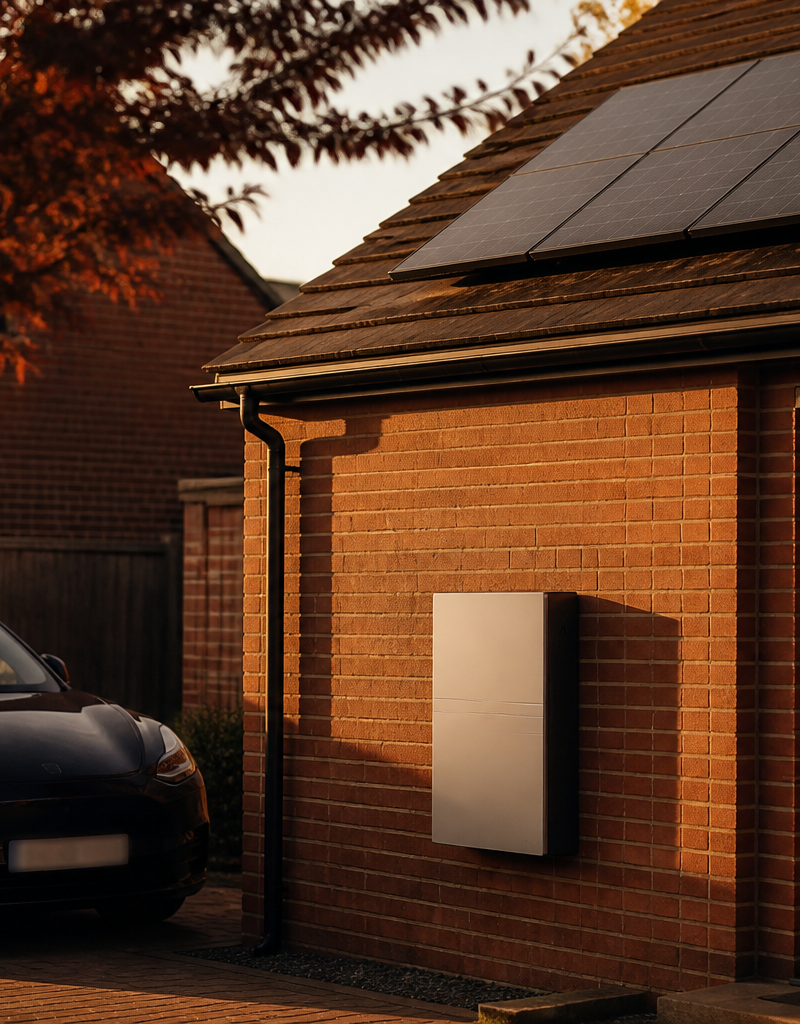
When solar panels generate electricity on a UK roof, the photovoltaic cells produce direct current (DC) power. Home appliances, consumer units, and the national grid operate on alternating current (AC) at 230 volts and 50 hertz. Every time electricity converts from DC to AC or from AC to DC, heat is generated inside the inverter power electronics, resulting in measurable energy losses.
Understanding how a home battery connects to a solar array dictates how many power conversion steps occur. In a direct current (DC) coupled system, the battery sits on the DC side of a shared hybrid inverter. Solar power flows through a direct current charge controller straight into the battery, incurring a single DC to DC voltage adjustment with efficiency typically around 97% to 98%. When that stored energy is later discharged to power household appliances, it passes through the hybrid inverter once (DC to AC), losing roughly 3% to 4% more energy. The total solar to battery to home round-trip efficiency (RTE) for DC-coupled solar charging ranges from 92% to 94%.
By contrast, an alternating current (AC) coupled system treats solar generation and battery storage as separate electrical circuits. Solar panels feed a dedicated solar inverter, converting DC to AC at roughly 97% efficiency. If the battery charges from that solar output, an AC-coupled battery inverter charger converts that AC power back into DC electricity to fill the battery cells, losing another 4% to 5%. When the house demands power, the battery inverter converts DC back into AC. This triple conversion process (DC to AC to DC to AC) reduces the solar to battery round-trip efficiency to between 85% and 88%.
Grid Tariff Charging and Winter Economics
The efficiency comparison shifts when evaluating overnight grid charging. During UK winter months, solar generation drops significantly due to lower irradiance and shorter day lengths. According to solar yield benchmarks published by the Microgeneration Certification Scheme (MCS), an average 4kWp UK solar system generates over 75% of its annual output between April and September, leaving limited excess solar energy to charge a battery between November and February.
To lower energy bills during winter, many households rely on smart time-of-use tariffs that offer cheap off-peak grid electricity overnight. When charging a home battery directly from the grid, electricity enters the property as AC power.
In an AC-coupled system, grid electricity undergoes one conversion from AC to DC during charging, and one conversion from DC to AC during discharging. In a DC-coupled hybrid inverter system, grid electricity also undergoes an AC to DC conversion to charge the battery, followed by a DC to AC conversion upon discharge. Consequently, for winter grid charging, both AC-coupled and DC-coupled architectures exhibit similar round-trip efficiencies of approximately 88% to 90%. Households that rely primarily on overnight off-peak grid tariffs rather than daytime solar self-consumption will observe minimal difference in annual conversion losses between the two setups.
Retrofitting Existing Solar versus New Installations
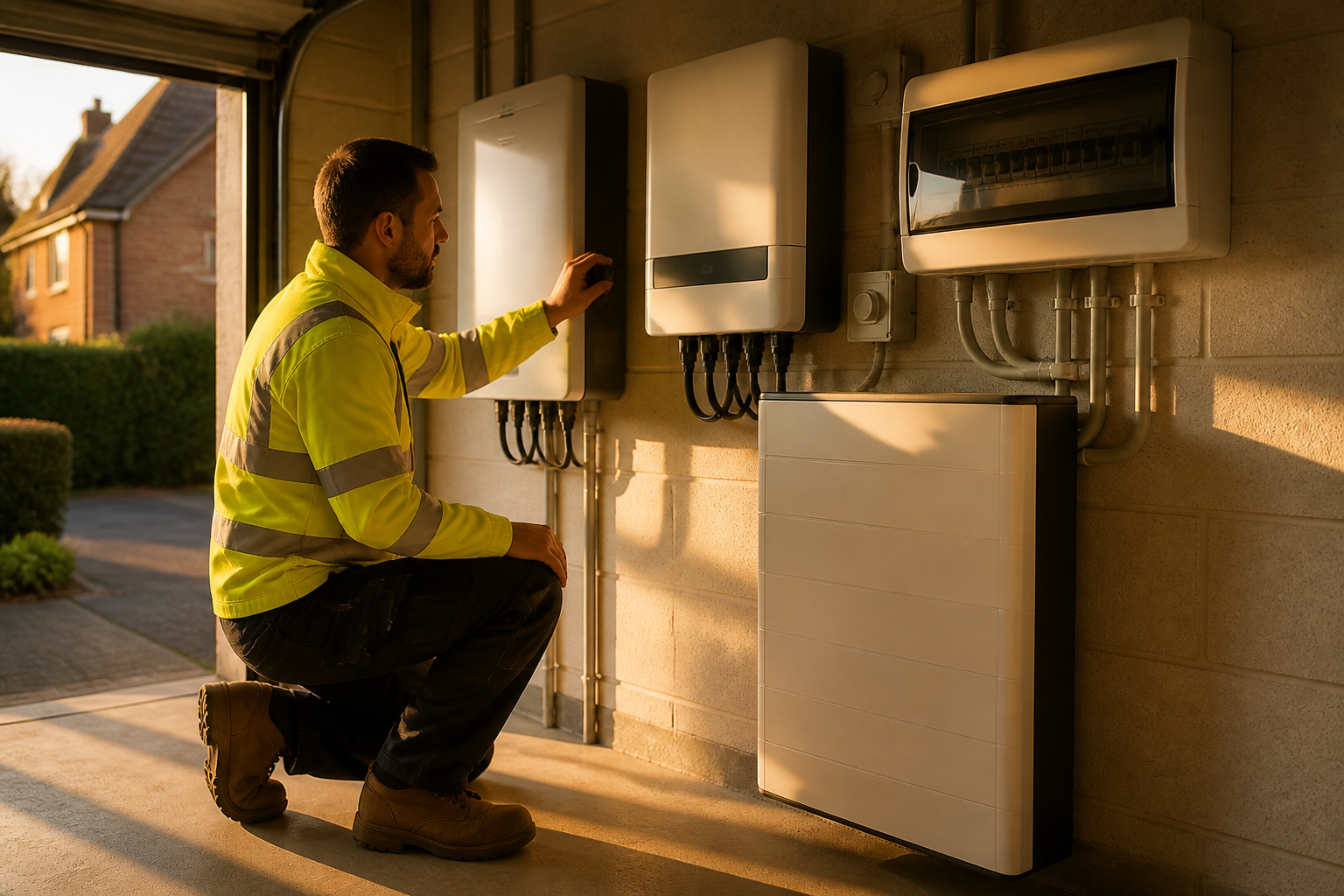
Physical installation requirements and electrical regulations under BS 7671 (the IET Wiring Regulations) and PAS 63100 (the code of practice for residential battery storage) differ significantly between new installations and retrofit projects.
For a household installing solar panels and battery storage simultaneously, DC-coupled systems offer clear financial and physical advantages. A single hybrid inverter manages both the photovoltaic array and the battery storage stack. This eliminates the cost of a second inverter, reduces wall mounting space in garages or utility rooms, and simplifies electrical wiring at the consumer unit. According to installation benchmarks published by the Institution of Engineering and Technology (IET), selecting a single hybrid inverter saves between £800 and £1,500 compared to purchasing separate solar and battery inverters.
For households retrofitting battery storage to an existing solar PV system, AC coupling is frequently the less intrusive option. Replacing an existing, fully functional solar inverter with a new hybrid unit requires disconnecting DC string cables, re-testing roof wiring, and potentially updating MCS compliance documentation. Furthermore, for homes installed under the historic Feed-in Tariff (FiT) scheme prior to March 2019, modifying the original solar inverter wiring can complicate generation meter recording. An AC-coupled battery installs downstream of the existing solar inverter on the AC side of the consumer unit, allowing the original solar installation to remain completely untouched.
| Feature | DC-Coupled System (Hybrid Inverter) | AC-Coupled System (Standalone Inverter) |
|---|---|---|
| Primary Solar Charging Route | Direct DC to DC conversion | Triple conversion (DC to AC to DC) |
| Solar Charging Round-Trip Efficiency | 92% to 94% | 85% to 88% |
| Winter Grid Charging Efficiency | 88% to 90% | 88% to 90% |
| Equipment Complexity | Single hybrid inverter unit | Two separate inverters (Solar + Battery) |
| Retrofit Suitability for Existing Solar | Moderate (requires inverter replacement) | High (connects directly to AC consumer unit) |
| Peak Combined AC Power Output | Limited by single hybrid inverter rating | Combined output of both separate inverters |
| Single Point of Hardware Failure | High (inverter fault stops solar and battery) | Low (battery fault leaves solar operational) |
| Typical Hardware Capital Cost | Lower for combined new solar and battery installs | Higher for new installs, lower for retrofits |
Grid Connection Limits and Power Discharge Capacities
A critical engineering consideration under Energy Networks Association (ENA) rules is the total AC power output permitted at a residential property. Standard domestic grid connections fall under Engineering Recommendation G98, which limits total inverted AC export to 3.68kW per phase without prior Network Operator approval.
In a DC-coupled system, a single 3.68kW hybrid inverter caps total AC power output at 3.68kW, regardless of whether that power originates from roof solar panels, battery discharge, or both combined. If a home is consuming 3kW for a heat pump and 2kW for an electric kettle simultaneously (5kW total demand), a 3.68kW hybrid inverter can only supply 3.68kW from the battery and solar combined, forcing the remaining 1.32kW to be imported from the grid.
In an AC-coupled setup with a 3.68kW solar inverter and a separate 3kW battery inverter, the system can deliver up to 6.68kW of instantaneous AC power into the property (provided grid connection approvals or G99 permissions allow it). This higher discharge capacity enables AC-coupled installations to cover larger household peak loads without importing peak-rate electricity, though installers must ensure consumer unit busbars and main service fuses are rated safely under BS 7671.
Frequently asked questions
Can an AC-coupled battery be converted to DC-coupled in the future?
Converting an AC-coupled system to a DC-coupled architecture requires replacing the battery inverter charger and the existing solar inverter with a unified hybrid inverter. The physical battery modules themselves may be compatible if their operational voltage ranges match the new hybrid unit, but the power conversion hardware must be entirely replaced. In most cases, the capital cost of replacing functional inverters outweighs the efficiency gains.
How does coupling affect Emergency Power Supply during power cuts?
Both AC-coupled and DC-coupled systems can provide Emergency Power Supply (EPS) during a grid outage if equipped with appropriate changeover switches and islanding protection. However, DC-coupled hybrid inverters generally re-charge the battery from solar panels during an extended power cut more efficiently, as solar power flows directly into the battery without needing an active AC grid reference signal.
Does DC coupling extend battery cell lifespan compared to AC coupling?
Battery cell degradation is primarily driven by operating temperature, state of charge ranges, and total throughput cycles rather than the coupling architecture. Because DC coupling reduces energy losses during solar charging, the battery completes fewer waste heat generation cycles per kilowatt-hour stored. However, high-quality lithium iron phosphate (LiFePO4) chemistry in both AC and DC systems typically achieves 6,000 cycles or a 10-year warranty when operated within manufacturer parameters.
What this means for you
When deciding between AC-coupled and DC-coupled battery storage, householders should evaluate their existing heating and solar infrastructure, roof generation potential, and primary use case.
If you are installing solar panels and battery storage at the same time, a DC-coupled system with a hybrid inverter offers lower upfront equipment costs, higher solar charging efficiency, and a cleaner physical installation. If you already have a functional solar array on your roof and wish to add storage without disrupting existing solar warranties or meter cabling, an AC-coupled system provides a straightforward retrofit path that connects directly into your main consumer unit.
Working with an MCS-accredited installer ensures that voltage drop calculations, G98 or G99 grid notifications, and safety separations under PAS 63100 comply fully with UK standards.
For employees seeking advice on home energy upgrades, the Net Zero Home Scheme provides member pricing on accredited solar panels, heat pumps, battery storage, and plug-in solar systems. Delivered by Net Zero Benefits alongside The Electric Car Scheme, the UK's largest independent salary sacrifice provider, the scheme is completely free for employers and involves no salary sacrifice or payroll deductions.
Sources
- Code of Practice for Electrical Energy Storage Systems, Institution of Engineering and Technology
- Microgeneration Certification Scheme Standards and Statistics, MCS
- Engineering Recommendation G98 and G99 Grid Connection Rules, Energy Networks Association