How to Install a Heat Pump in a Victorian Terraced Home
A practical guide to retrofitting an air source heat pump in a UK Victorian terrace, covering heat loss, costs, grants, pipework and timelines.
- Written by
- Net Zero Home Scheme editorial team
- Last updated
- Topic
- heat pumps, energy efficiency, energy bills
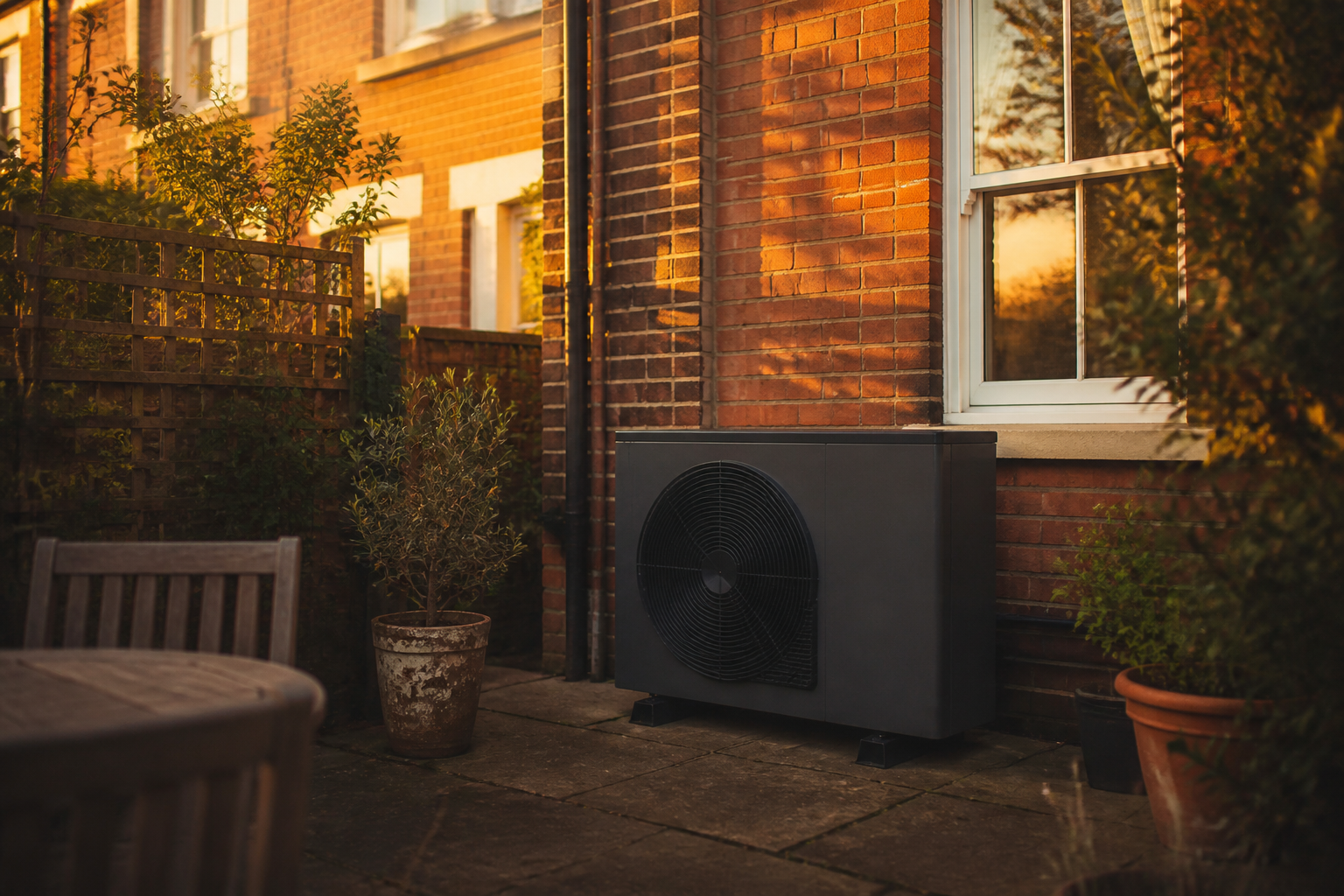
Victorian terraced homes represent a significant portion of the UK housing stock, but they present specific heating challenges. Built with uninsulated 9-inch solid brick walls, suspended timber floors and high ceilings, these properties lose heat far faster than modern homes. Despite these features, retrofitting an air source heat pump into a Victorian terrace is entirely practical when designed correctly.
This guide steps through the technical checks, costs, grant funding, installer accreditations and practical timescales required to install an efficient heat pump in a Victorian terraced property.
Step 1: Assess heat loss and space constraints
The first technical step is a room-by-room heat loss calculation carried out in accordance with MCS MIS 3005 standards. Solid brick walls typically have a U-value of around 2.1 W/m²K, compared to 0.18 W/m²K for modern cavity walls. This means a typical mid-terrace Victorian home requires a heat pump rated between 5 kW and 8 kW, while an end-terrace may require 8 kW to 10 kW.
Space planning is equally critical in compact terraced layouts:
- Outdoor monobloc unit: Under Permitted Development rights in England, the outdoor unit must be located at least 1 metre from the property boundary unless acoustic calculations under MCS 020 demonstrate that sound levels will not exceed 42 dB(A) at the nearest neighbouring habitable room window.
- Hot water cylinder: Most Victorian terraces currently use combi boilers. Switching to a heat pump requires installing a dedicated hot water cylinder, typically 150 to 210 litres for a two- to three-bedroom property. Slimline cylinders with a 550mm diameter can often fit inside an under-stairs cupboard, a utility room or an eaves space.
- Electrical consumer unit: The main electrical supply must handle the heat pump compressor load, which usually requires a 32A dedicated breaker and a service fuse checked by the Distribution Network Operator (DNO).
Step 2: Evaluate pipework and radiator sizing
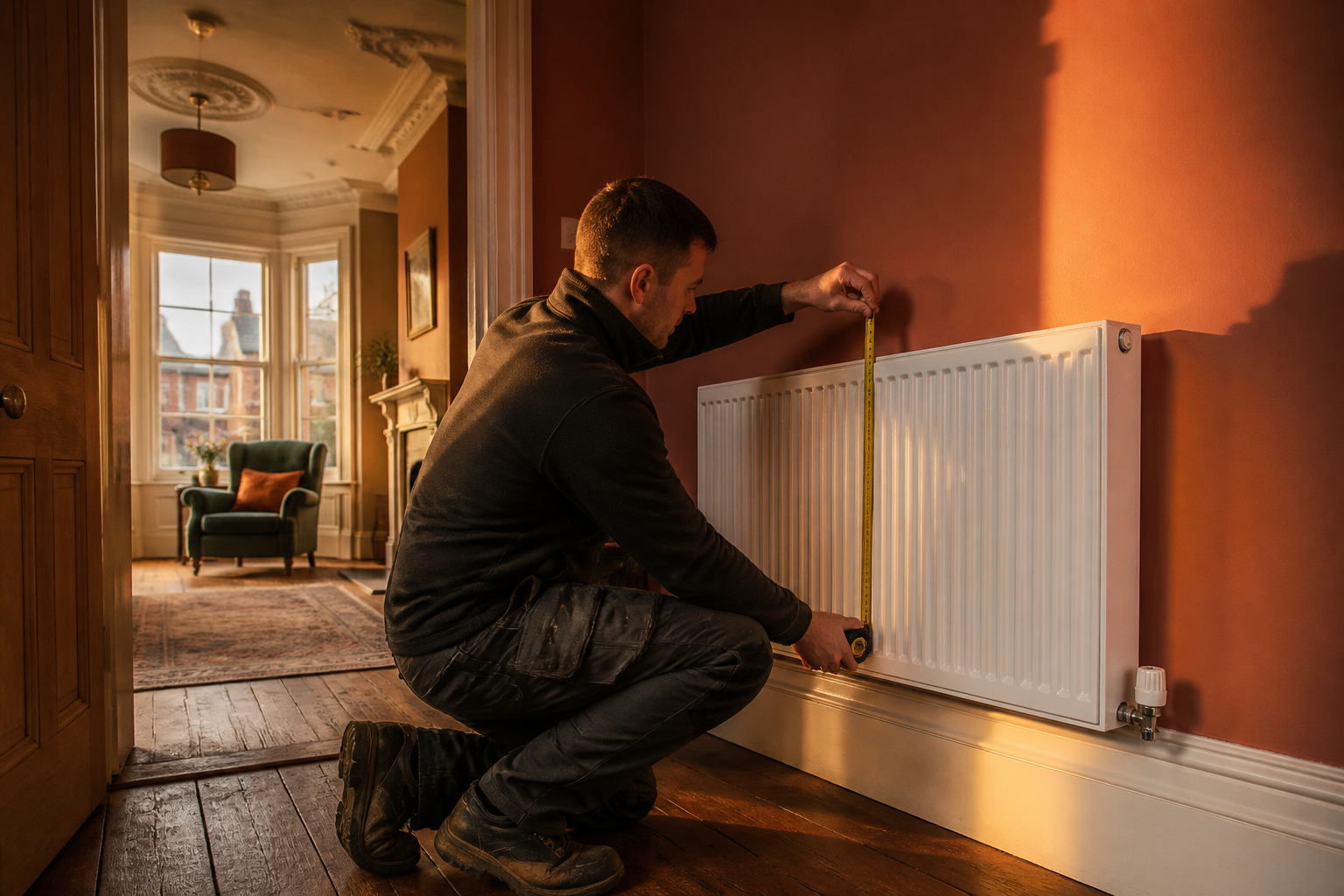
Gas boilers deliver water to radiators at 60°C to 70°C, whereas heat pumps operate most efficiently at lower flow temperatures of 45°C to 50°C. To deliver the same heat output at lower temperatures, the surface area of your radiators must increase.
In many Victorian retrofits, existing original cast iron or small single-panel radiators must be replaced with larger double-panel (Type 22) radiators or fan-assisted units. In bedrooms where space is tight, higher-output compact radiators can be selected to fit beneath existing window sills.
Pipework diameters must also be inspected. Victorian homes often feature 15mm copper pipework or older microbore systems. Because heat pumps move a higher volume of water at lower temperature differences, primary flow and return pipework from the outdoor unit to the internal manifold should ideally be 22mm or 28mm copper to avoid noise and pump strain.
Step 3: Understand realistic costs and project timelines
Installing an air source heat pump in a Victorian terrace involves equipment costs, cylinder integration, radiator replacements and electrical adjustments. The UK Government's Boiler Upgrade Scheme (BUS) provides a £7,500 tax-free grant in England and Wales, which installers deduct directly from your quotation.
| Project Phase | Key Technical Tasks | Typical Duration | Output / Deliverable |
|---|---|---|---|
| Desktop & Site Survey | Room-by-room heat loss assessment (MIS 3005) and radiator sizing | 1 to 2 weeks | Formal design proposal and heat loss report |
| Approvals & Grants | BUS grant application and DNO G98 notification | 2 to 4 weeks | Approved grant voucher and grid connection clearance |
| Physical Installation | Outdoor unit mounting, cylinder fitting, radiator upgrades and wiring | 3 to 5 days | System fully installed and pressure tested |
| Commissioning & Handover | Hydraulic balancing, weather compensation setup and user training | 1 day | MCS certificate, RECC warranty and BUS grant redemption |
For a typical three-bedroom Victorian terrace, total installation costs before grant funding usually range from £11,500 to £14,500 including radiator upgrades and a new hot water cylinder. With the £7,500 Boiler Upgrade Scheme grant applied, the net out-of-pocket cost to the homeowner is typically between £4,000 and £7,000.
In Scotland, equivalent support is available through the Home Energy Scotland Grant and Loan scheme, offering up to £7,500 in grant funding with an optional interest-free loan.
Step 4: Choose accredited installers and ask the right questions
To ensure quality and maintain grant eligibility, your chosen installer must hold formal accreditations:
- MCS (Microgeneration Certification Scheme): Essential for validating system design standards and claiming the Boiler Upgrade Scheme grant.
- TrustMark: Demonstrates compliance with government-endorsed quality standards and consumer protection.
- Consumer Code Membership: Membership of RECC (Renewable Energy Consumer Code) or HIES (Home Insulation & Energy Systems Contractors Scheme) to safeguard deposit payments and guarantees.
- Electrical Certification: Installers or sub-contracted electricians must be registered with NICEIC, NAPIT or SELECT (in Scotland).
When meeting prospective installers, ask these four practical questions:
- What design flow temperature have you used for the heat loss calculation at outdoor temperatures of -3°C?
- Does my existing primary pipework need upgrading to 22mm or 28mm to maintain correct water flow rates?
- How will you calculate MCS 020 noise compliance relative to my neighbours' windows?
- Do you manage the Boiler Upgrade Scheme grant application process directly on my behalf?
Recent market analysis reported by BBC News in September 2026 highlights that wholesale energy volatility continues to affect home heating budgets (https://www.bbc.co.uk/news/articles/cm274mwxy1vo). Upgrading to a modern heat pump provides predictable, low-carbon heating that reduces reliance on imported fossil gas.
What this means for you
Retrofitting a heat pump into a Victorian terrace requires careful space planning for the hot water cylinder and appropriate radiator upgrades, but it is a proven and practical project. Leveraging government support like the £7,500 Boiler Upgrade Scheme grant lowers capital expenditure to a level comparable with a premium boiler replacement.
If your employer participates in the Net Zero Home Scheme, you can access member pricing on heat pumps, solar PV and battery storage systems installed by accredited professionals across England, Scotland and Wales.
Frequently asked questions
Can I install a heat pump in a Victorian terrace without solid wall insulation?
Yes. Solid wall insulation reduces overall energy demand and operational costs, but it is not mandatory for a heat pump installation. An accredited installer will calculate your home's heat loss as it stands and size the heat pump and radiators to meet that heating demand at low flow temperatures.
Where can I put the hot water cylinder if I currently have a combi boiler?
Common locations in Victorian terraced houses include an under-stairs cupboard, a ground-floor utility room, an eaves space in a converted loft, or a fitted bedroom wardrobe. Modern slimline cylinders with a 550mm diameter are specifically designed to fit standard cupboard spaces.
Do I need planning permission for an air source heat pump on a terraced house?
In England and Wales, heat pump installations are generally Permitted Development provided the unit meets MCS 020 noise limits (42 dB(A) at the nearest neighbouring window) and is situated at least 1 metre from the property boundary. If your home is listed or located within a Conservation Area, formal planning consent or listed building consent may be required.