Home Battery Degradation Physics, C-Rates and Economics
Understand how cell chemistry, C-rates, and depth of discharge impact home battery degradation, lifetime capacity, and overall investment returns.
- Written by
- Net Zero Home Scheme editorial team
- Last updated
- Topic
- battery storage, energy efficiency, energy bills
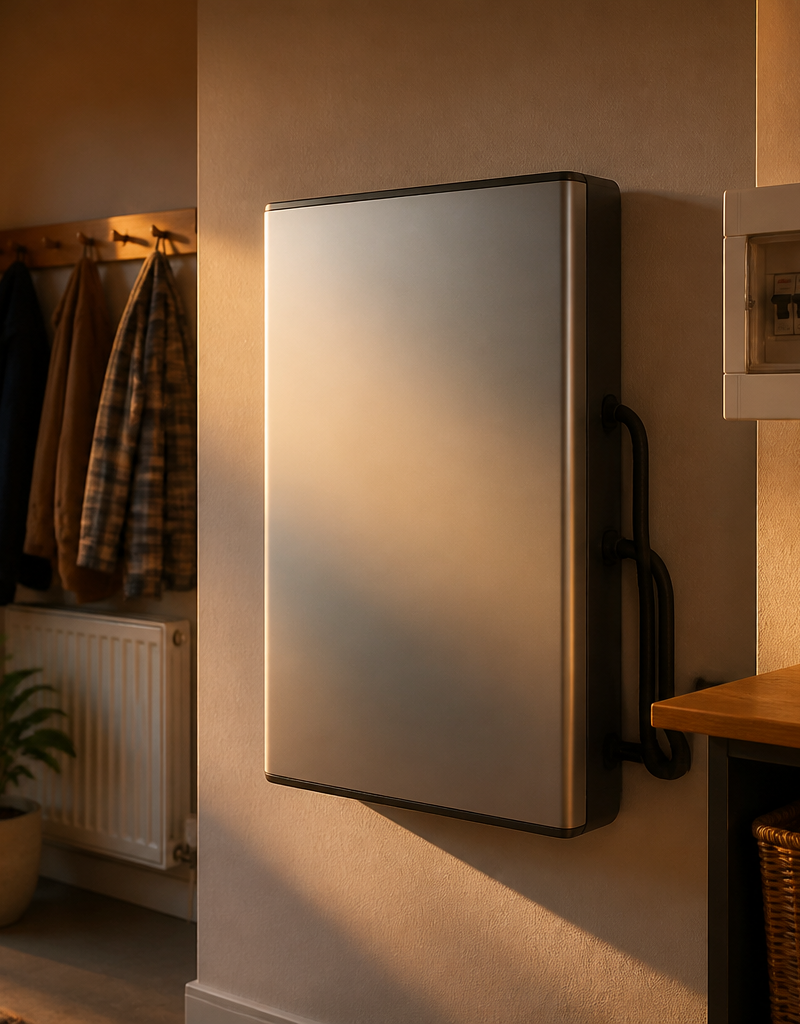
When you evaluate home battery storage, manufacturers usually promise a warranty covering 6,000 cycles or ten years to 70% retained capacity. Behind these figures lies chemical degradation driven by ambient temperatures, operating power limits, and charge thresholds. Understanding the underlying physics allows you to manage cell health, protect your return on investment, and set realistic financial expectations.
How Lithium-Ion Cell Degradation Works in Practice
All residential energy storage systems installed in the UK rely on lithium-ion chemistries. The two dominant types are Lithium Iron Phosphate (LiFePO4 or LFP) and Nickel Manganese Cobalt (LiNiMnCoO2 or NMC).
Cell degradation occurs through two distinct processes: calendar ageing and cycle ageing. Calendar ageing takes place constantly over time, regardless of whether energy moves in or out of the pack. Cycle ageing occurs whenever the battery charges or discharges.
At the microscopic level, lithium ions shuttle between the positive cathode and negative anode through an electrolyte solution during charge and discharge cycles. Every cycle causes small structural changes:
- Solid Electrolyte Interphase (SEI) growth: A thin passivation layer forms on the graphite anode surface. While this layer prevents electrolyte decomposition, continuous charging and high temperatures cause it to thicken, consuming active lithium ions and increasing internal electrical resistance.
- Lithium plating: When a battery is charged rapidly at cold temperatures, lithium ions cannot intercalate into the anode structure quickly enough. Instead, metallic lithium deposits on the anode surface, permanently removing active capacity and raising internal resistance.
- Mechanical stress: Intercalation causes physical expansion and contraction of electrode active materials. Over thousands of cycles, micro-cracking occurs in the electrode coating, isolating active materials and reducing usable capacity.
According to research published by the Institution of Engineering and Technology (IET) in its Code of Practice for Electrical Energy Storage Systems, these combined mechanisms cause gradual, irreversible capacity loss alongside an increase in internal resistance.
Key Factors Affecting Home Battery Degradation
Depth of Discharge (DoD)
Depth of Discharge refers to the percentage of total battery capacity that is discharged during a cycle. Discharging a battery from 100% down to 0% (100% DoD) exerts significantly more mechanical and chemical stress on the electrodes than cycling between 80% and 20% (60% DoD).
Modern Battery Management Systems (BMS) enforce a hardware safety buffer. A pack rated at 10 kWh nominal capacity might only expose 9 kWh as usable capacity, preventing true 0% or 100% states of charge. LFP cells tolerate deep discharging far better than NMC cells, retaining acceptable health over 6,000 cycles at 90% DoD, whereas older NMC packs suffered accelerated degradation when regularly cycled beyond 80% DoD.
C-Rate (Charge and Discharge Speeds)
The C-rate measures the speed at which a battery is charged or discharged relative to its total capacity. A 1C rate means a 5 kWh battery charges or discharges at 5 kW, completing a full cycle in one hour. A 0.5C rate means the same 5 kWh battery operates at 2.5 kW, taking two hours.
Higher C-rates generate greater internal heating (I²R losses). High temperatures accelerate chemical side-reactions and SEI growth. For domestic installations, most LFP batteries operate between 0.5C and 1.0C continuous rates. If a 5 kWh battery is coupled to a 3.68 kW inverter, its peak C-rate is roughly 0.74C, which balances system responsiveness with long cell life.
Operating Temperature Enclosure
Temperature is the single biggest environmental driver of degradation. According to guidance from the Energy Saving Trust, lithium-ion battery performance degrades faster at elevated temperatures, while charging at sub-zero temperatures risks permanent lithium plating damage.
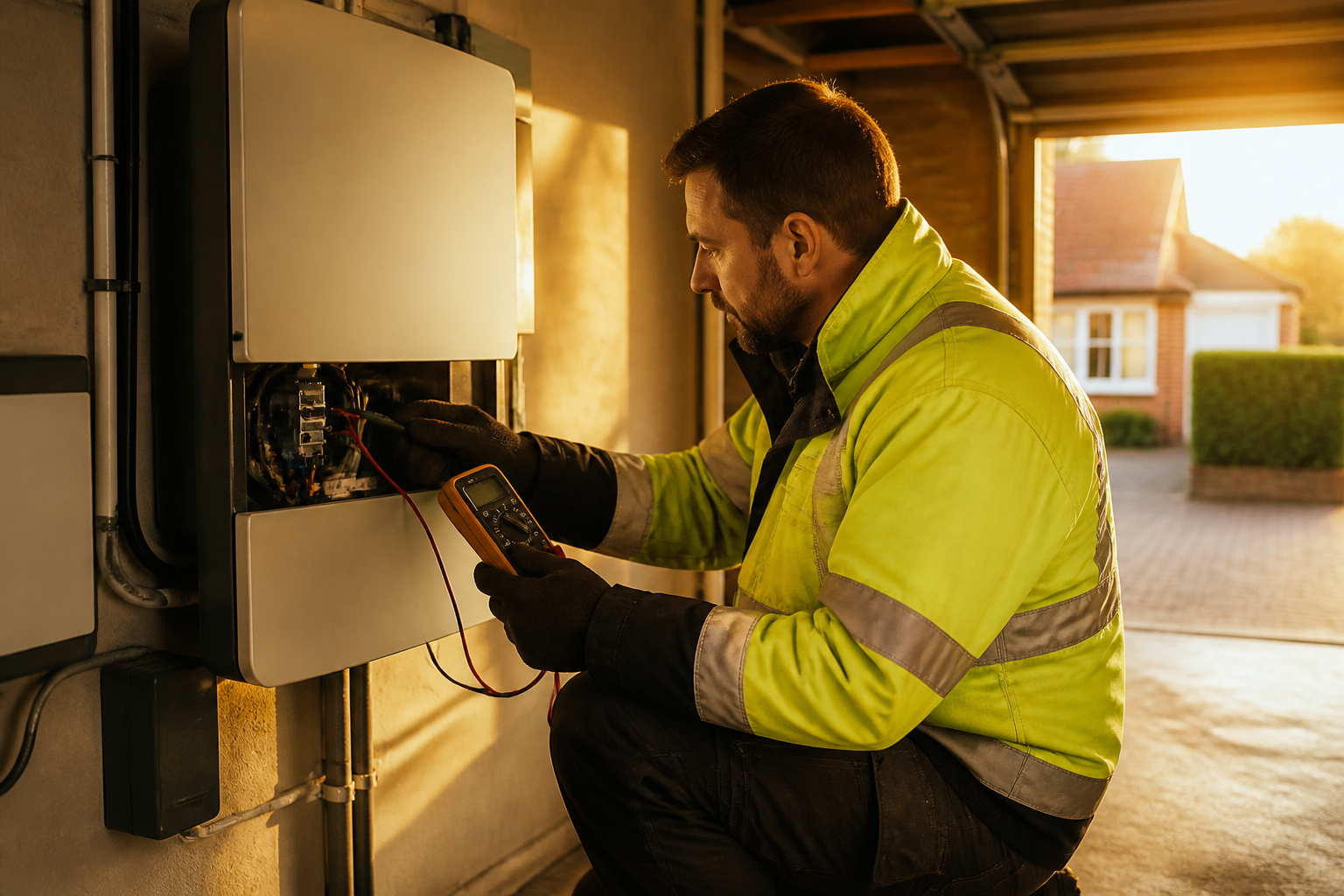
The optimal operating temperature window for residential LFP batteries is between 15°C and 25°C. Installing a battery in an uninsulated outdoor location exposed to summer direct sun can elevate internal cell temperatures above 40°C, doubling the rate of calendar ageing. Conversely, installing a battery in an unheated loft or cold garage without integrated thermal management can force the BMS to throttle charge rates to prevent freezing damage.
Degradation Physics: LFP vs NMC Compared
The table below summarizes how key physical characteristics differ between the two principal residential battery chemistries used across the UK market.
| Feature or Metric | Lithium Iron Phosphate (LFP) | Nickel Manganese Cobalt (NMC) |
|---|---|---|
| Nominal Voltage per Cell | 3.2 V | 3.6 V to 3.7 V |
| Typical Cycle Life (to 70% SOH) | 6,000 to 10,000 cycles | 2,000 to 4,000 cycles |
| Recommended Max Depth of Discharge | 90% to 100% | 80% |
| Thermal Runaway Onset Temp | Approx 270°C | Approx 210°C |
| Ideal Charge C-Rate Range | 0.5C to 1.0C | 0.3C to 0.5C |
| Sensitivity to High SoC Storage | Moderate | High |
Financial Impact: How Degradation Affects Payback Calculations
When financial models predict home energy battery savings, they often assume constant usable storage capacity over 10 or 15 years. Incorporating actual degradation physics alters lifetime financial performance.
Consider a 10 kWh LFP battery system installed alongside solar PV. If the battery experiences 2.5% linear capacity degradation each year, its usable capacity drops over time:
- Year 1: 10.0 kWh usable
- Year 5: 9.0 kWh usable
- Year 10: 7.5 kWh usable
If the battery charges from cheap off-peak electricity at 9p per kWh and offsets peak grid imports at 24p per kWh (a spread of 15p per kWh), a single full daily cycle saves:
- Year 1: £1.50 per day (£547.50 per year)
- Year 5: £1.35 per day (£492.75 per year)
- Year 10: £1.12 per day (£410.63 per year)
Over 10 years, progressive capacity reduction reduces total energy throughput by roughly 12.5% compared to a simplified zero-degradation model. Financial payback calculations should therefore incorporate state-of-health degradation curves to avoid overestimating long-term savings.
Counter-Arguments: Is Battery Degradation Overstated?
Some industry analysts argue that battery degradation concerns are exaggerated for standard domestic applications. There are three main counter-arguments:
- Oversized Software Reserves: Many manufacturers configure cell management software to hide early degradation. The usable capacity stays constant for the first few years by gradually unlocking software-restricted reserve capacity as physical cell capacity decays.
- Low Daily Cycle Frequencies: Most UK homes complete between 1.0 and 1.5 equivalent full cycles per day. Even over 10 years, 1.2 daily cycles total only 4,380 cycles, well within the 6,000-cycle threshold of modern LFP cells.
- Second-Life Residual Value: A battery retaining 70% capacity after 10 years is not non-functional. It retains substantial utility for secondary storage or low-demand applications, providing residual asset value beyond its initial primary warranty period.
What this means for you
To protect your home battery investment and ensure maximum lifetime throughput:
- Specify LFP Cell Chemistry: Choose systems utilizing Lithium Iron Phosphate chemistry, which offers superior thermal stability and higher cycle life under UK residential use patterns.
- Select Optimal Installation Locations: Mount indoor units inside attached garages, utility rooms, or insulated outbuildings to avoid temperature extremes. Avoid direct sunlight and unheated lofts.
- Size Inverters to Match C-Rates: Ensure inverter output ratings do not exceed 0.7C to 1.0C relative to total battery capacity to minimize ohmic heat buildup.
- Verify Warranty Terms: Check whether manufacturer warranties guarantee end-of-life capacity (typically 70% state of health) based on elapsed years or cumulative energy throughput in megawatt-hours delivered, whichever comes first.
If you are exploring home energy upgrades, employees can access accredited installers and member pricing on solar panels, heat pumps, and home storage through the Net Zero Home Scheme. Delivered by Net Zero Benefits alongside The Electric Car Scheme, the UK's largest independent salary sacrifice provider, the scheme is completely free for employers with no salary sacrifice or payroll deduction involved.
Frequently asked questions
Does charging a home battery rapidly degrade its capacity?
Rapid charging increases internal electrical resistance and cell temperature, which accelerates solid electrolyte interphase (SEI) growth. However, most domestic battery systems operating with a C-rate below 1.0C generate minimal excess heat, ensuring degradation remains within normal expected manufacturer limits.
What is the difference between calendar degradation and cycle degradation?
Calendar degradation is the natural loss of chemical capacity over time due to electrolyte reactions, occurring even when the battery is idle. Cycle degradation is the physical and chemical breakdown of electrode structures caused by the movement of lithium ions during active charging and discharging.
Should I set my battery to only charge to 80% or 90%?
While limiting state of charge to 80% protects cell health in Nickel Manganese Cobalt (NMC) batteries, modern Lithium Iron Phosphate (LFP) domestic batteries are designed to operate routinely up to 100% state of charge. Furthermore, LFP battery management systems require regular 100% charges to recalibrate cell voltage readings accurately.
Sources
- Storing electricity from solar PV, Energy Saving Trust
- Code of Practice for Electrical Energy Storage Systems, Institution of Engineering and Technology
- MCS Standards Library (MIS 3012 Battery Storage), Microgeneration Certification Scheme